
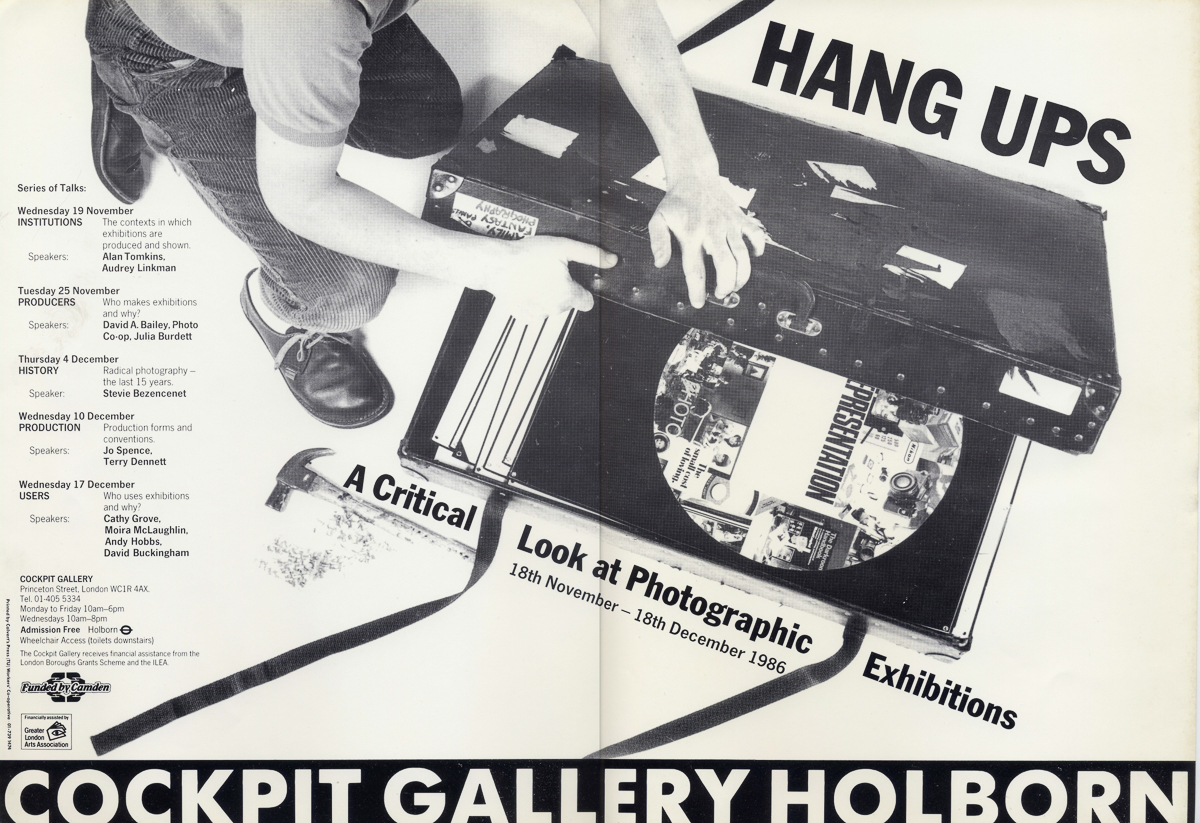
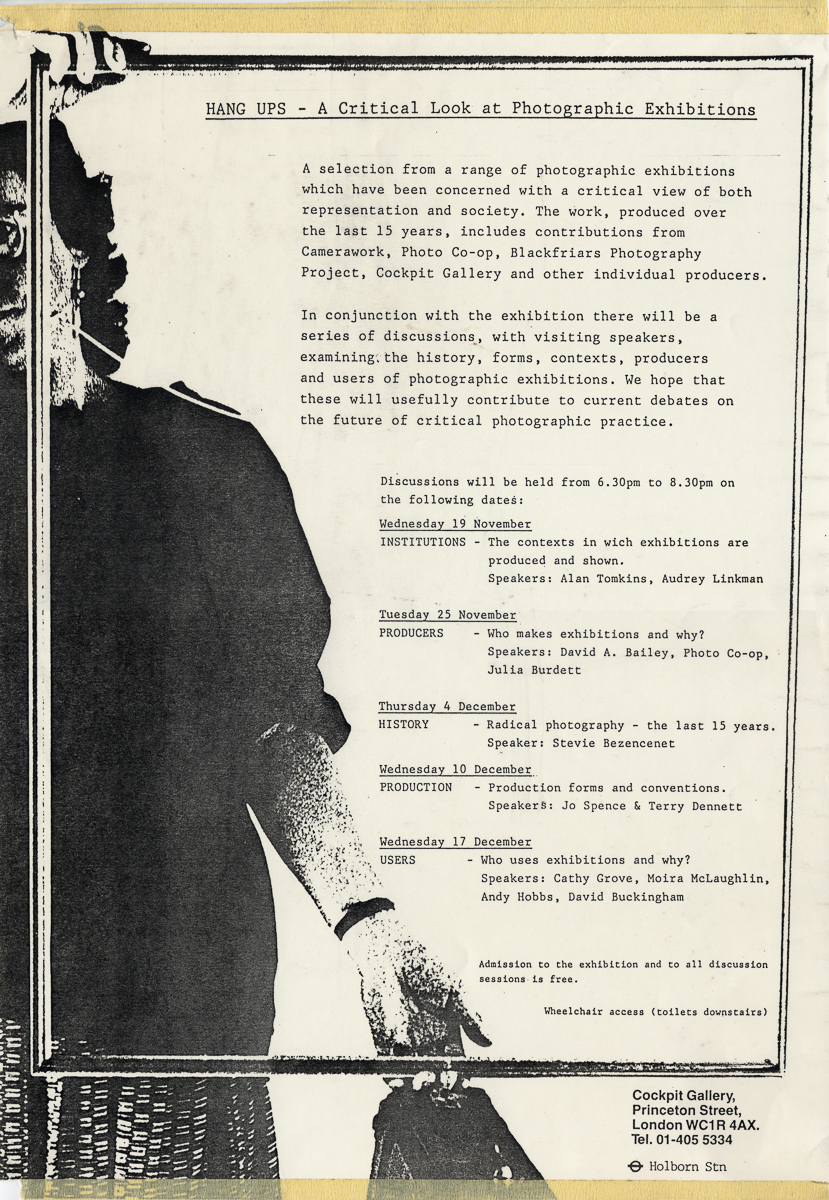
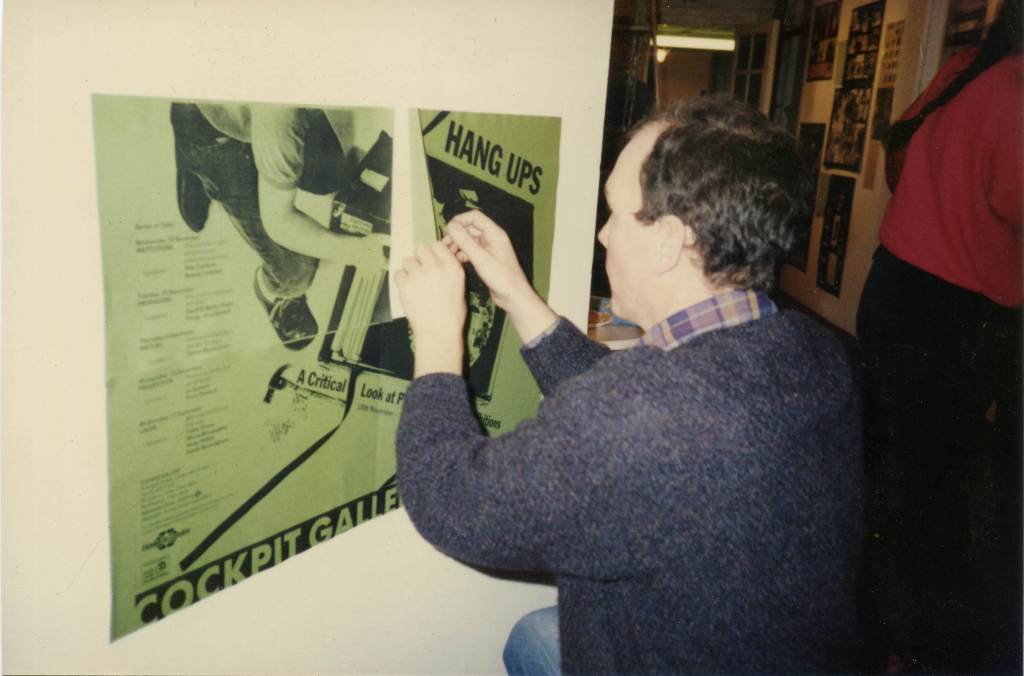
Hang Ups
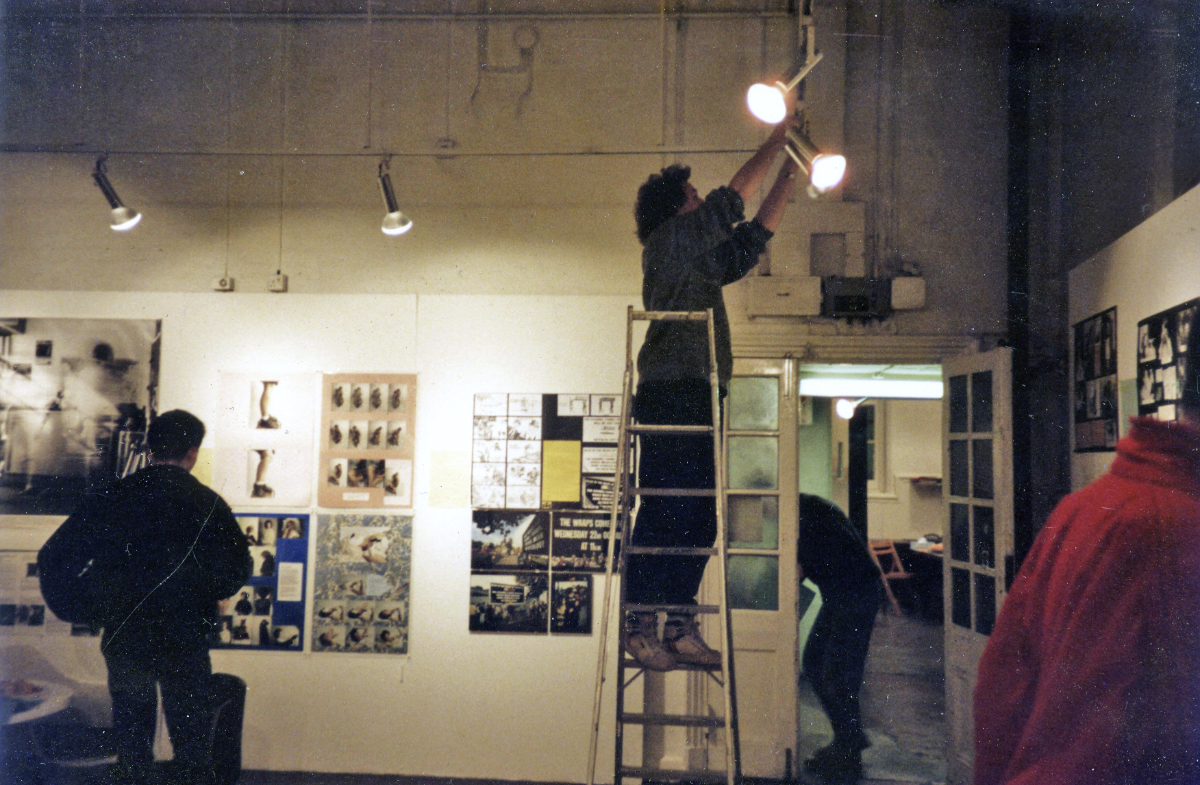
A selection from a range of photographic exhibitions which have been concerned with a critical view of both representation and society. The work, produced over the last 15 years, includes contributions from Camerawork, Photo Co-op, Blackfriars Photography Project, Cockpit Gallery and other individual producers.
In conjunction with the exhibition, there will be a series of discussions, with visiting speakers, examining; the history, forms, contexts, producers and users of photographic exhibitions. We hope that these will usefully contribute to current debates on the future of critical photographic practice.
37 exhibitions: alphabetical list with text from the 1986 catalogue
A Place To Stay – Age Exchange, (1983)
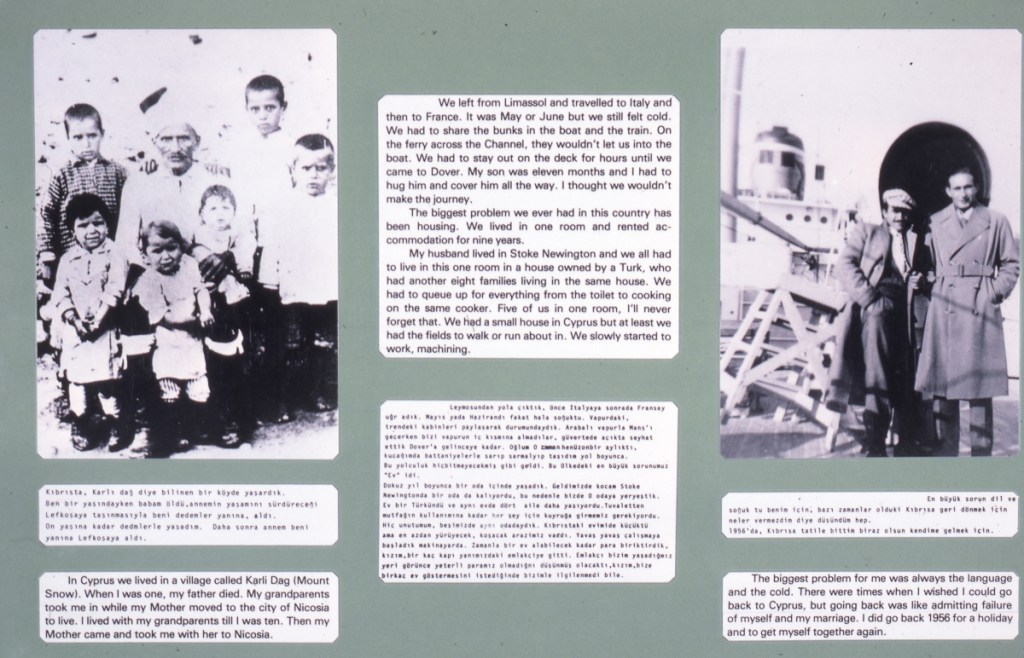
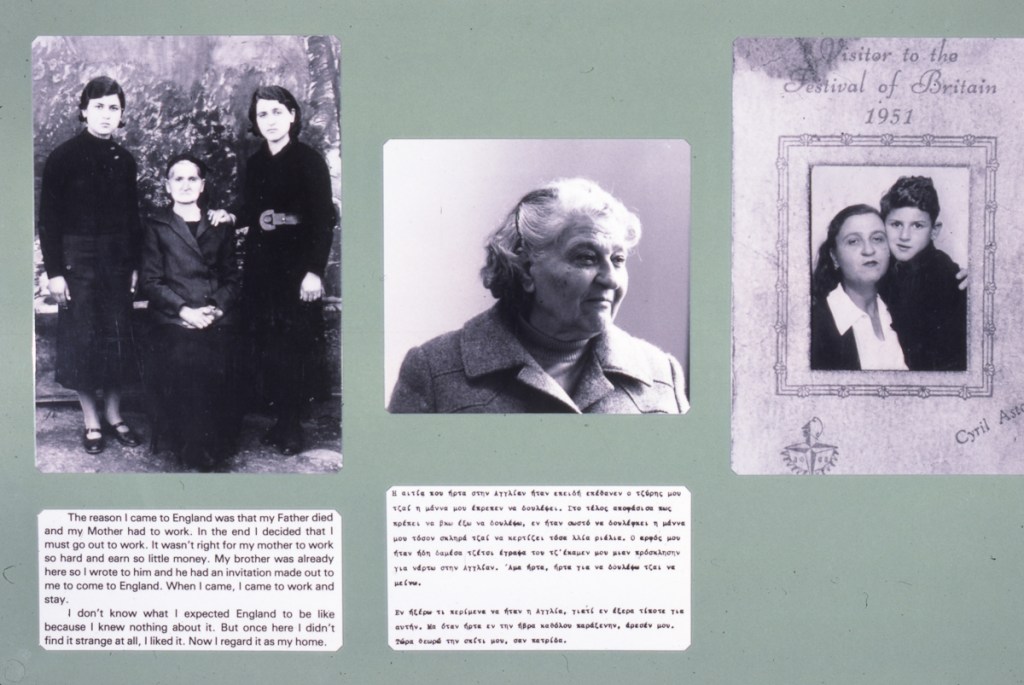
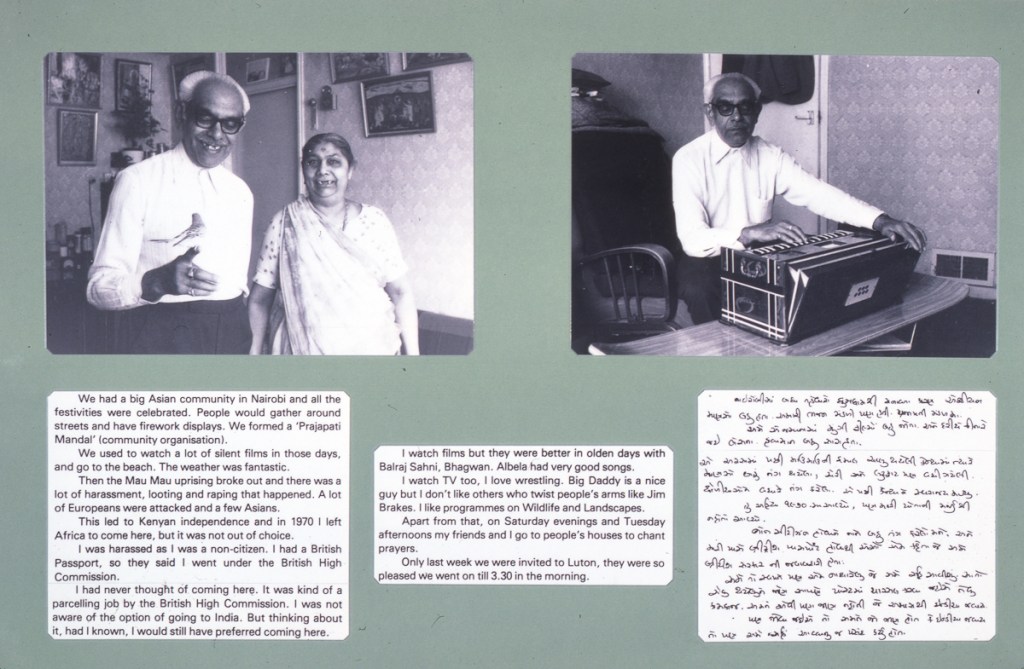
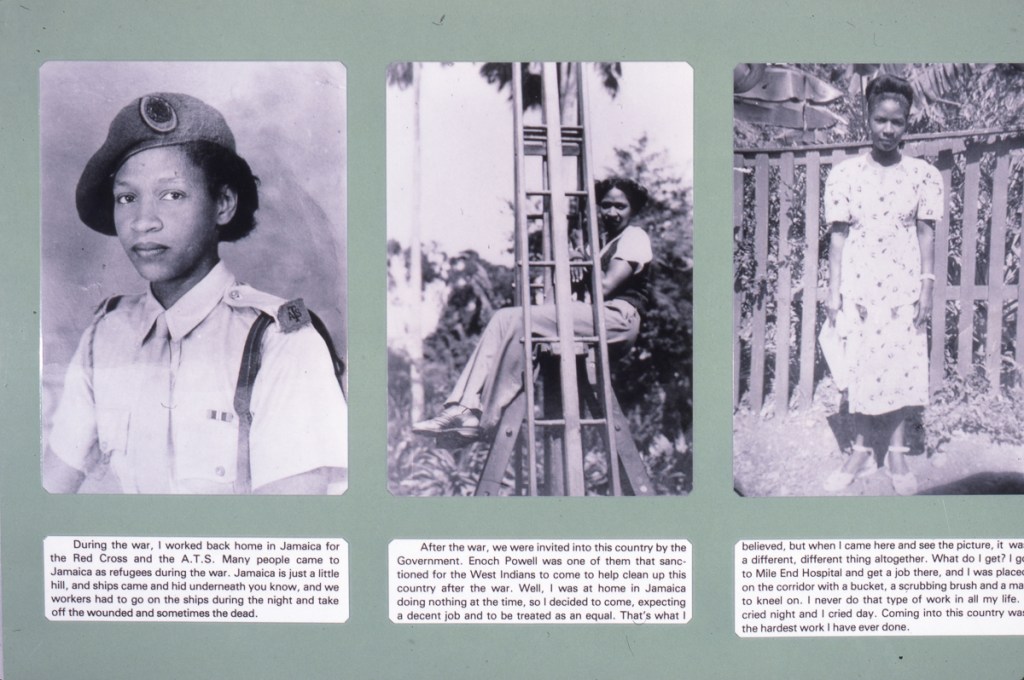
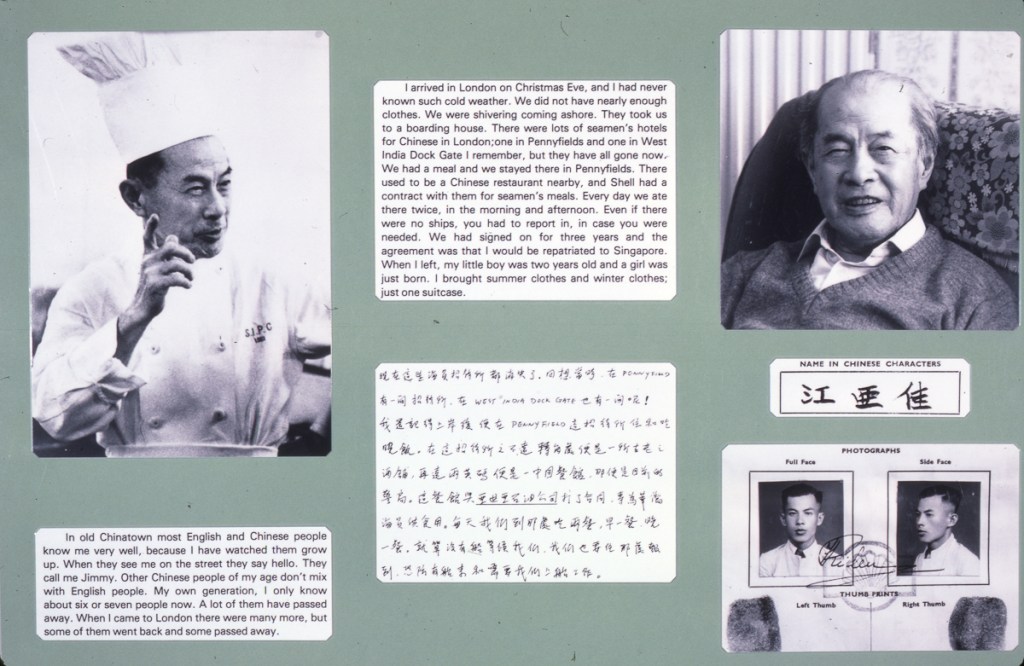
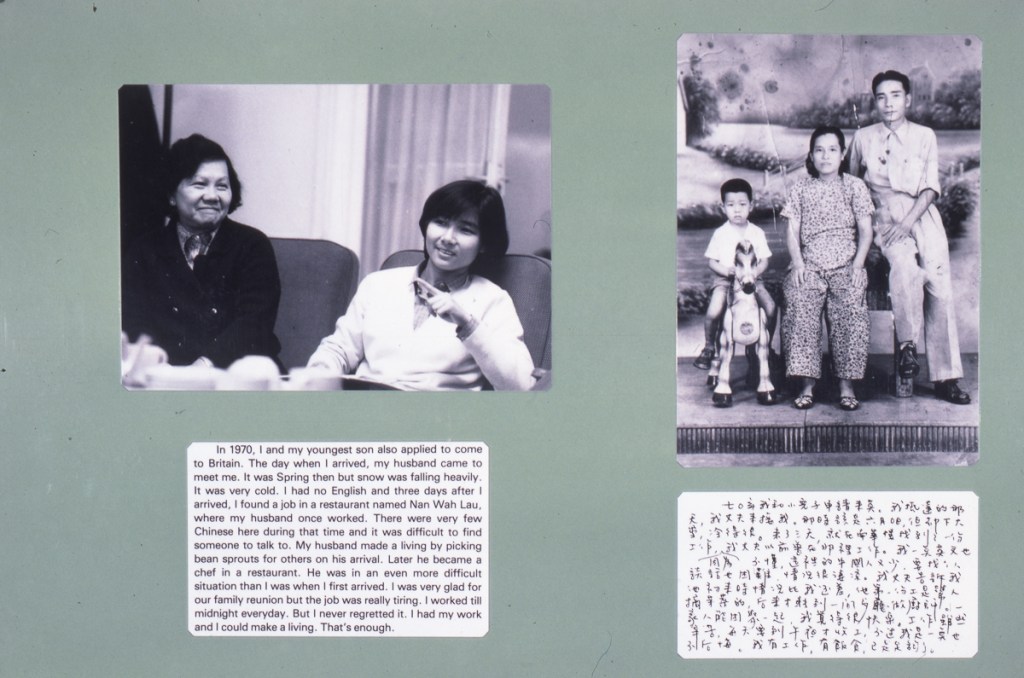
PAM & ALEX SCHWEITZER from AGE EXCHANGE THEATRE
DATE: 1983 Age Exchange are a Theatre and Publishing Company that works with London pensioners on shows and books which record their life experience and current concerns.
SIZE: 21 Laminated Panels 20″ x 30″
RACE EQUALITY UNIT, LONDON BOROUGH OF LEWISHAM
Material researched with pensioners from the West Indies, India, The Far East, Cyprus, Poland and Italy. In their own words, they recall their homelands, their arrival in Britain, settling in London and their varied experience here. In all cases, stories appear in the original language as well as English.
“It was made to draw attention to the views and feelings of a group whose voice is not usually heard. Our show and book of the same name have been effective as a focus for discussion and the exhibition hopes to achieve similar ends. It is used in schools colleges, hospitals, libraries, clubs, pensioners events etc.. It has been an effective and accessible stimulus to discussion and a useful way of breaking down barriers.”
WAS AVAILABLE: For Hire from AGE EXCHANGE 15 CAMDEN ROW BLACKHEATH SE3
Appropriation And Control, David A. Bailey (1986)
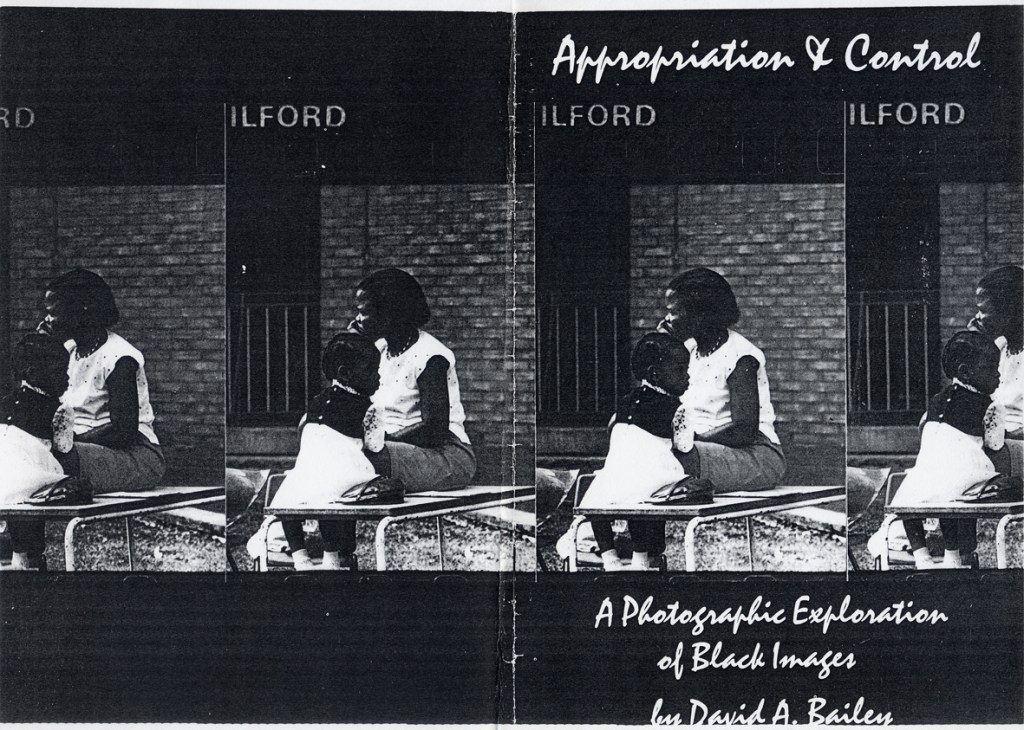
DAVID A. BAILEY
DATE: 1986
SIZE: 10 panels 48″x48M 20 panels 36″x36″
FUNDED: Commissioned by Sheffield Council for the Mappin Art Gallery for the ‘Black Edge’ Show.
SYNOPSIS: The exhibition was divided into 3 sections.
The first shows examples of how Anthropology used photography as a means of surveillance to categorise, identify and control subject nations. The functions of photography as a means of appropriation and control were beginning to reveal themselves. It was through the voyeuristic perceptions of the West that we acquired images of Black people as exotic savages reinforcing the dominant West hegemony – a process that is still maintained today.
Section Two relates the process of taking stolen images (where the subject was unaware that the photo had been taken) to the theme. The stolen image can be seen as a cold and inhuman process where the voyeur has the ultimate power to construct and select a particular image – in other words to appropriate and control a person’s image. This section questions this voyeuristic relationship, looking at how the photographer can reduce the distance between the subject and the spectator.
In Section Three the selection, cropping/recropping framing and social construction is given ( to a certain extent ) back to the subjects. The image of the Black Woman and Representation Group is the most important one in this section. It challenges and confronts traditional images of Black people – especially women.
WAS AVAILABLE FROM: DAVID A. BAILEY, 18 RICHMOND AVENUE, N1
Aurat Shakti, Cockpit (1986)
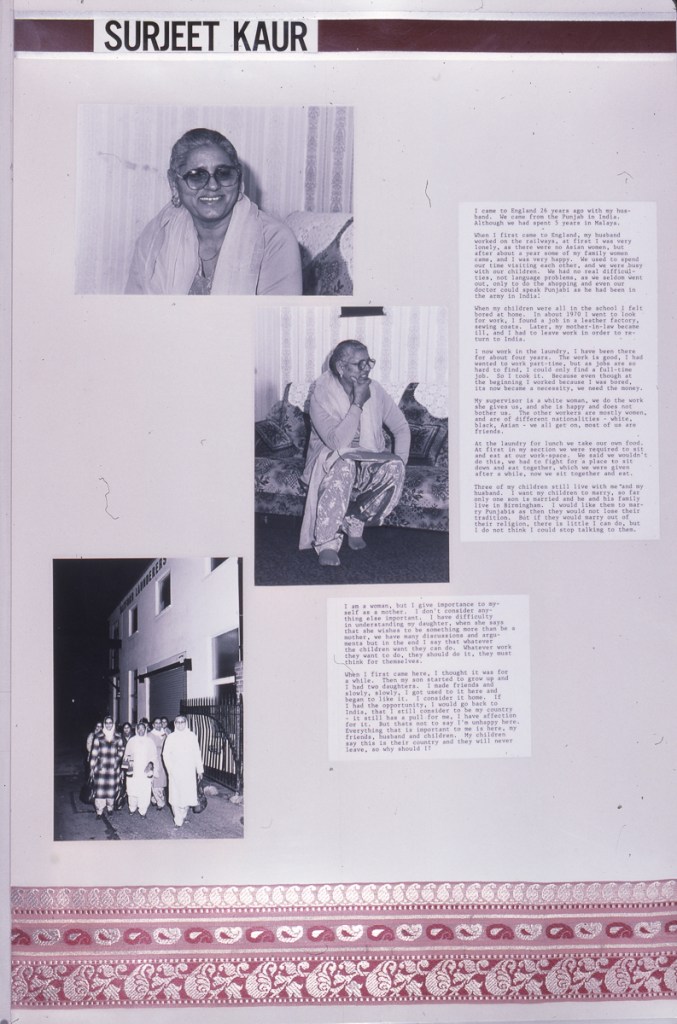
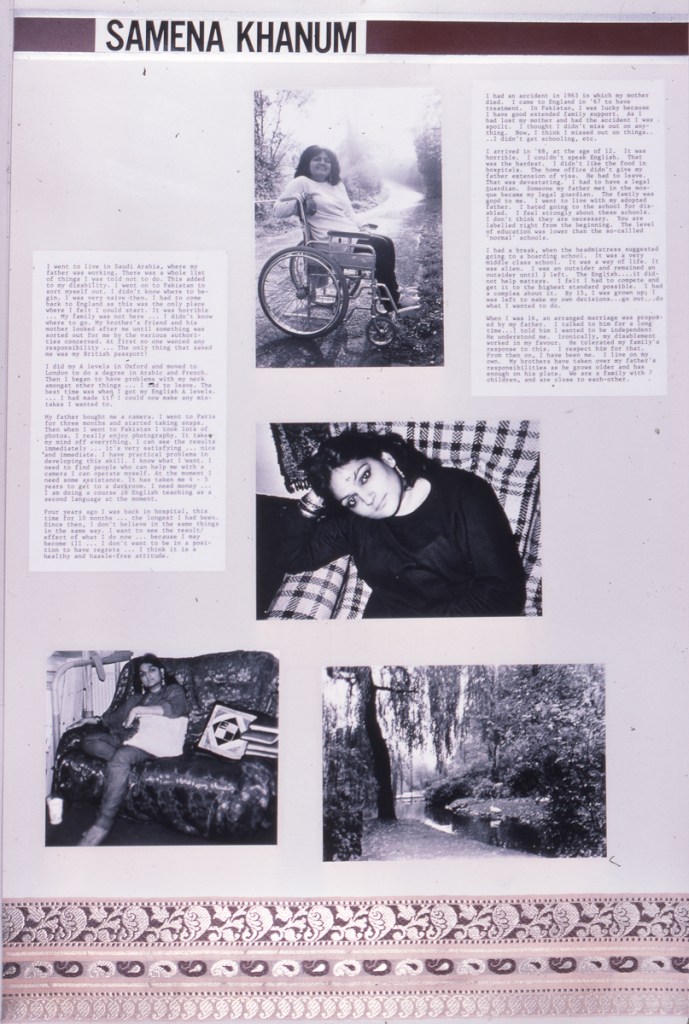
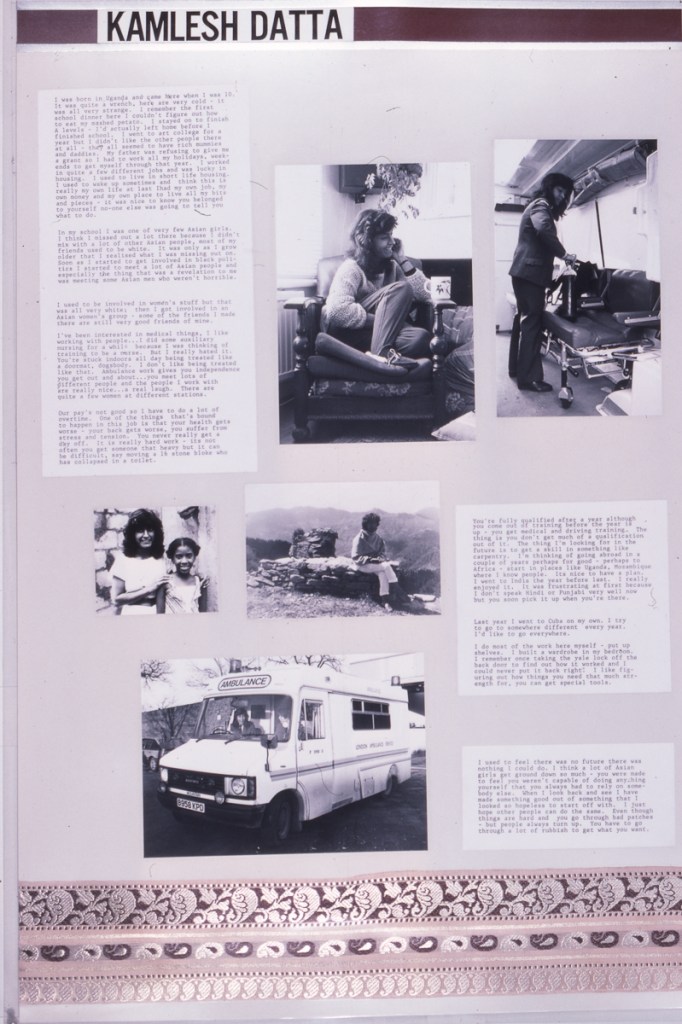
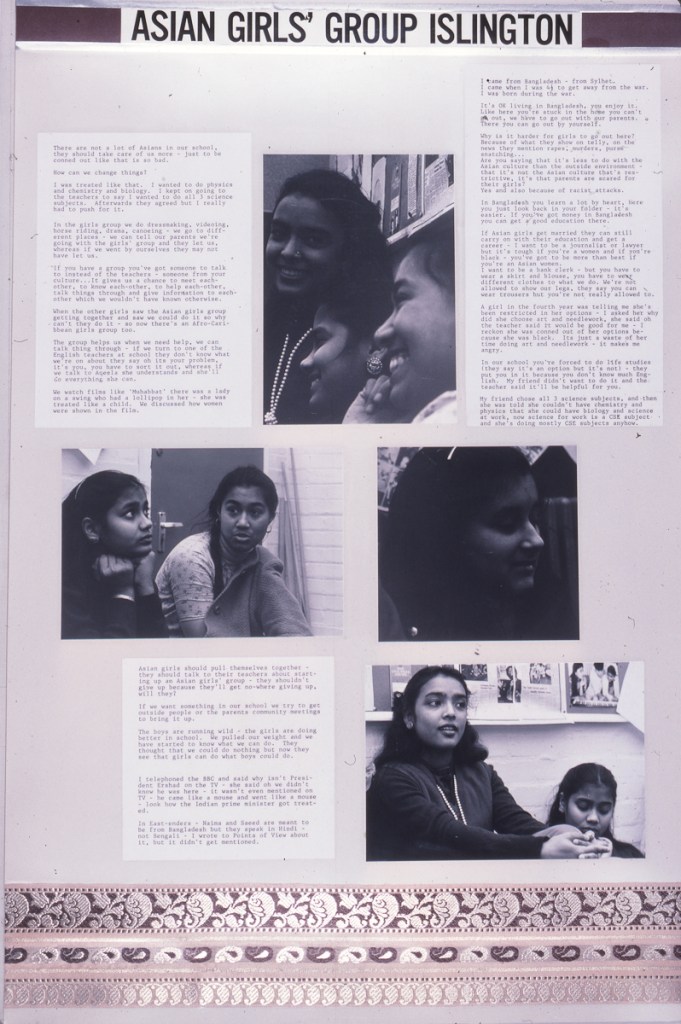
BY: MUNTAZ KARIMJEE, VIBHA OSBON, MANJULA MUKERJEE, AMINA PATEL
DATE: 1986
SIZE: 26 laminated panels 23″ x 37″
FUNDED: GLA, BLACK EXPERIENCE (GLC) COCKPIT GALLERY
SYNOPSIS: After working on the book “Breaking the Silence” in which Asian women talk about their lives and experience in this country, Manjula Mukerjee was asked by Centerprise about the possibility of producing an exhibition based on the book. The initial meetings led Manjula to a realisation that such an exhibition needed to be worked on by Asian women and that the issues covered needed to be wider. Eventually, the above working group was formed.
‘Aurat Shakti’ was aimed primarily at Asian women and each panel portrays one of twenty women of different ages and backgrounds. “We wanted to reflect the variety of our experiences, the range of our identities, to portray women we meet or see every day and share their portrayal through the exhibition. We called the exhibition ‘Aurat Shakti1, a title that would speak for all women with origins in the Indian sub-continent; for those of us who did not speak the language to discover and explore the meaning of the title.”
Two copies of the exhibition were produced and both have been used widely by schools, youth clubs, libraries and bookshops. The producers are trying to raise money to translate the text into the other languages the women speak.
WAS AVAILABLE: For hire from THE COCKPIT GALLERY
Brick Lane, Paul Trevor, Camerawork (1978)
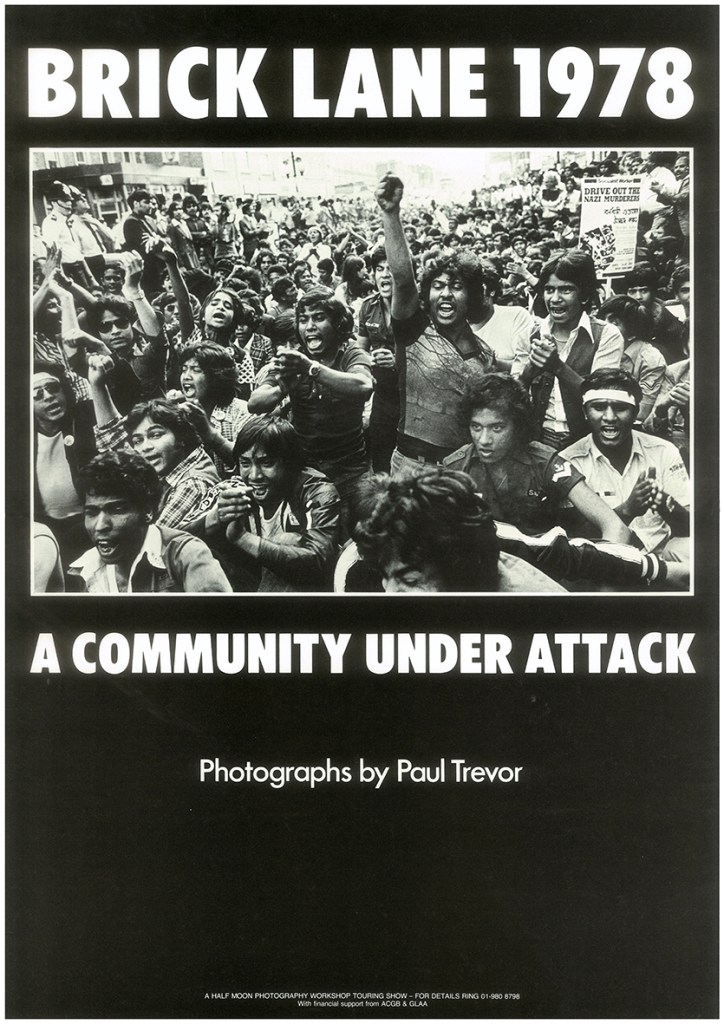
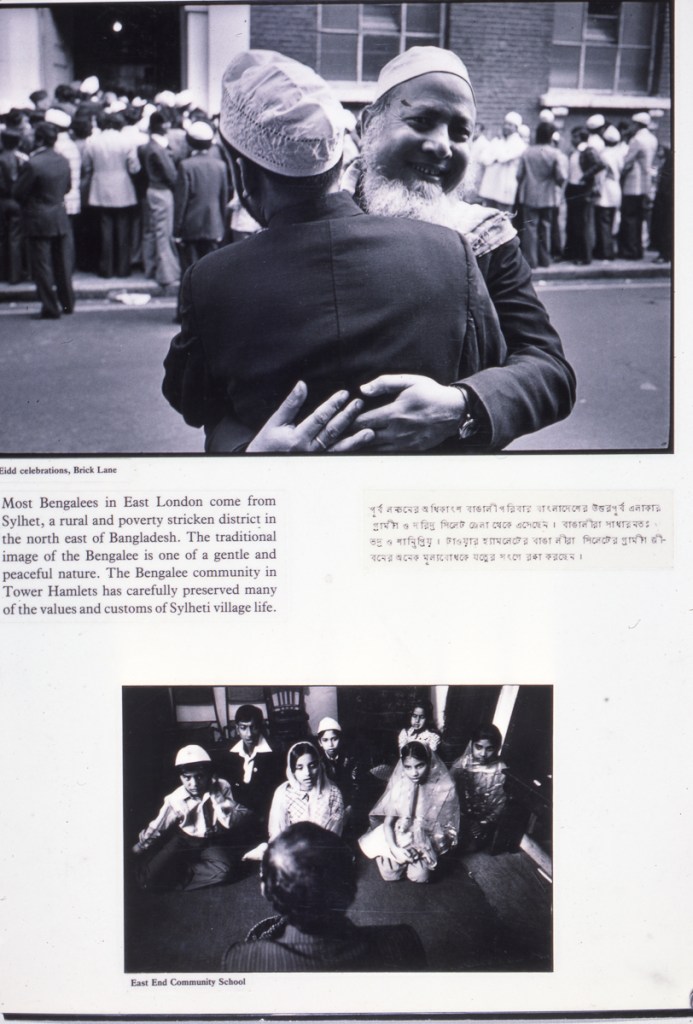
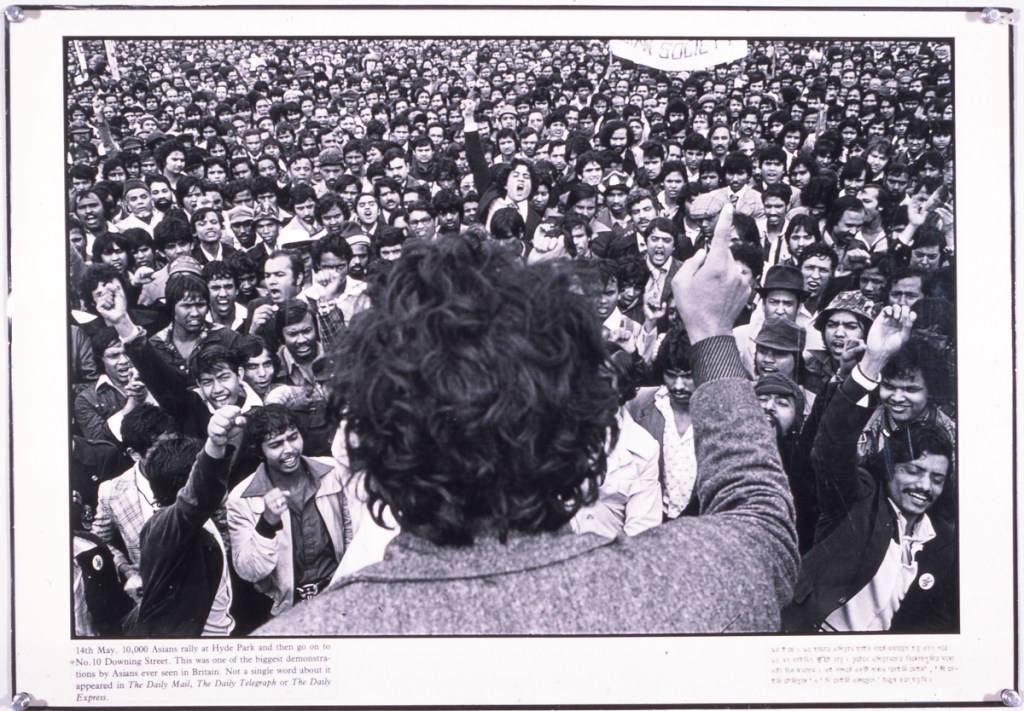
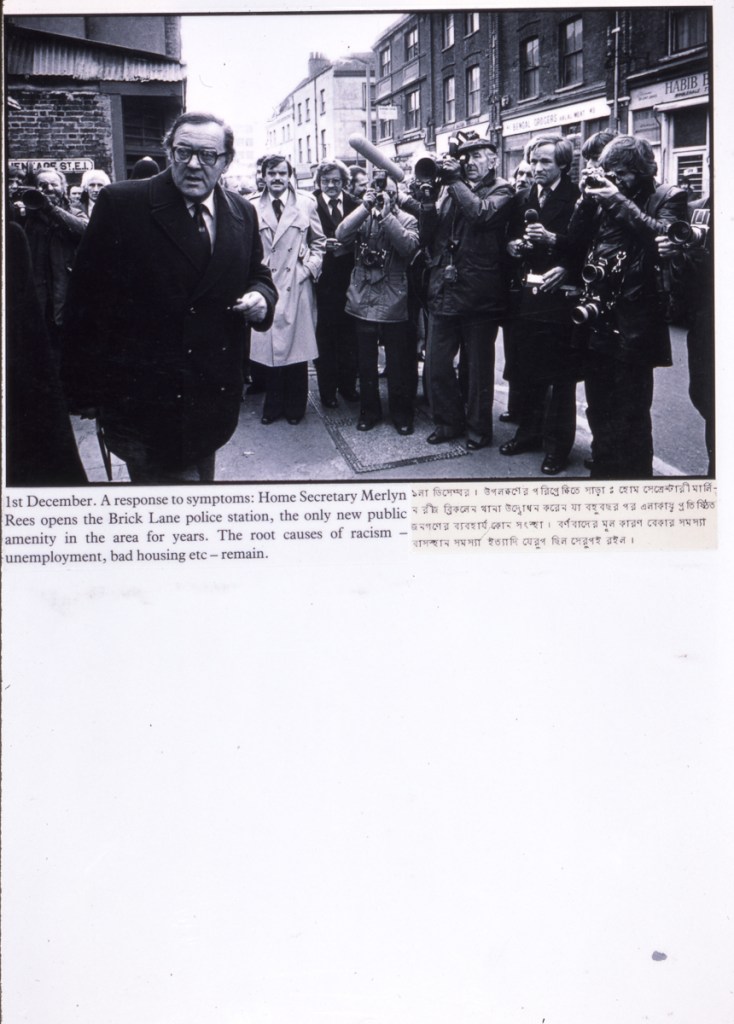
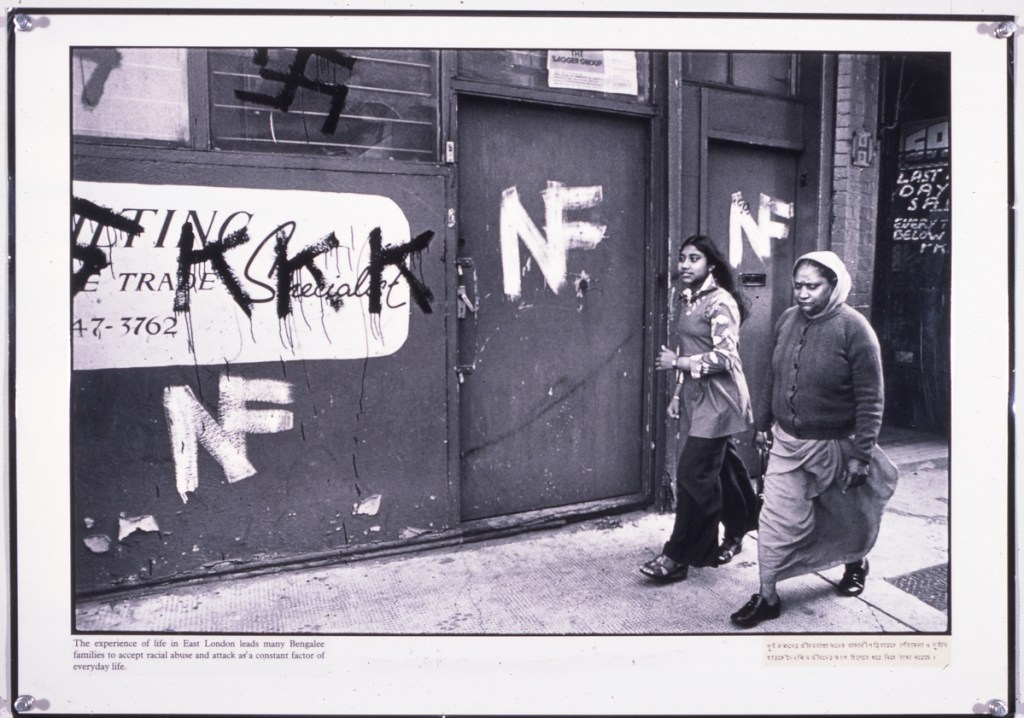
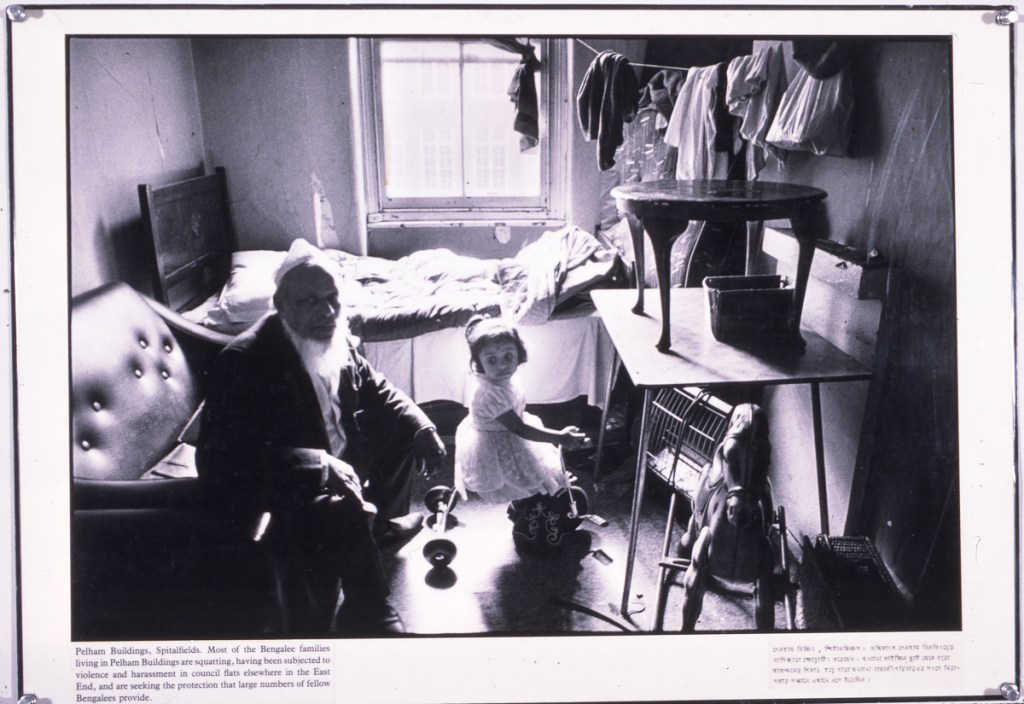
BY: PAUL TREVOR, DESIGNED BY ED BARBER AND MIKE GOLDWATER OF THE HALF MOON PHOTO WORKSHOP
DATE: MAY 1978
SIZE: 26 laminated panels, 8 panels 24″x16{“, 18 panels 16i”x12′ Text in English and Bengali.
FUNDED: Self-funded by Paul Trevor. Exhibition costs were met by a grant of £245 from the Commission for Racial Equality
SYNOPSIS: “The exhibition photographs were drawn from a larger ongoing self-imposed project about my neighbourhood. Many of the pictures illustrated a book called BLOOD ON THE SffEETS, published by Bethnal Green and Stepney Trades Council. Its purpose was to put or. record some of the events of 1978 and to provide some understanding of the social and political background.”
It documents the events of 1978 in Brick Lane and the response of the Bengali Community to racist attacks and provocation. It was initially toured in community centres, youth clubs and schools in Tower Hamlets, later shown in other London boroughs and then in other parts of the country.
A CAMERAWORK EXHIBITION
Bringing It All Back Home, Half Moon, Camerawork (1980)
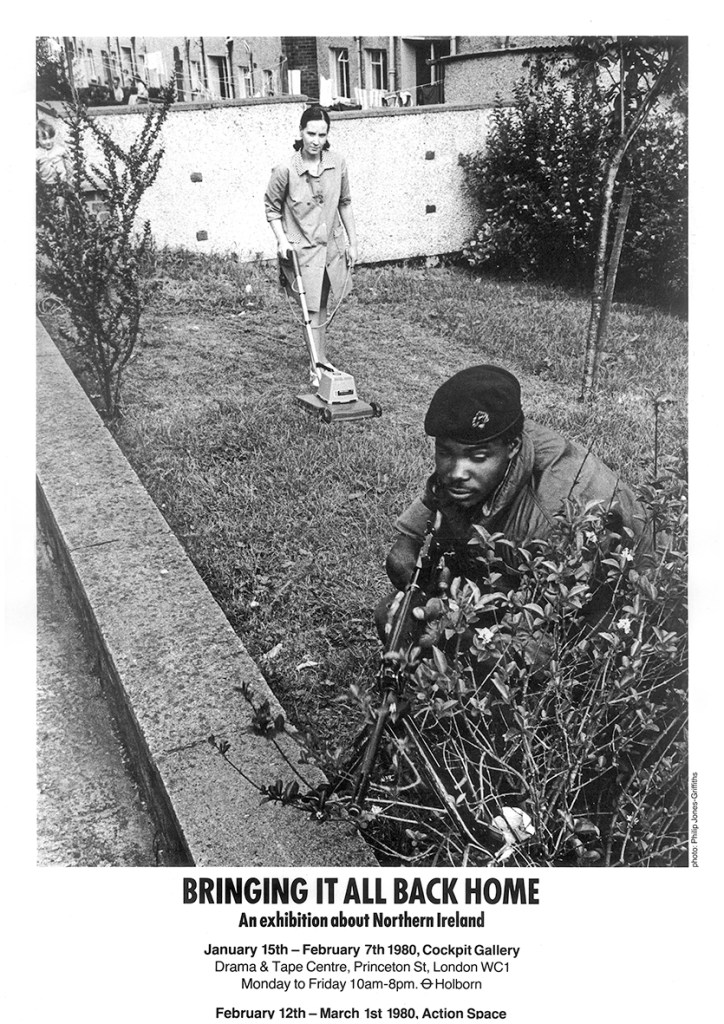
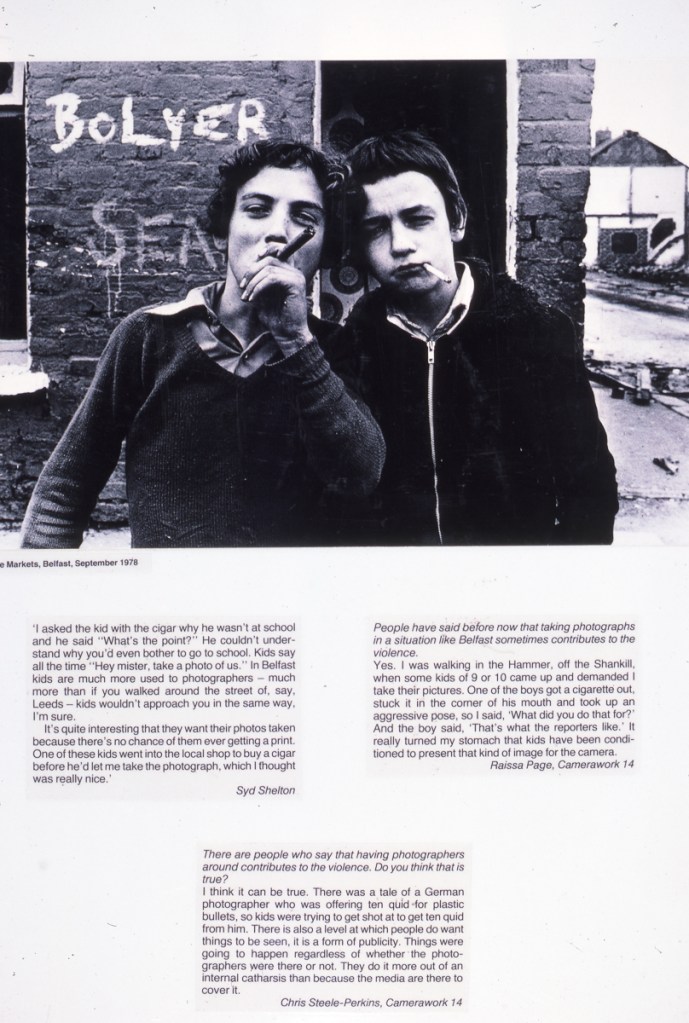
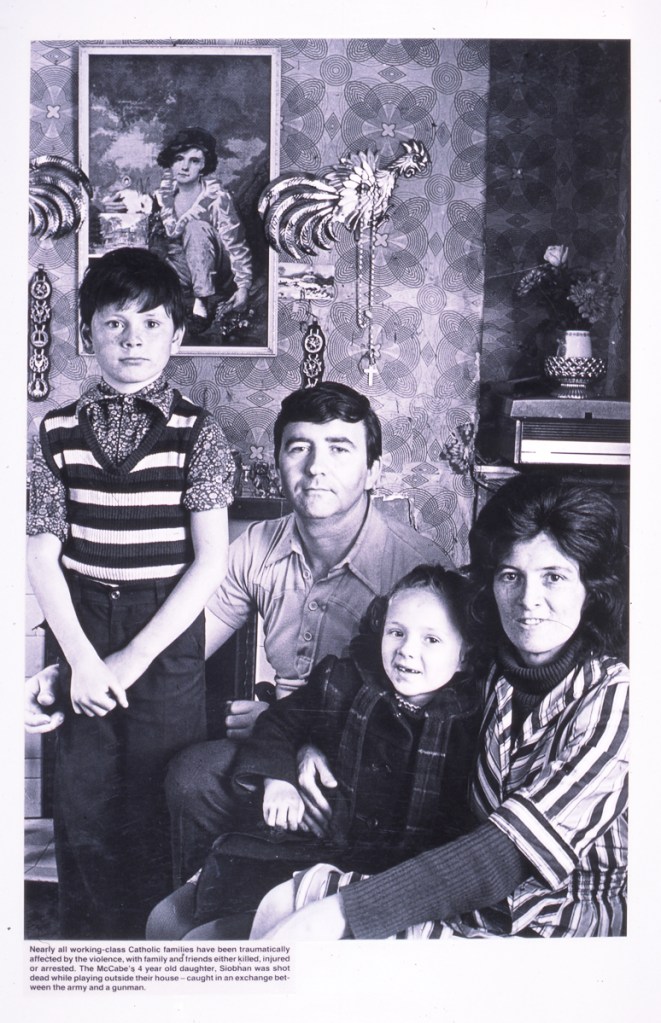
BY: HALF MOON PHOTOGRAPHY WORKSHOP
DATE: 1980
SIZE: 100 panels (30 panels 28″ x 22″ and 70 panels 22″ x 16″)
FUNDED: Half Moon Photography Workshop
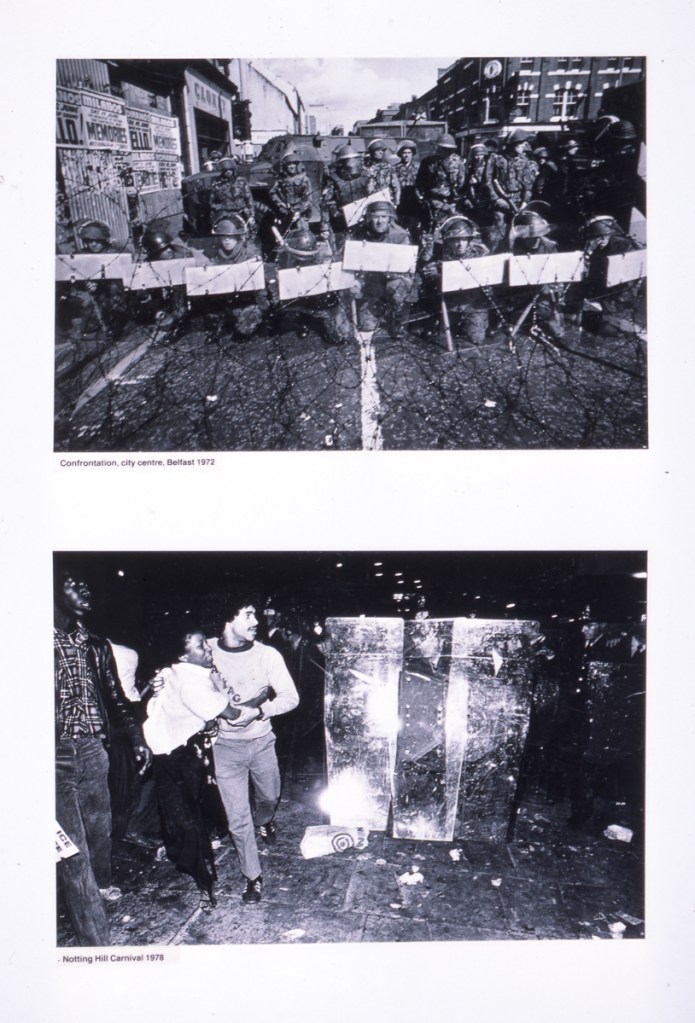
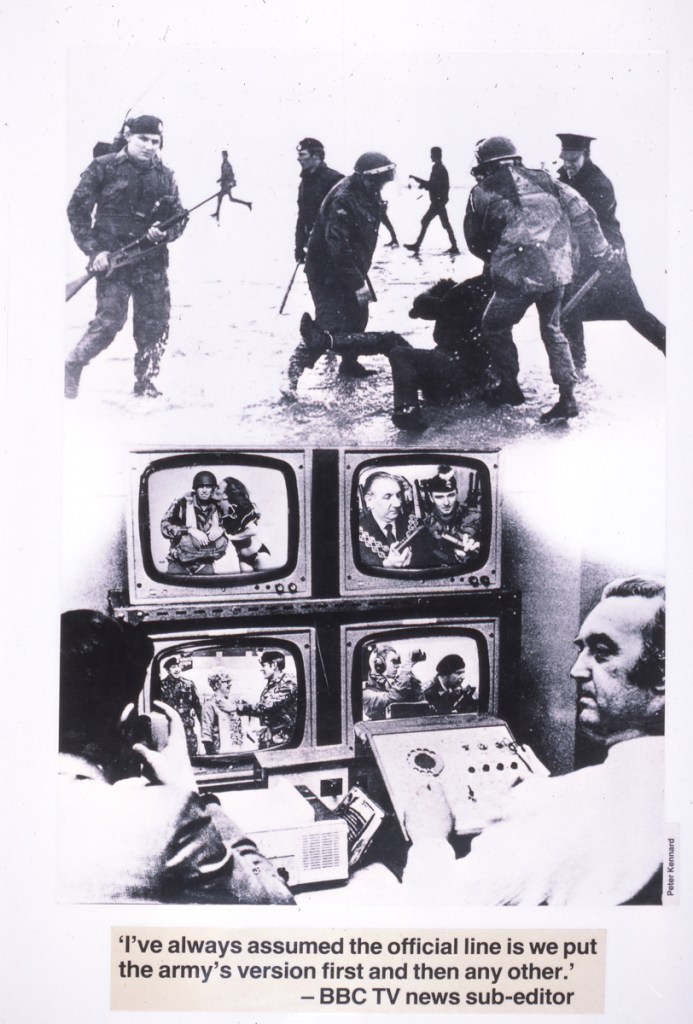
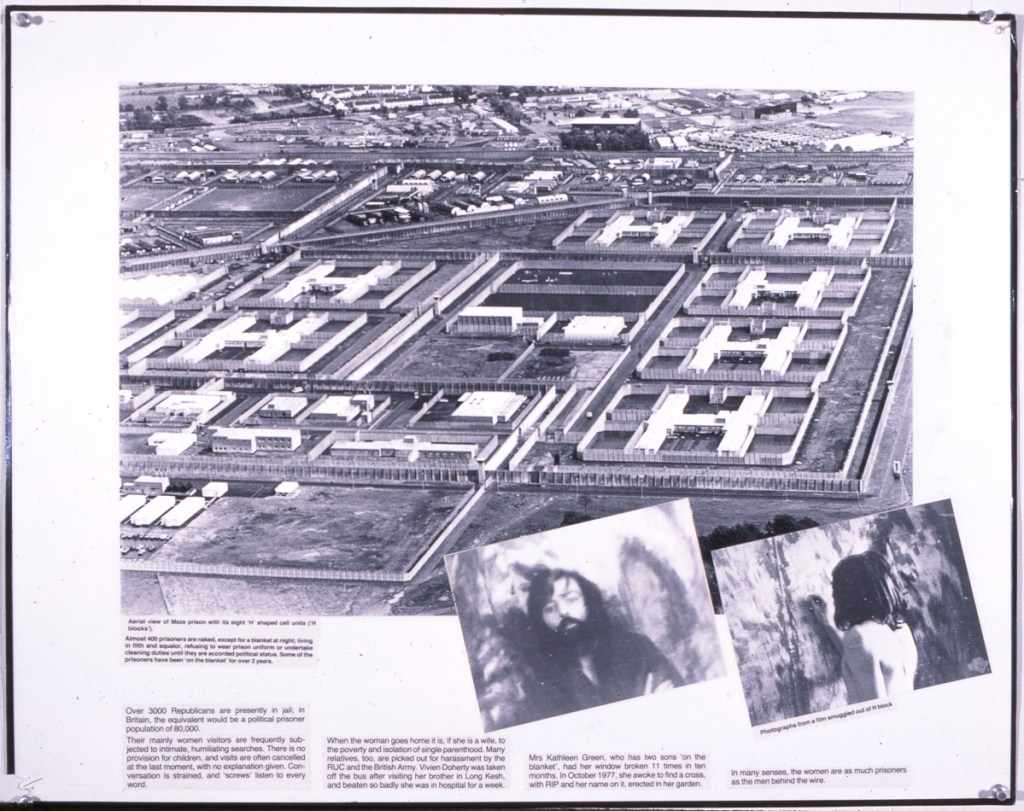
SYNOPSIS: The exhibition was based on issue 14 of Camerawork magazine: “Reporting on Northern Ireland”. It begins with a history section and has further sections on housing, unemployment, the security forces, demonstrations, and the role of the British media.
“In Vietnam film and photography played a significant role in changing public understanding of American involvement in the war there, leading to American withdrawal. It is fair to say that photography has not played this role in Northern Ireland. Thousands of photographs have been taken there, but the few that appear in the British press have concentrated on the violence, underlining “The tragedy of it all”.
The way they have been used distorts our understanding of events by failing to put them into an appropriate context. The information we receive is censored both by the Army and by editorial decisions within the media. The Half Moon Photography Workshop has put together this exhibition in an attempt to demystify the issues that affect the Six Counties, and provide a context within which they can be understood”.
A HALF MOON PHOTOGRAPHY WORKSHOP EXHIBITION
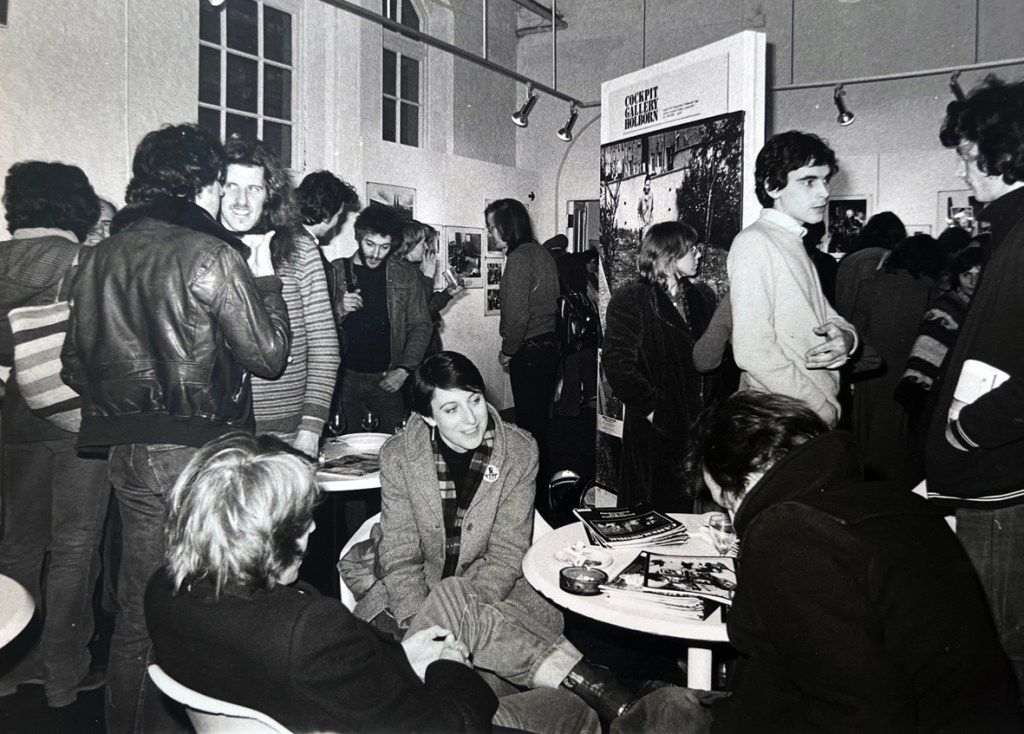
As the exhibition was large, it had originally opened in the Cockpit Gallery in January 1980.
Changing Images, Cath Tate (1980)
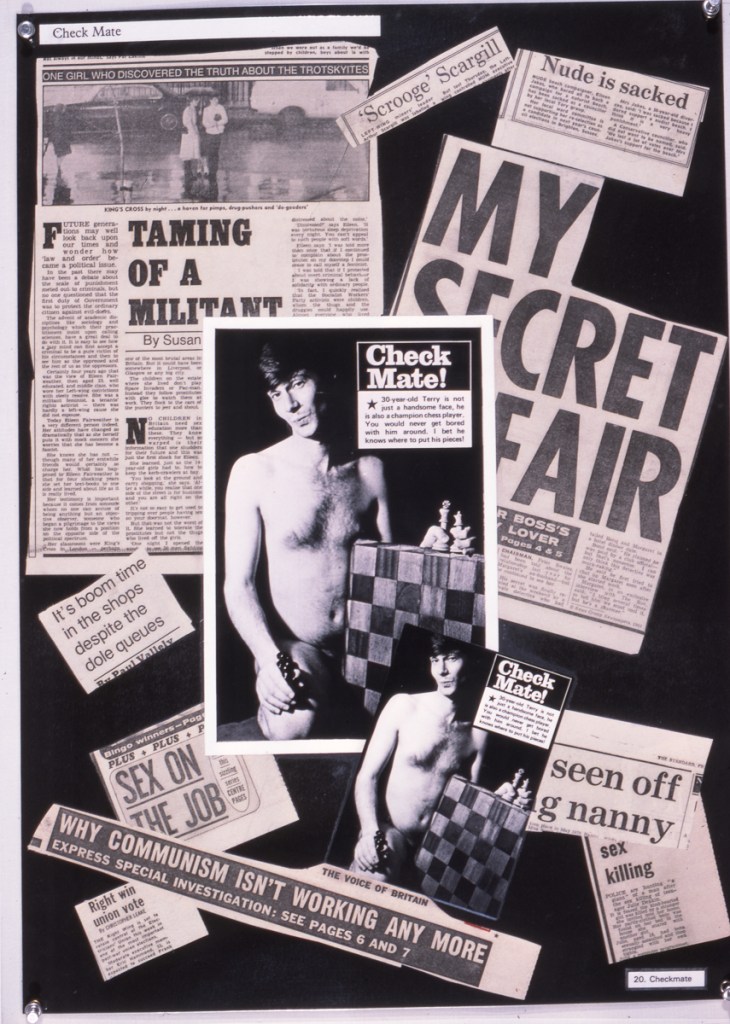
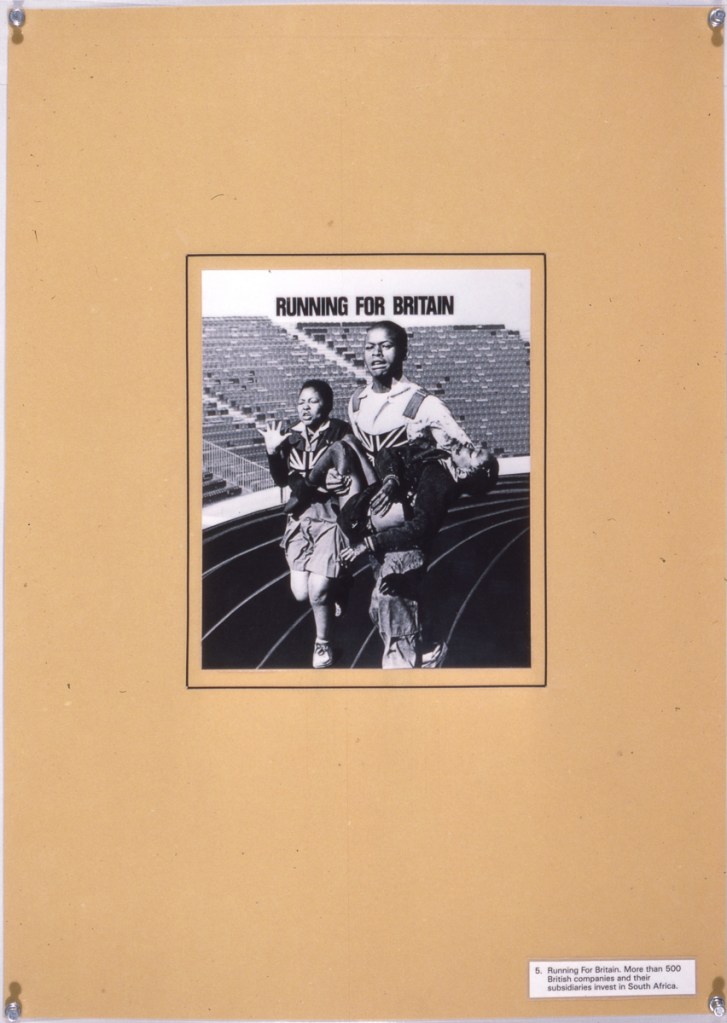
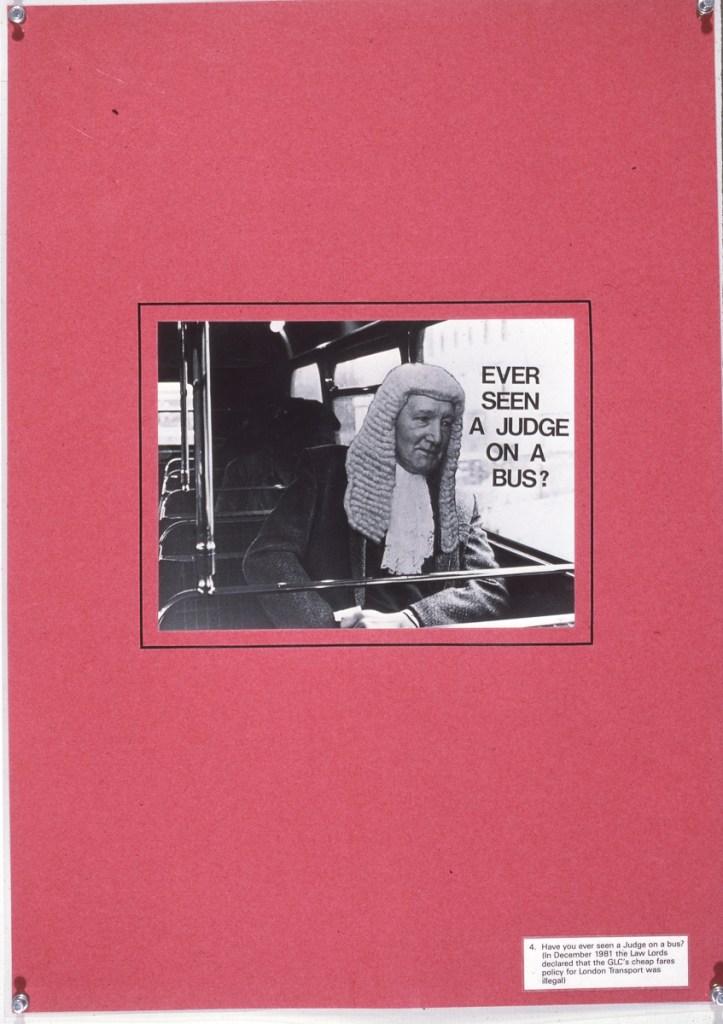
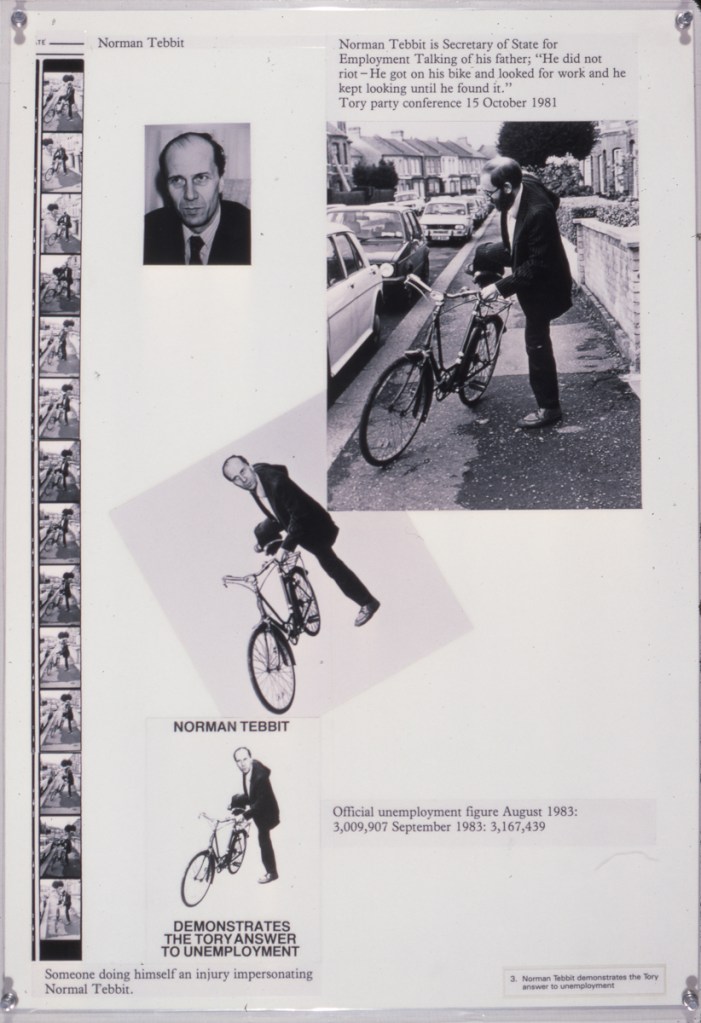
BY: CATH TATE
DATE: Checkmate 1980 / Judge on a Bus 1982
SIZE: 24 laminated panels 17″ x 24″
FUNDED: Self-funded. Cath is dependent on sales of postcards -and occasional low reproduction fees.
SYNOPSIS: ‘Checkmate’ was produced for the ‘Women’s Images of Men’ exhibition at the ICA in 1981.
‘Ever seen a judge on a bus?’ was produced for the Fares Fair campaign that was fighting against the Law Lords judgement that forced London Transport to put up fares.
They have all been produced as postcards.
WAS AVAILABLE FOR HIRE: FROM THE COCKPIT GALLERY
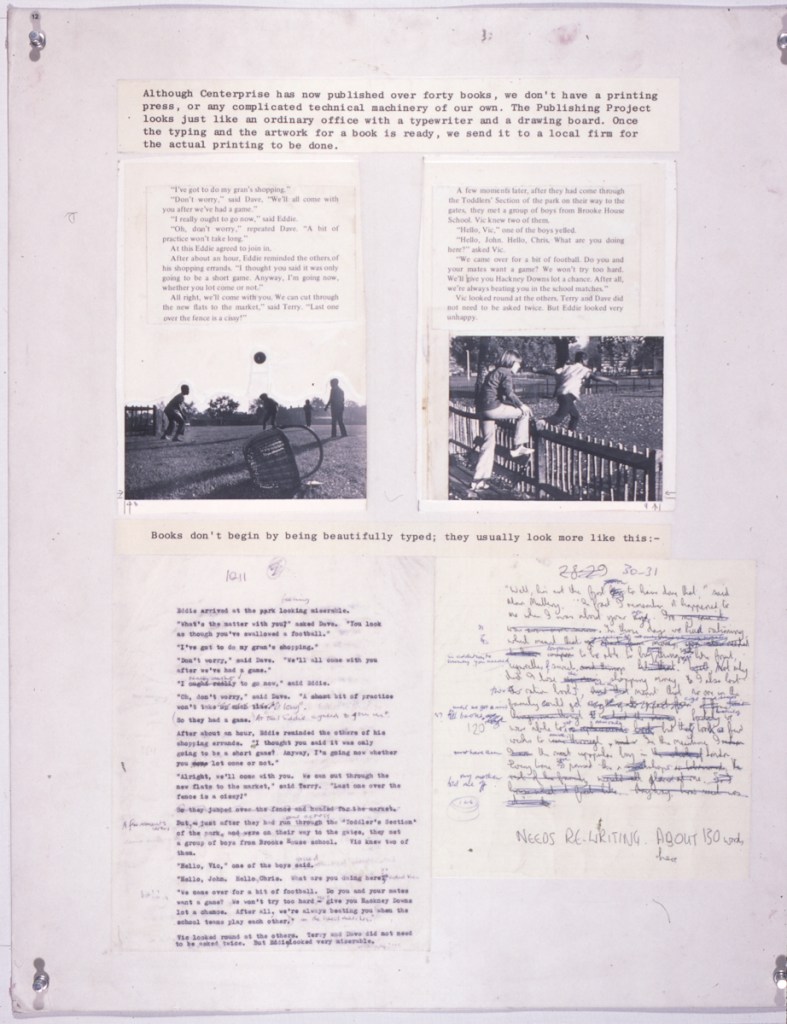
Centerprise And Its Books, Maggie Hewitt (1979)
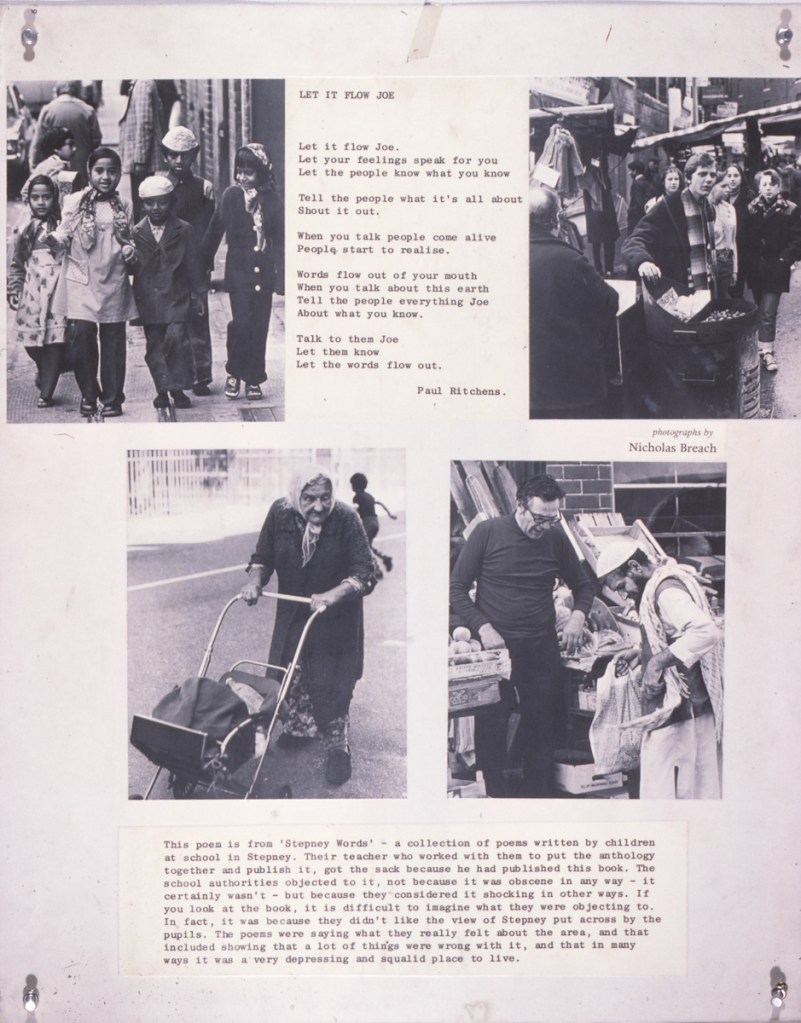
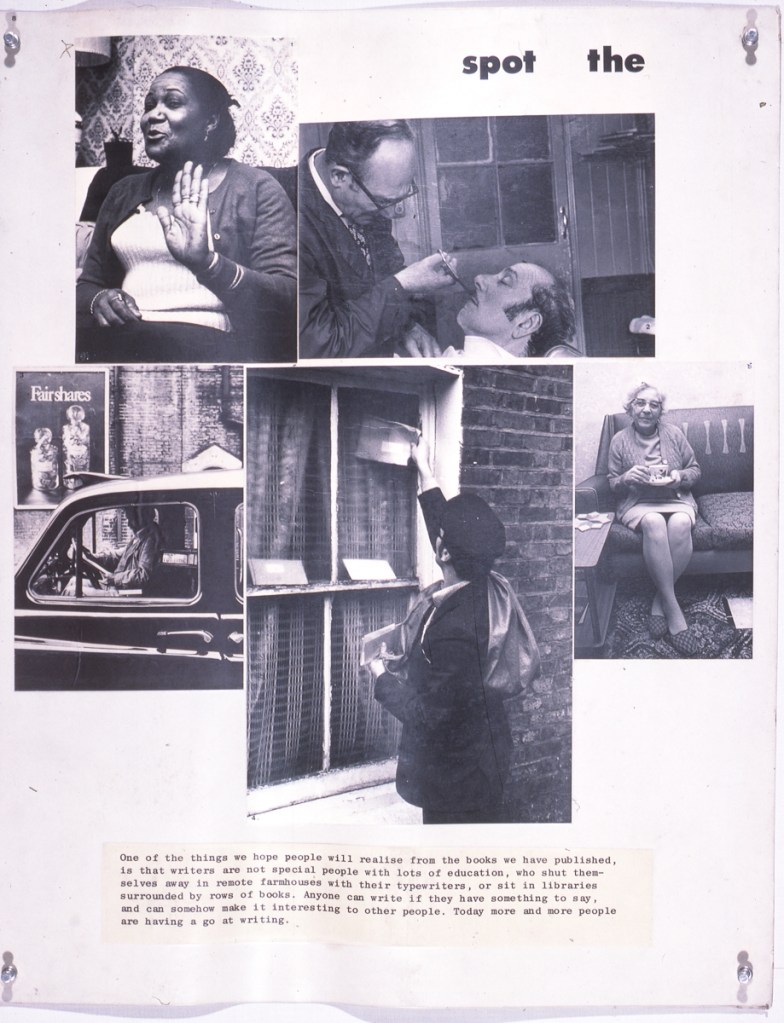
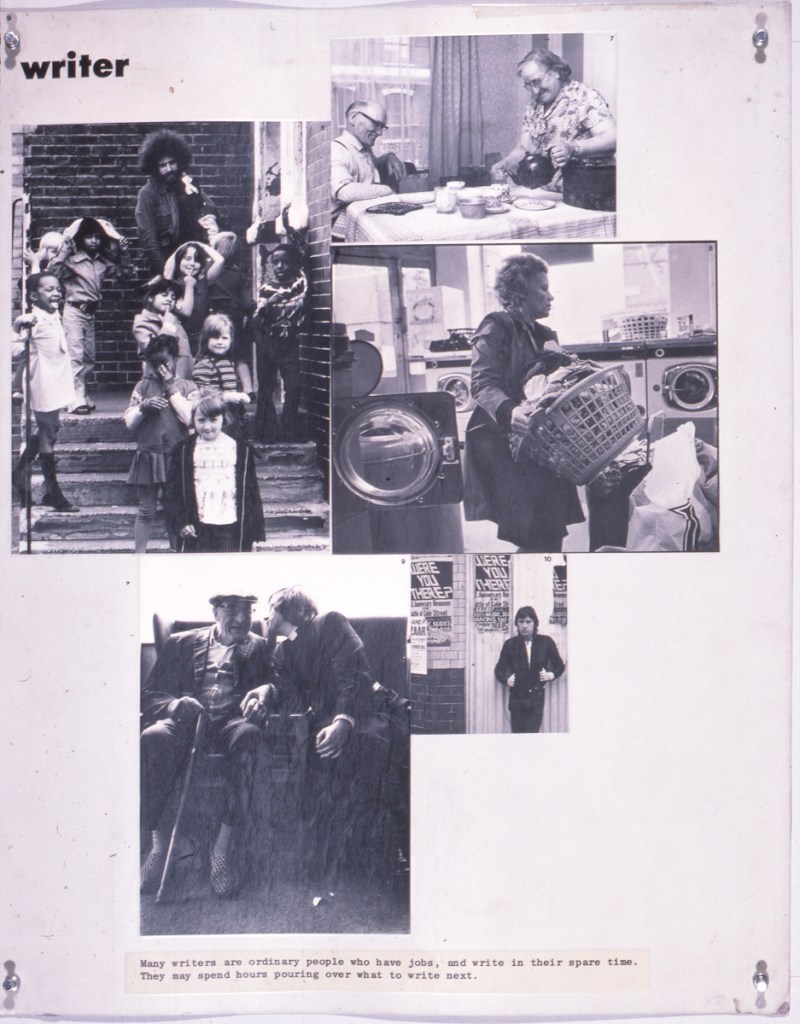
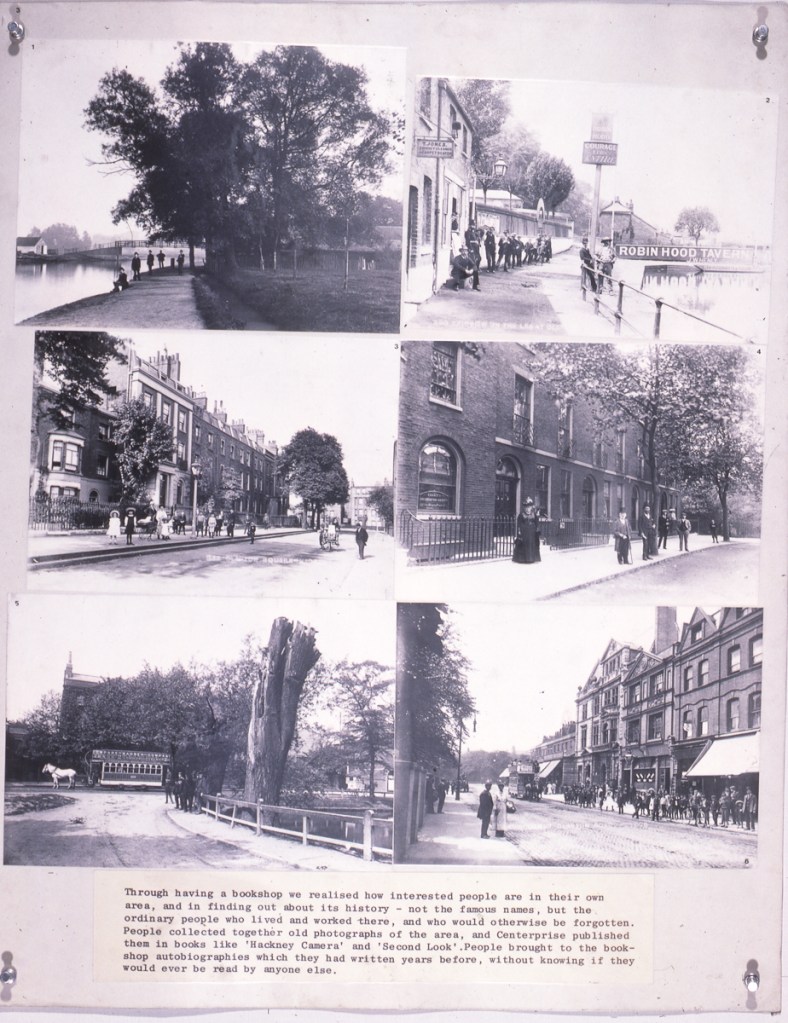
BY: MAGGIE HEWITT
DATE: 1979
SIZE: 18 panels
FUNDED: Through Centerprise, whose funding came from various sources including Hackney Council, Greater London Arts, and the sale of its own books.
SYNOPSIS: The exhibition was designed for use in schools; part of it in the form of a quiz so that kids would actively engage with it. e.g.The idea behind ‘Spot the Writer’ was to challenge their conceptions of who a writer could be.
The other panels focused on books by young writers, including ‘Stepney Words’, and ‘The Gates’ by Billy House and Lesley Mildiner, and poems by Vivian Usherwood and Savitri Hensman.
There was a section on the location of bookshops in London, pointing out that working-class areas didn’t have them; and a section on how a book is made, showing the stages of production of the book ‘Half Term Adventure’.
Schools would book the exhibition as part of a book week for example, or it would accompany a writer giving a talk at a school
WAS AVAILABLE FROM: CENTERPRISE, 136 KINGSLAND HIGH STREET, E8.
Doing Photography, Blackfriars Settlement (1975)


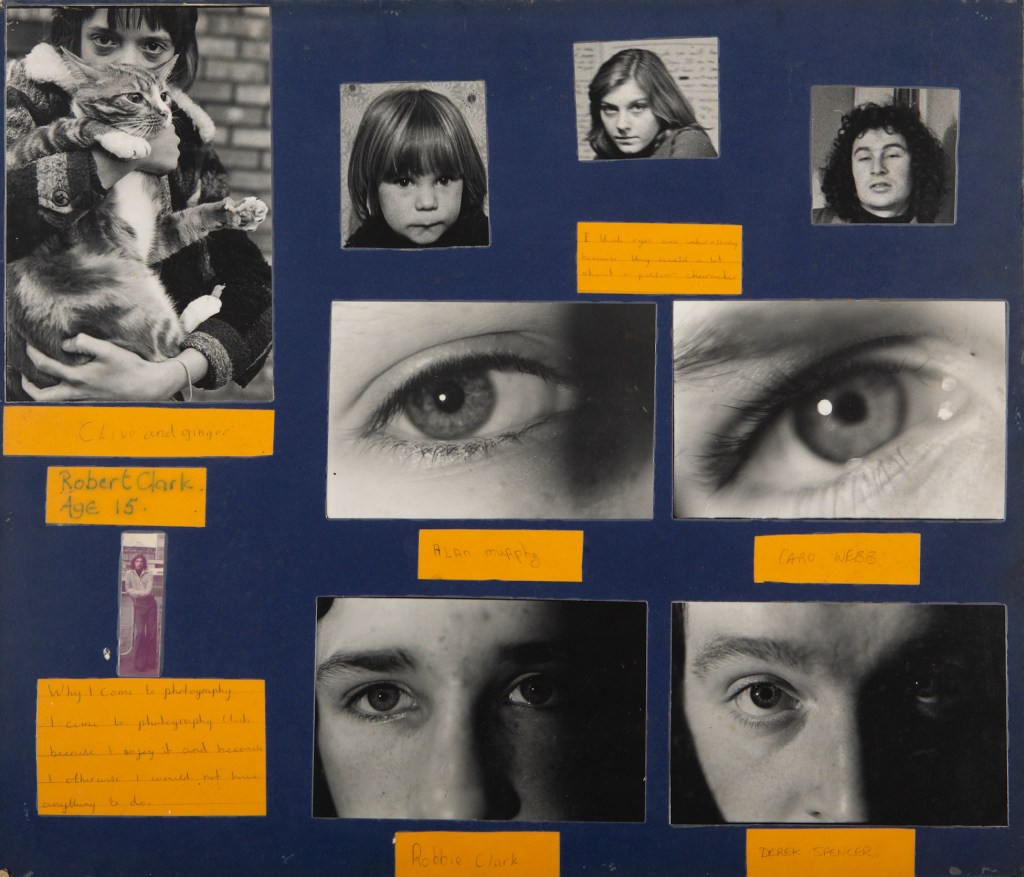
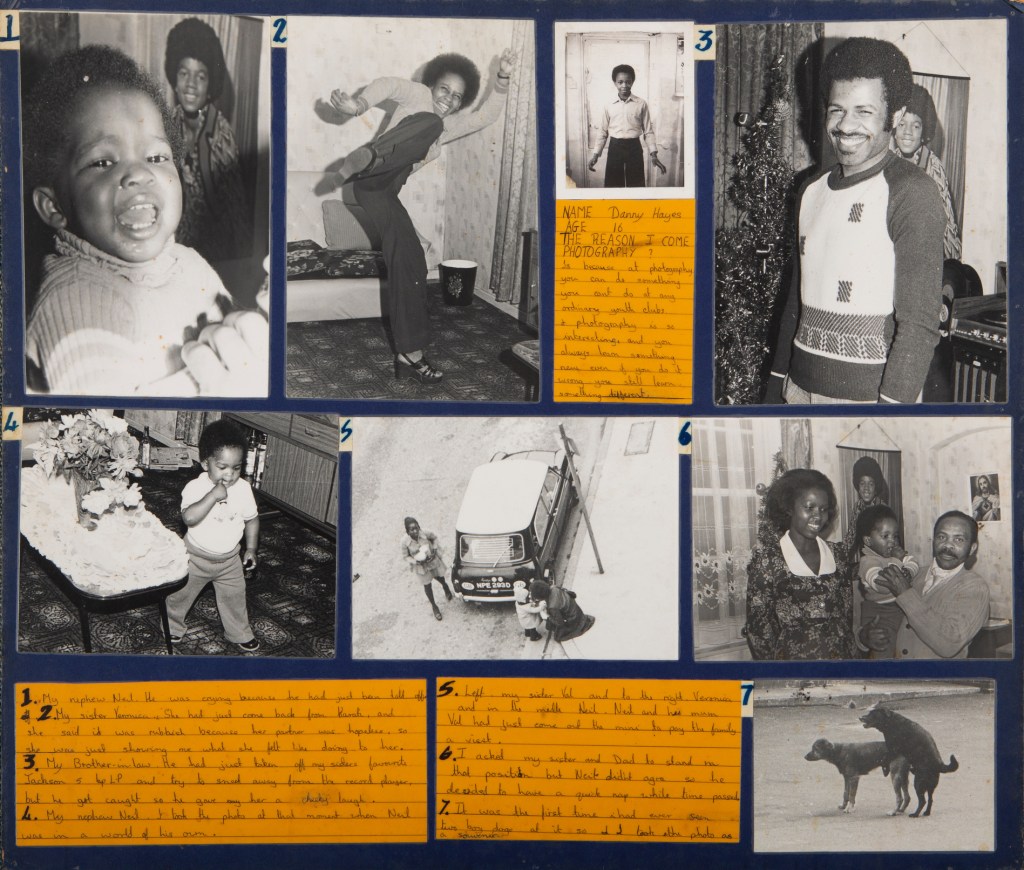
BY: YOUTH PHOTOGRAPHY PROGRAMME AT THE BLACKFRIARS SETTLEMENT WITH PAUL CARTER
DATE: 1975
SIZE: 20-30 panels
FUNDED: The programme was set up with money from Kodak and the Arts Council. Paul Carter received a Kodak bursary for socially committed photography and later he was employed as a part-time youth worker by the ILEA.
SYNOPSIS: The photography project at Blackfriars included a programme to teach photography to young people. The kids were aged between 10 and 18 and lived on local housing estates. The project ran four nights a week with groups of 8 to 10 kids each night. It aimed to give young people a new skill and enable them to find ways of using it for their own and the community’s benefit. Twenty-six members of the group were given a 21″ x 24″ card on which to mount whatever photographs they wanted; they were also asked to write something about the photographs and why they came to do photography. The exhibition was first displayed locally and then in a variety of locations both in and out of London.
BLACKFRIARS EXHIBITION WAS FROM BOERMUND CENTRE, 177 ABBEY STREET, LONDON SE1
Don’t Say Cheese, Say Lesbian – Rosy Martin & Jo Spence (1986)
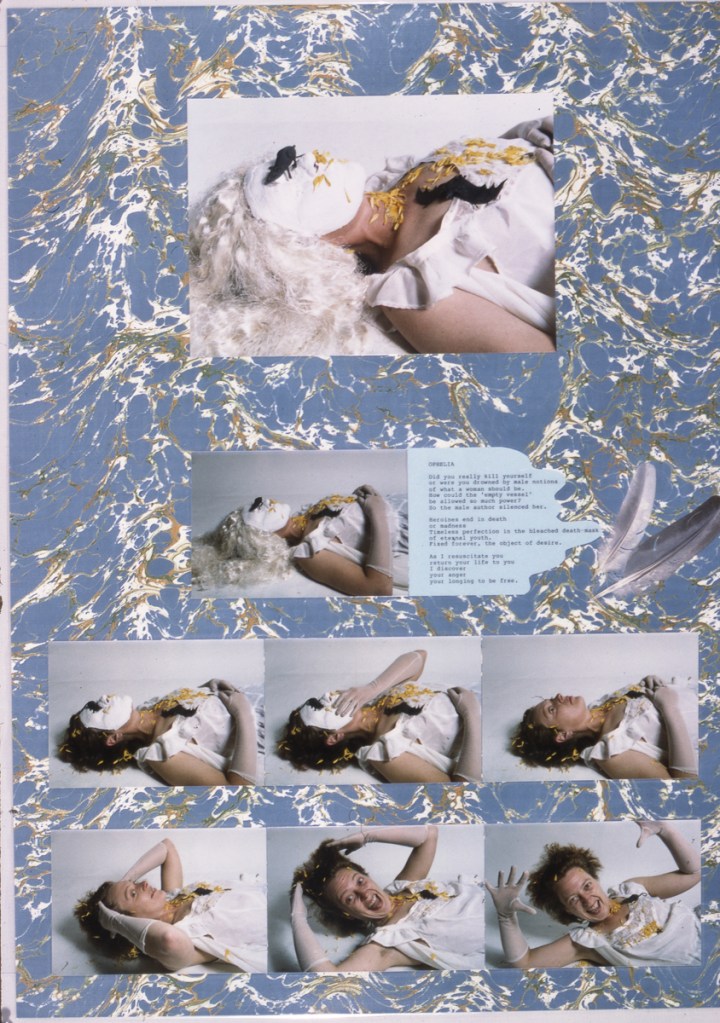
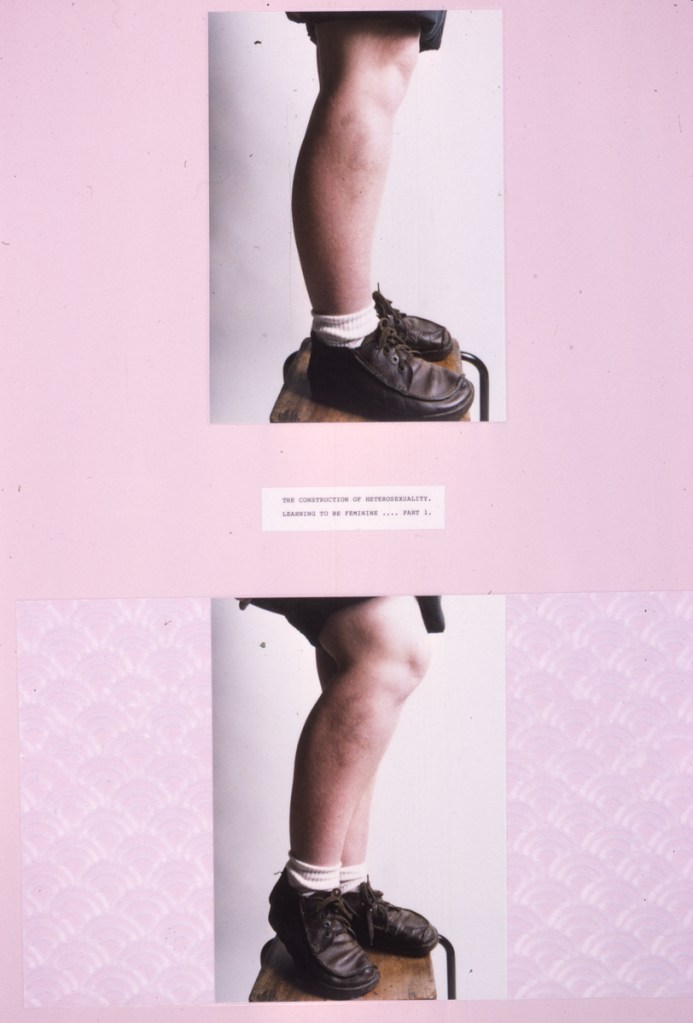
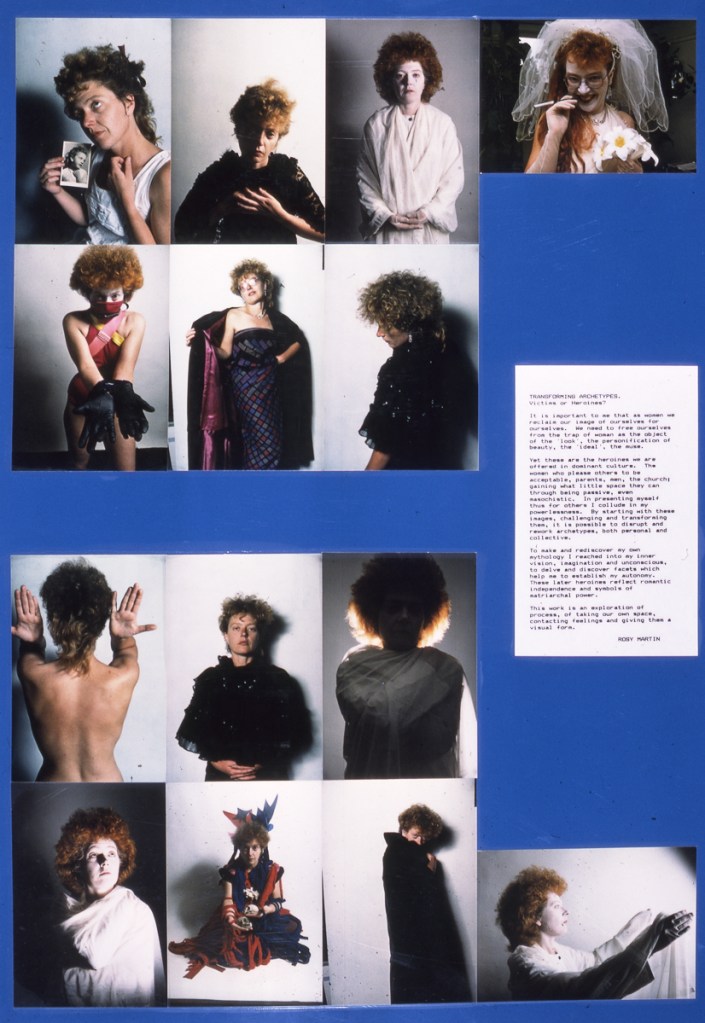
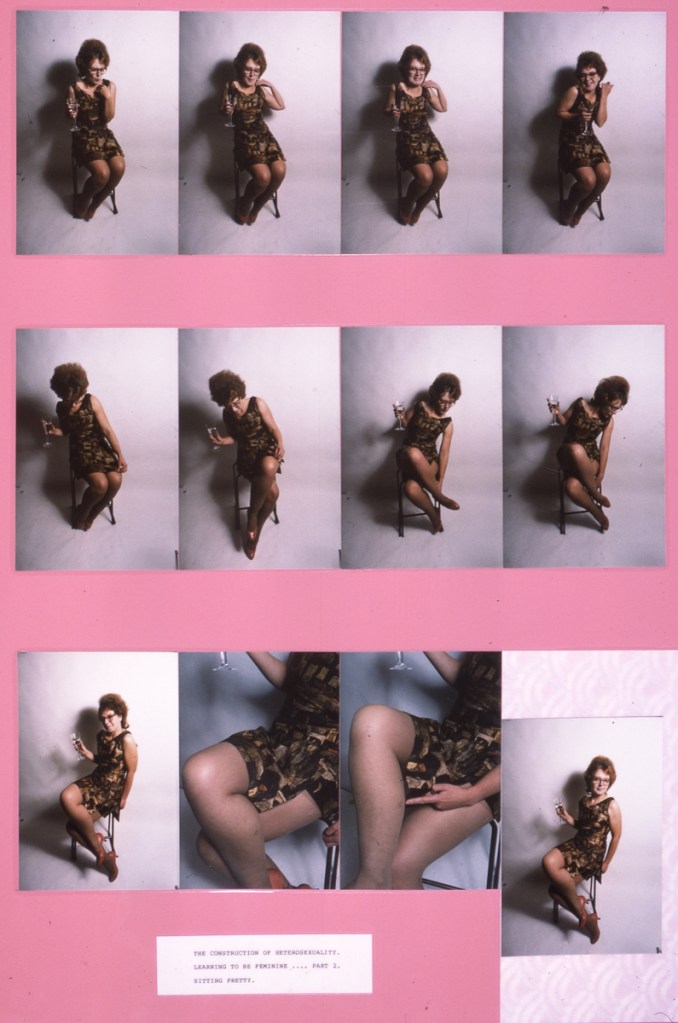
BY: ROSY MARTIN AND JO SPENCE
DATE: 1986
SIZE: 25 Laminated panels 20″x30″
FUNDED: Self-funded and made for an exhibition of lesbian work held at the Pavilion in Leeds in May 1986
SYNOPSIS: “The exhibition engages with the issues of personal and sexual politics. I have used phototherapy techniques, which Jo Spence and I have developed together to examine our self-identity. I have replaced myself within the Family Album, taking up the positions of my mother, my father and myself as a young child. I have examined the unnatural and extraordinary process of growing up as a young heterosexual woman (circa 1962). I have transformed archetypes of the victim and the heroine and reconstructed stereotypes as a means of challenging the fixity of social and sexual roles. There is no ‘real me’, only the fragments and contradictions that have formed me. I cannot be held or represented by any one image, and phototherapy is the process that Jo and I have developed to explore and make visible the many, many parts of which we are formed”
Rosy Martin
WAS AVAILABLE FOR HIRE FROM ROSY MARTIN
El Salvador: Repression And Revolution – Shirley Read, Camerawork (1981)
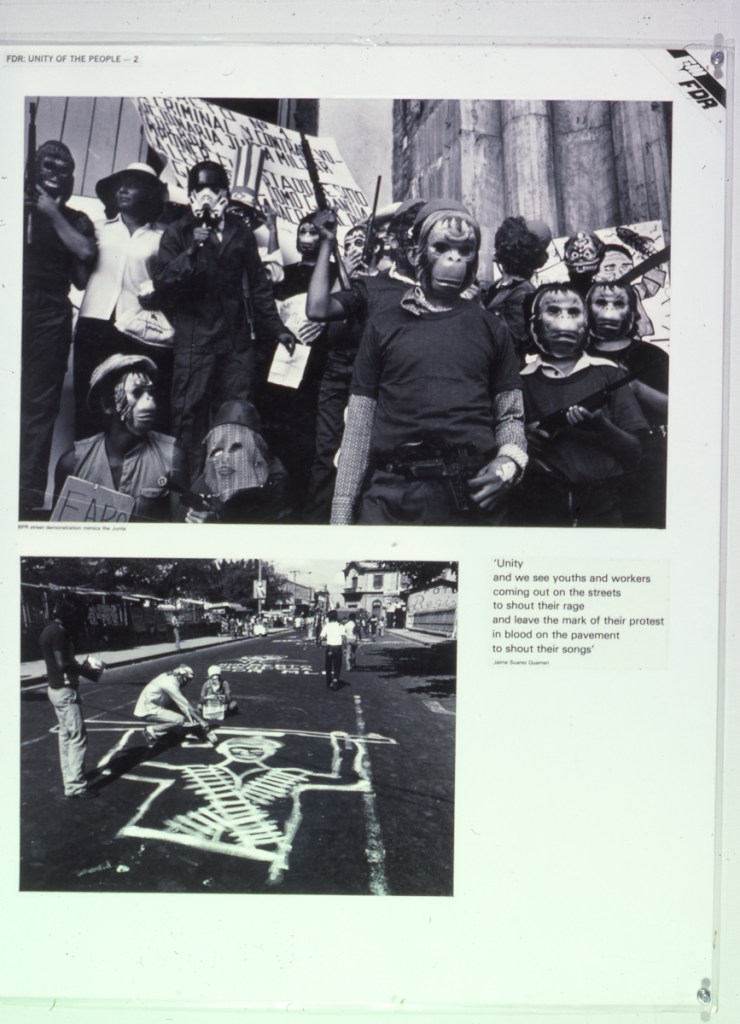
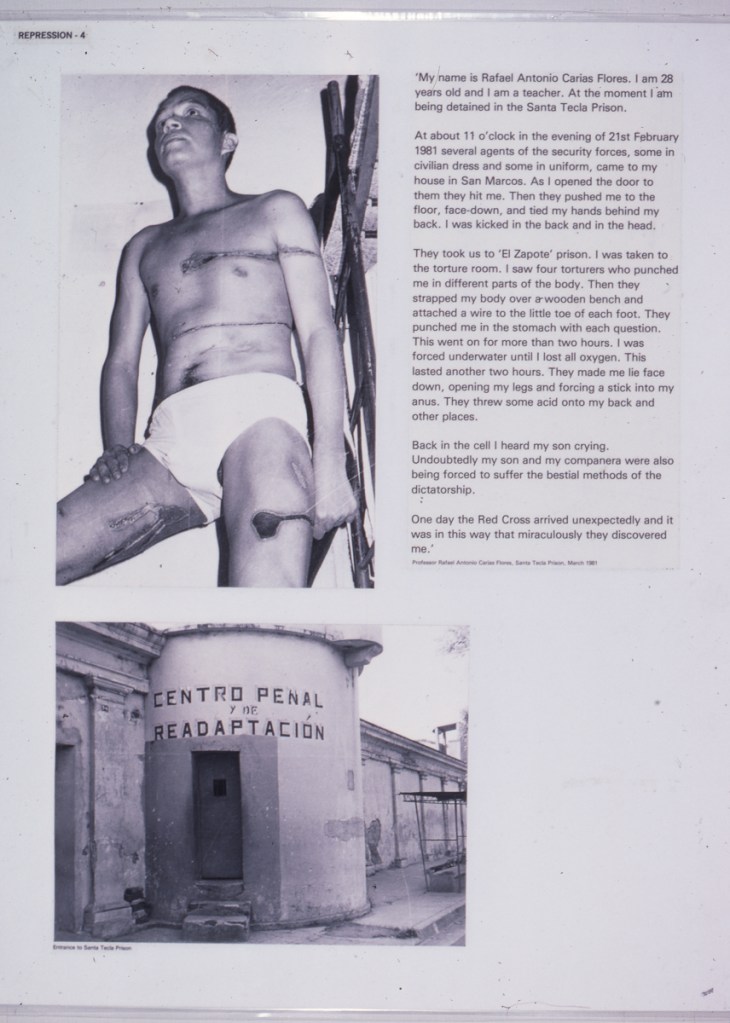
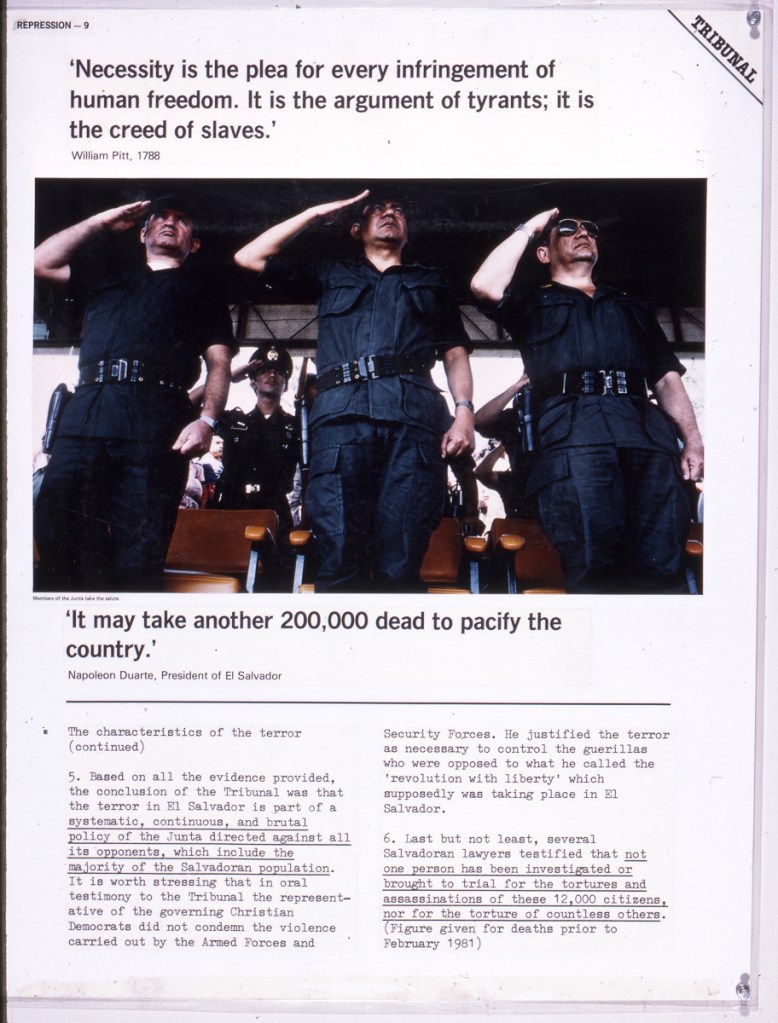
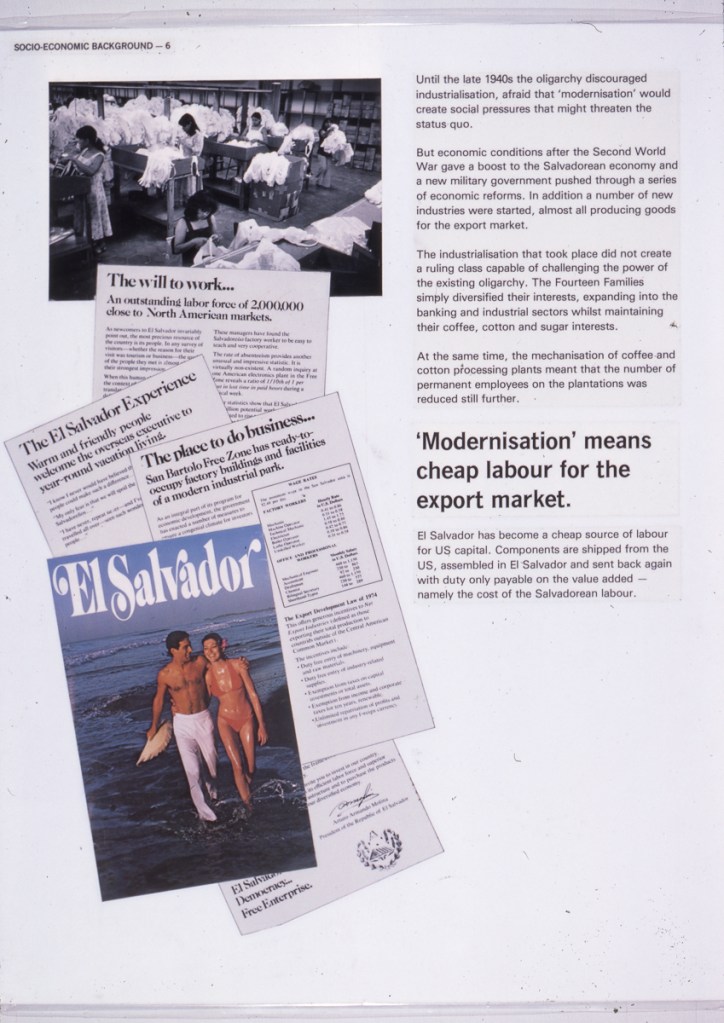
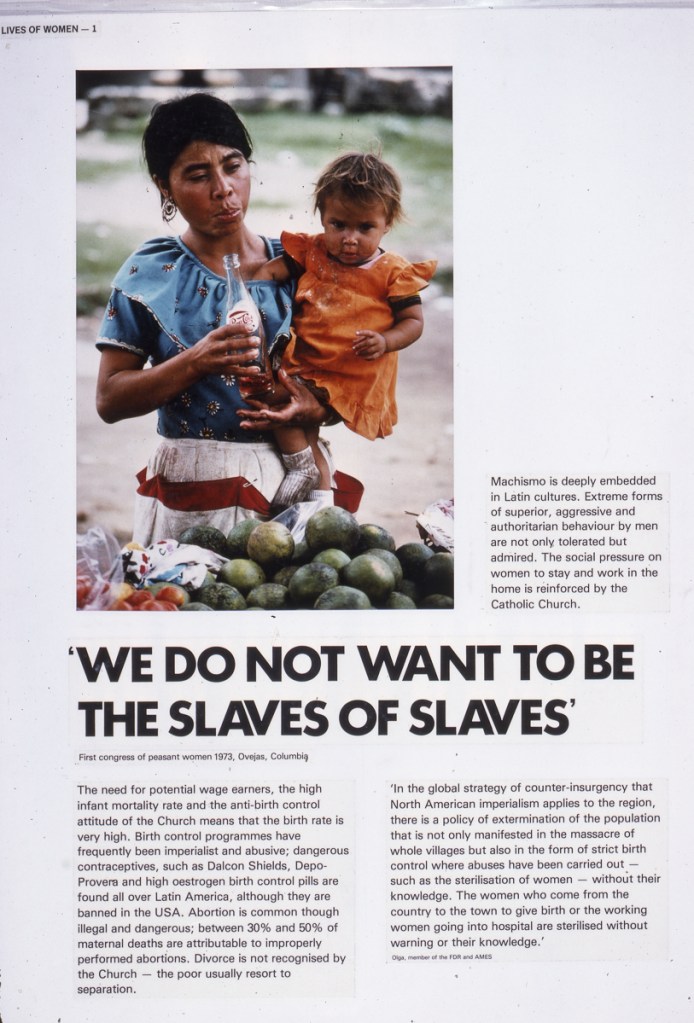
BY: SHIRLEY READ FROM CAMERAWORK IN ASSOCIATION WITH FRANCOISE BRETON AND PAUL WILLIAMS FROM THE EL SALVADOR SOLIDARITY CAMPAIGN, AND GIL SHAW FROM INFORMATION DESIGN WORKSHOP
DATE: 1981
SIZE: 66 laminated panels 28″x22″
FUNDED: By Camerawork revenue funding from the Arts Council and El Salvador Solidarity Campaign. Most of the work done for the exhibition was unpaid labour.
SYNOPSIS: “Over 100 black and white and colour photographs, mostly from British, American and French photojournalists and filmmakers accompanied by informative text. Photos and text panels were broken into a number of sub-sections dealing with the history, socio-economic background, US intervention, repression, the role of the junta, the church, women and children and the rise of the FDR and the FMLN. It was aimed at providing very basic information since at that time very little was known publically about events in Central America.
The exhibition was made to counteract the media portrayal of El Salvador as a savage and backward country, by producing an in-depth portrait of the country and its people. We wanted to let the people of El Salvador speak for themselves. We also wanted to produce a tool for human rights and solidarity workers. It was aimed at a very broad audience. We hoped that the simplicity of its design would make it very accessible and it was intended to be used in different types of venues, not just galleries.”
A CAMERAWORK EXHIBITION
Family Enlargements: The New Extended Family, Gina Glover (1986)
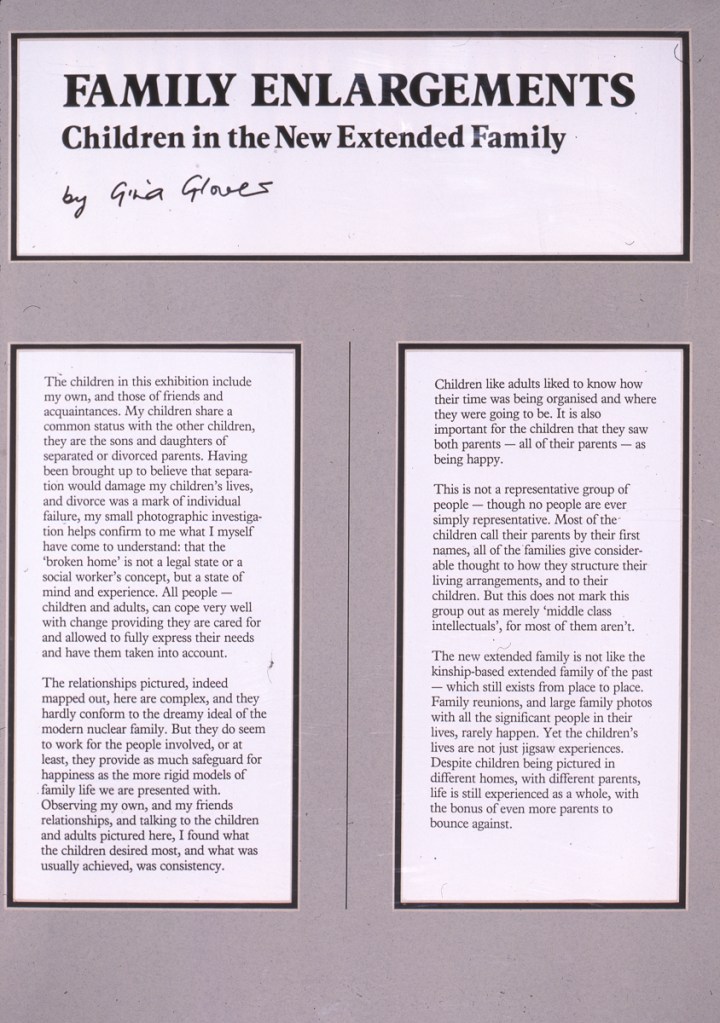
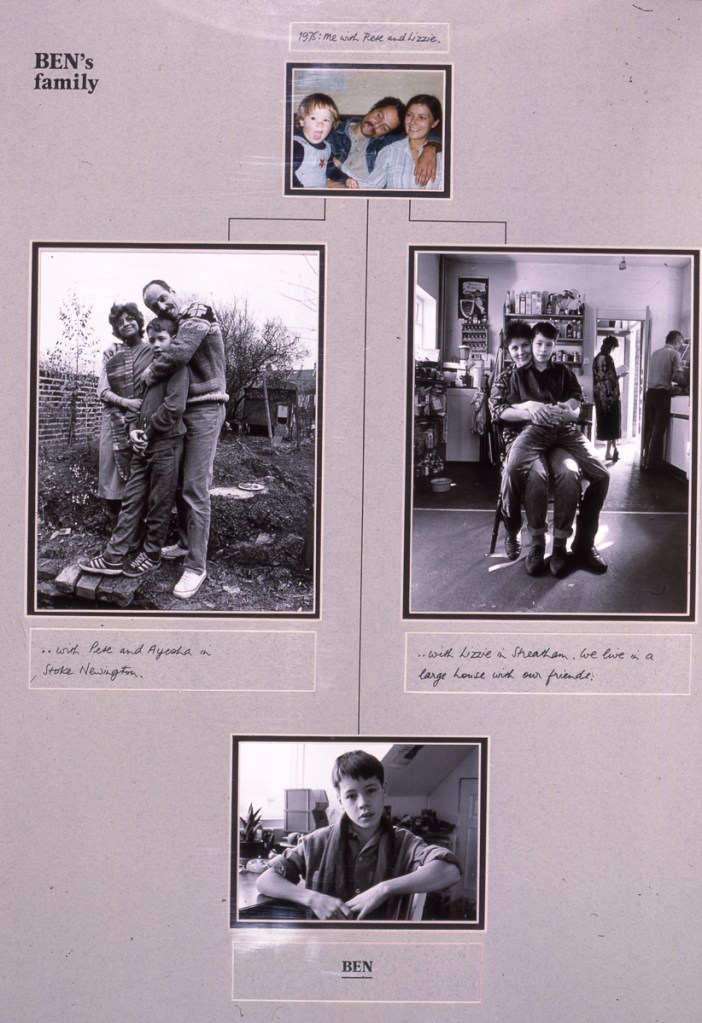
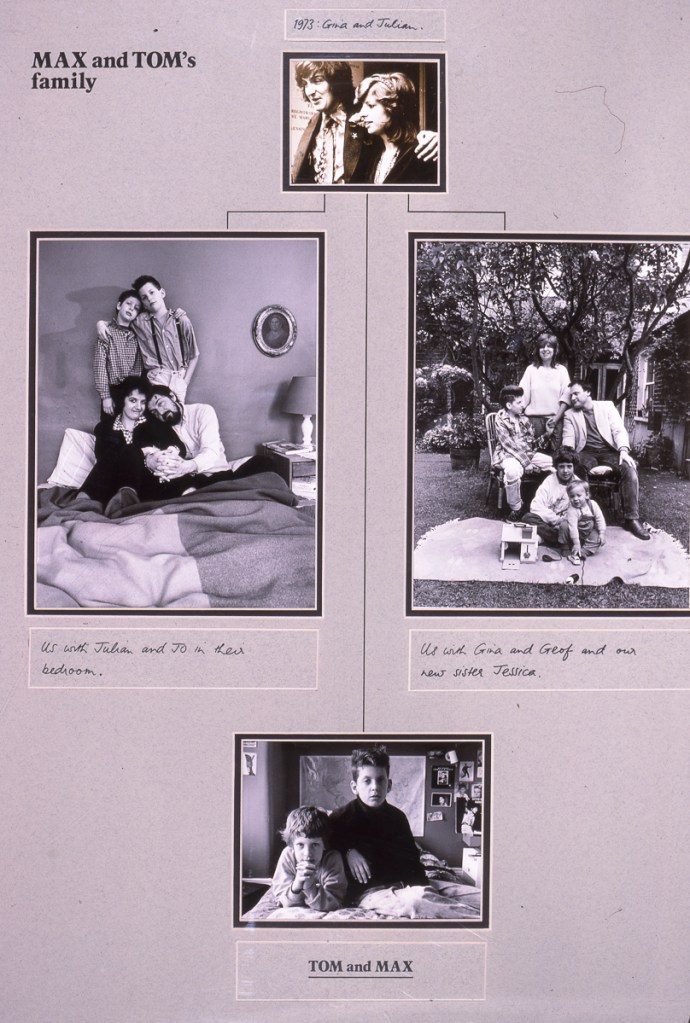
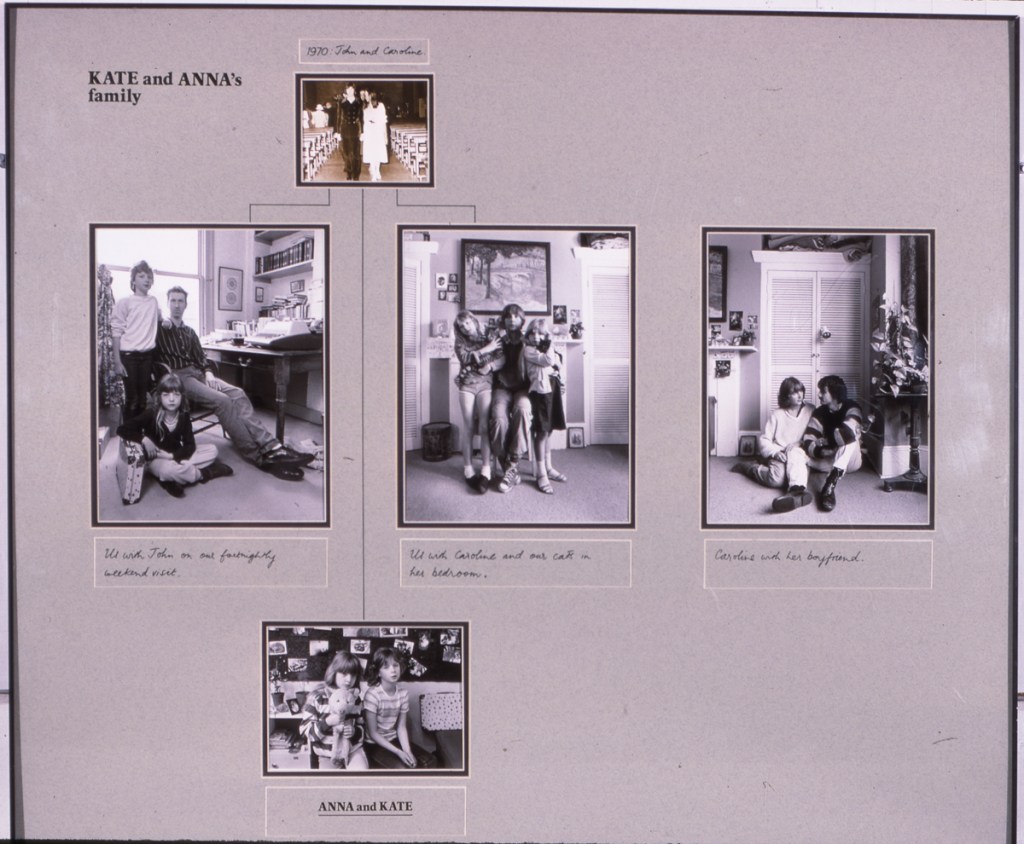
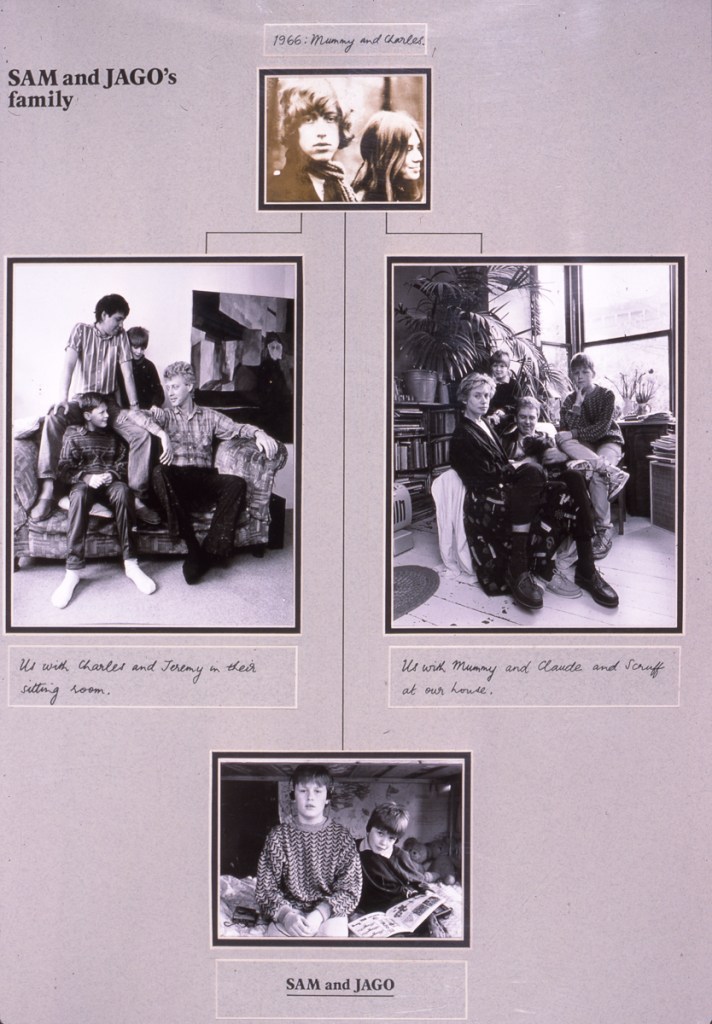
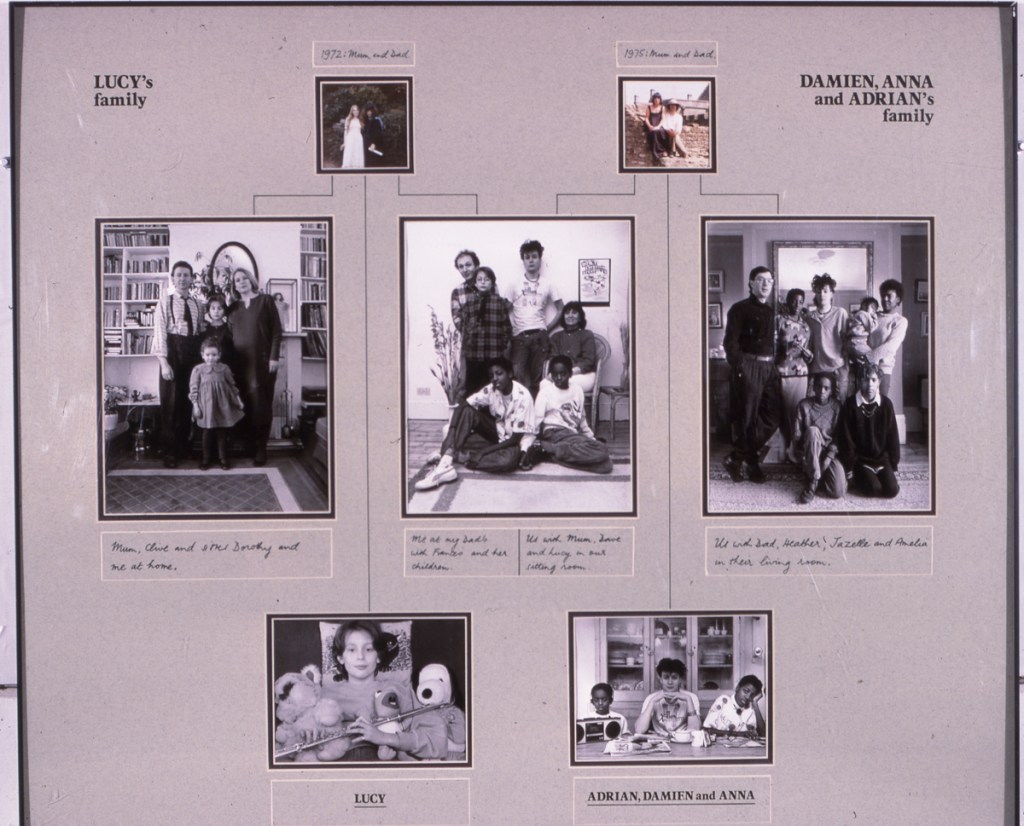
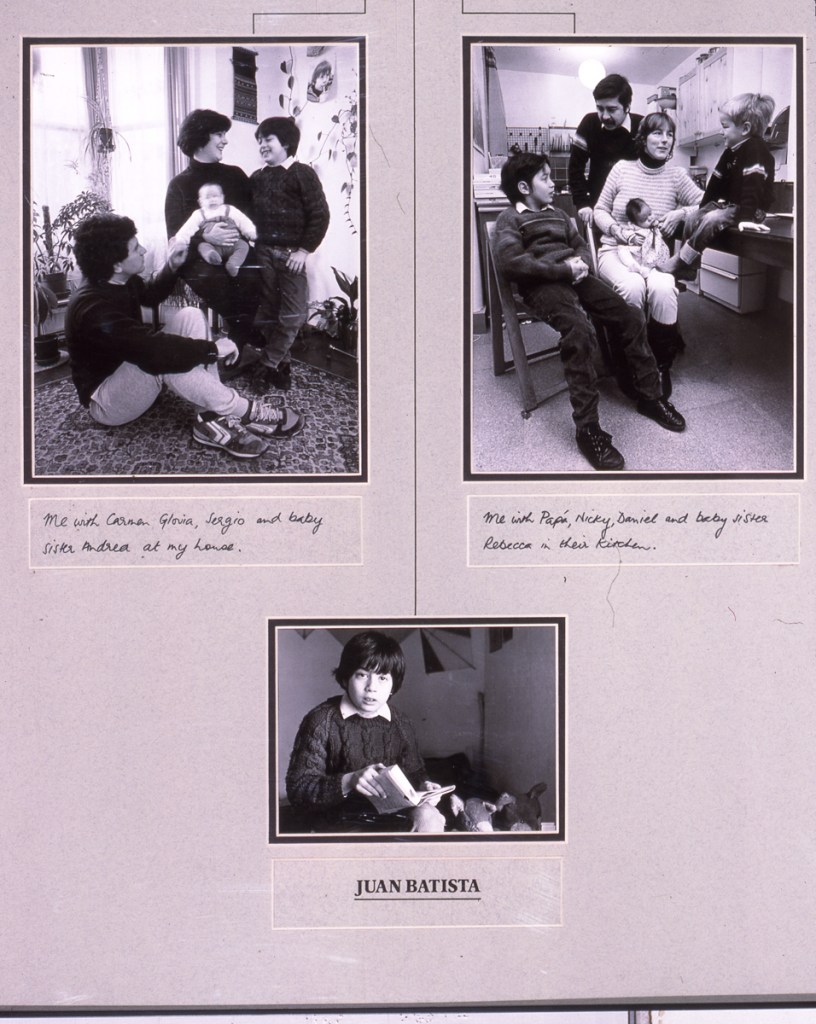
BY: GINA GLOVER
DATE: 1986
SIZE: 30″ x 34″ frames 24″ x 30″ frames
FUNDED: SELF-FINANCED FOR POLYTECHNIC CENTRAL LONDON DEGREE SHOW
SYNOPSIS: It looks at six “divorced families” with pictures in the form of family trees. It was made to present a personal view that divorced families can be a positive environment for children to grow in. Two copies were made, one in frames for galleries and one laminated copy for community centres and schools etc. It may be incorporated into a broader-based book or pack of educational materials.
WAS AVAILABLE: From GINA GLOVER, PHOTO CO-OP, 61 WEBBS ROAD, LONDON SWll 6RX
Family, Fantasy And Photography – Polysnappers, Cockpit (1981)
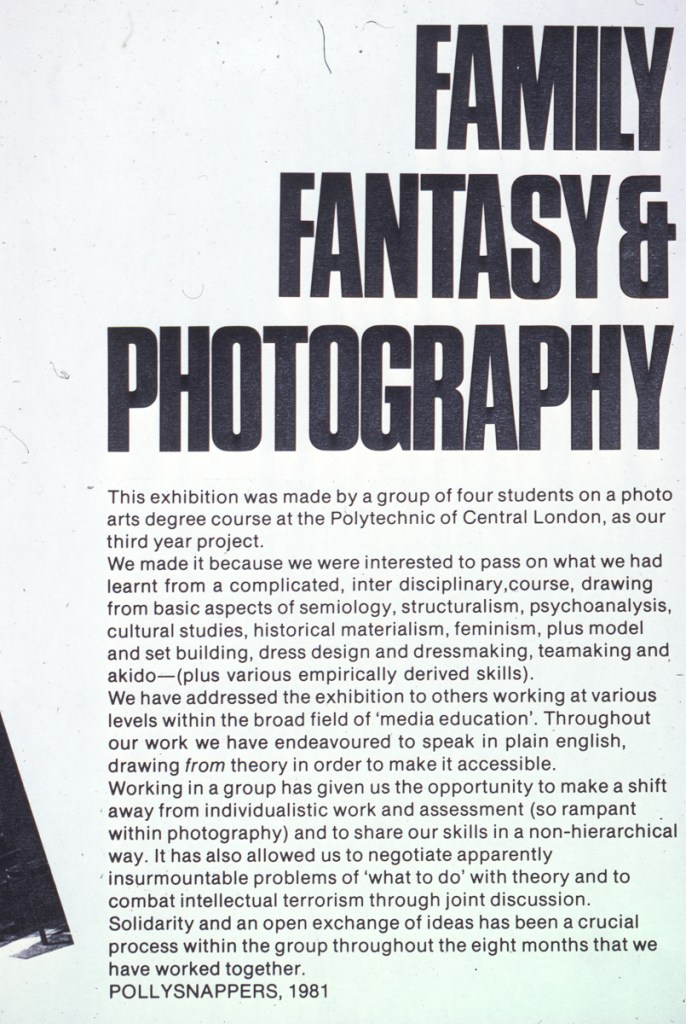
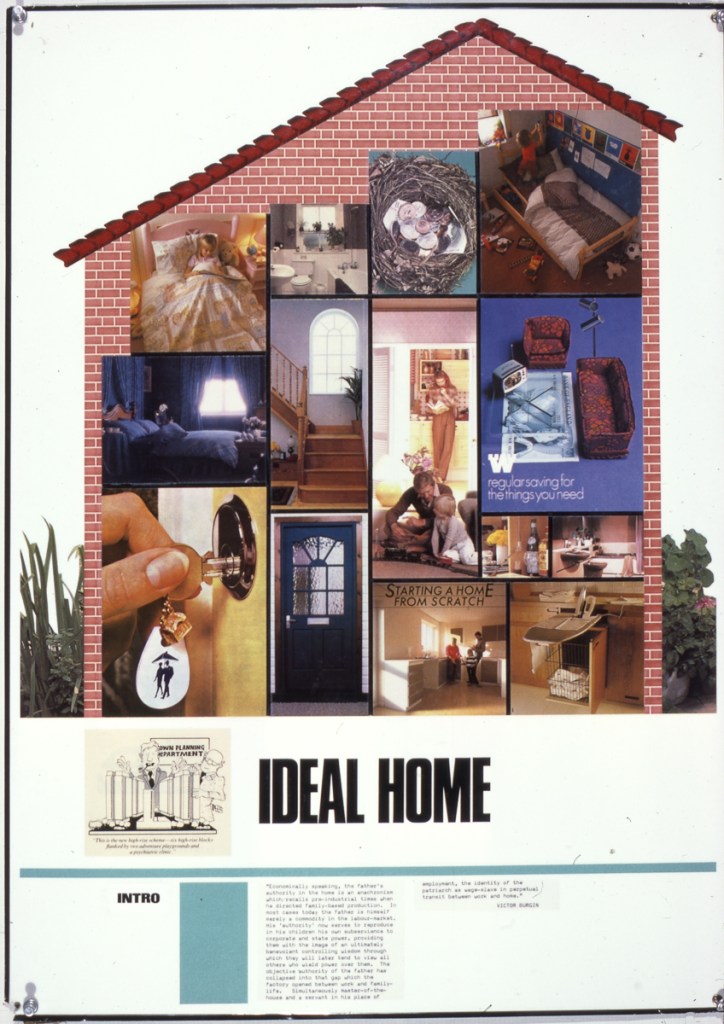
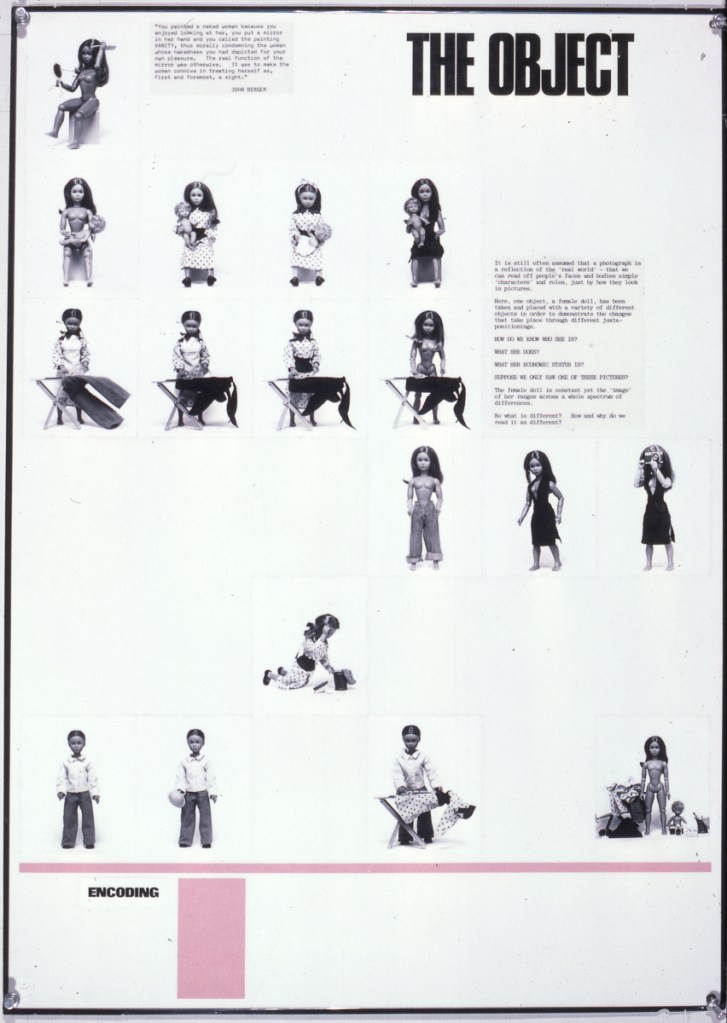
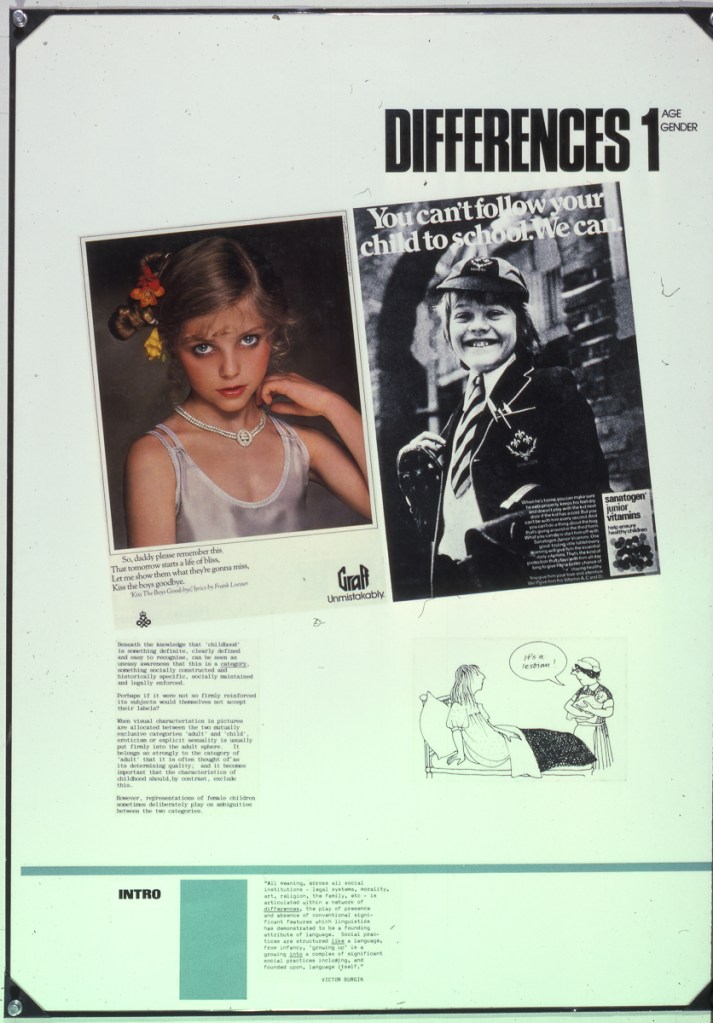
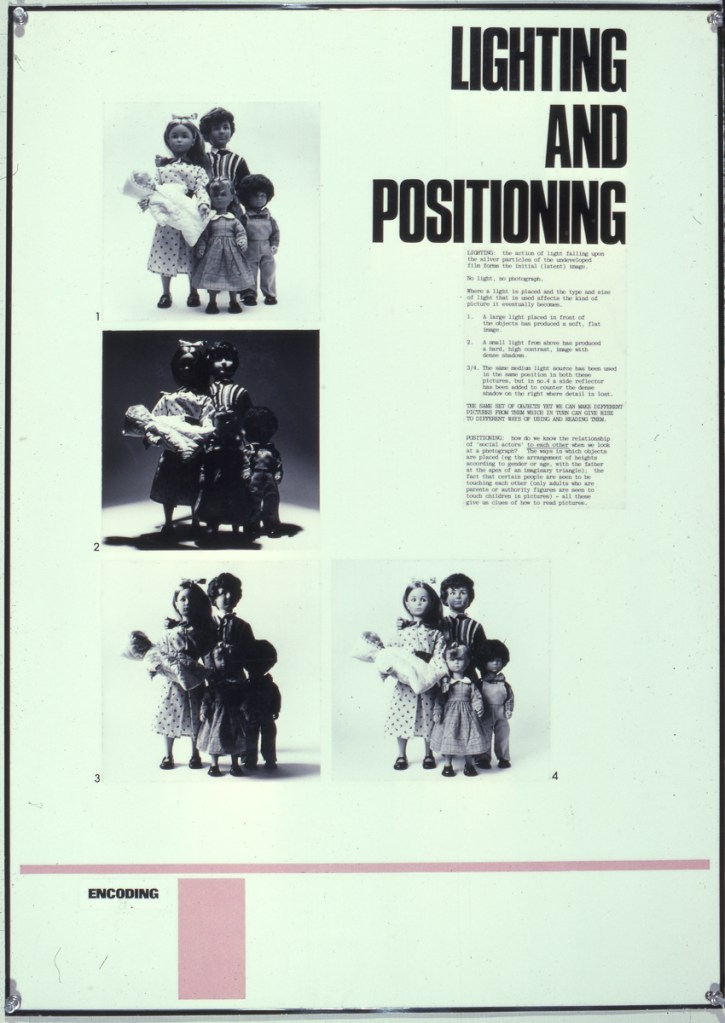
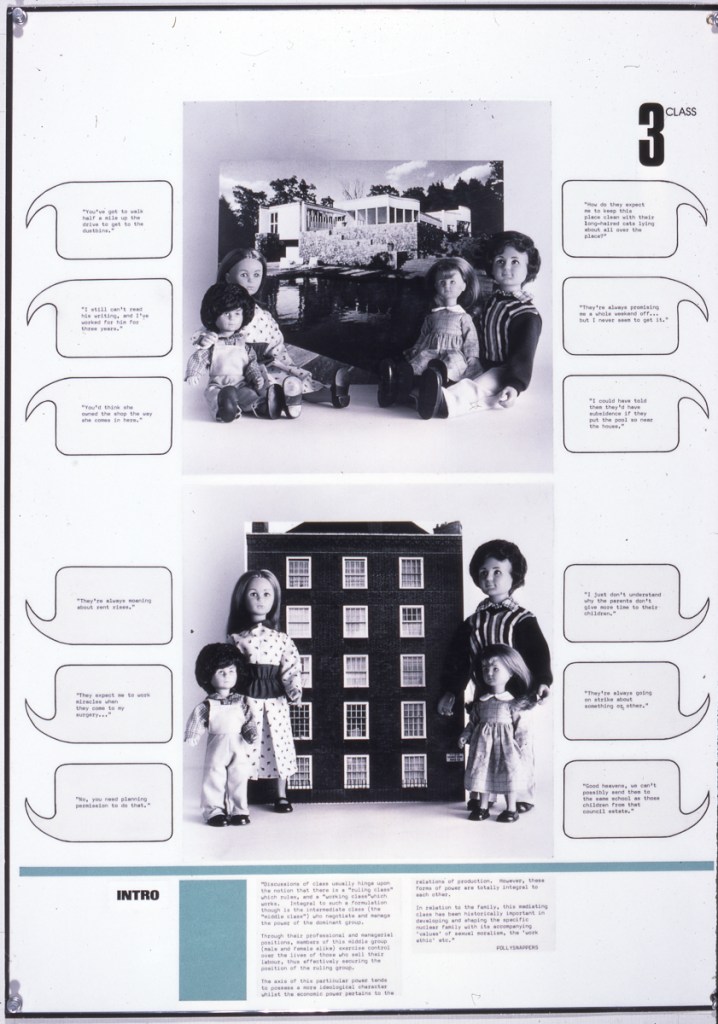
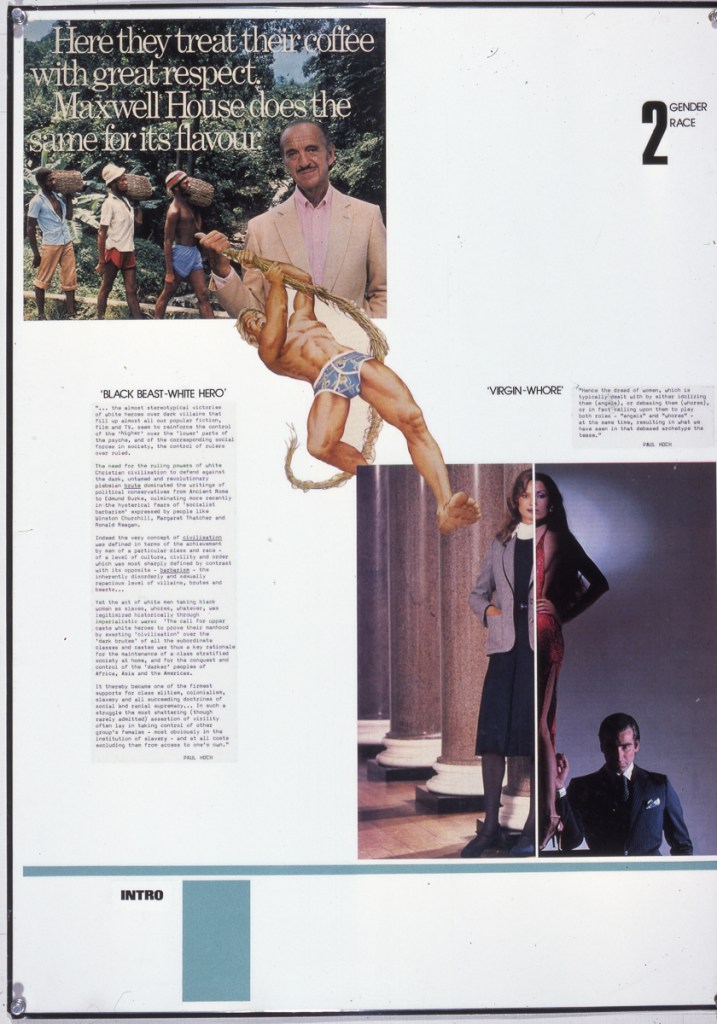
BY: POLYSNAPPERS – A GROUP OF FOUR STUDENTS
DATE: 1981 ON A PHOTO ARTS DEGREE COURSE AT THE POLYTECHNIC OF CENTRAL LONDON AS THEIR THIRD-YEAR PROJECT
SIZE: 64 laminated panels 19″ x 26″
SYNOPSIS: We made it because we were interested in passing on what we had learnt from a complicated, inter-disciplinary course, drawing from basic aspects of semiology, structuralism, psychoanalysis, cultural studies, historical materialism, feminism, plus model and set building, dress design and dressmaking, teamaking and aikido – (plus various empirically derived skills).
We have addressed the exhibition to others working at various levels within the broad field of ‘media education‘. Throughout our work we have endeavoured to speak in plain English, drawing from theory in order to make it accessible.
Working in a group has given us the opportunity to make a shift away from individualistic work and assessment (so rampant within photography) and to share our skills in a non-hierarchical way. It has also allowed us to negotiate apparently insurmountable problems of ‘what to do’ with theory and to combat intellectual terrorism through joint discussion. Solidarity and an open exchange of ideas have been a crucial process within the group throughout the eight months that we have worked together.
WAS AVAILABLE FOR HIRE FROM THE COCKPIT GALLERY
General Strike, Half Moon, Terry Dennett (1976)
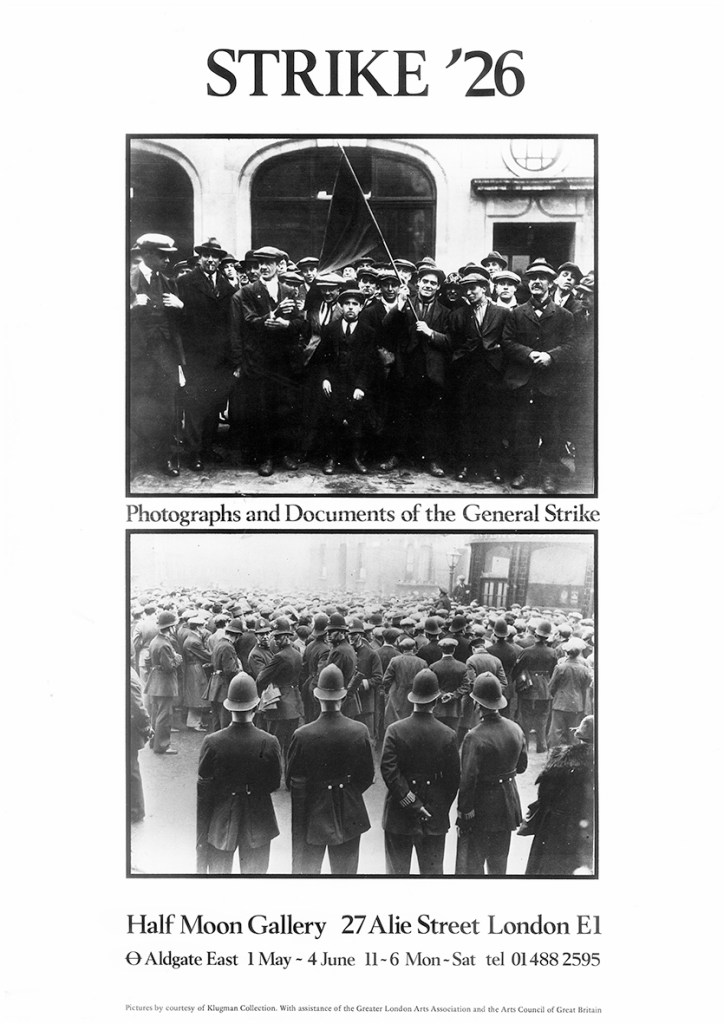
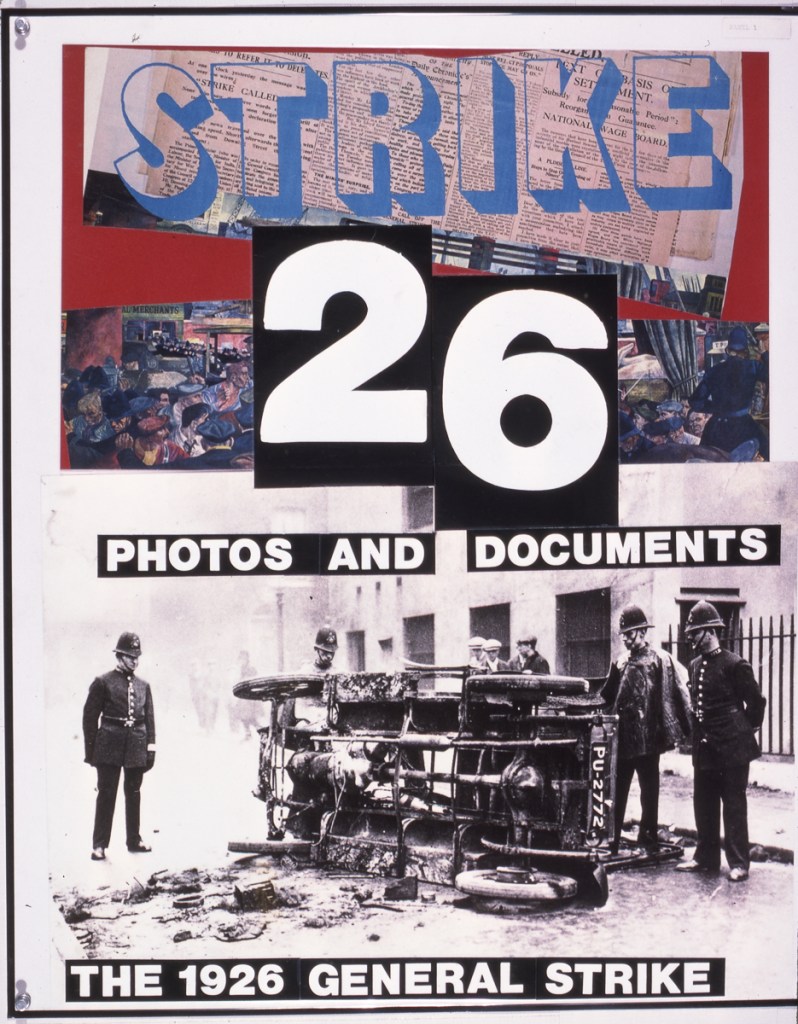
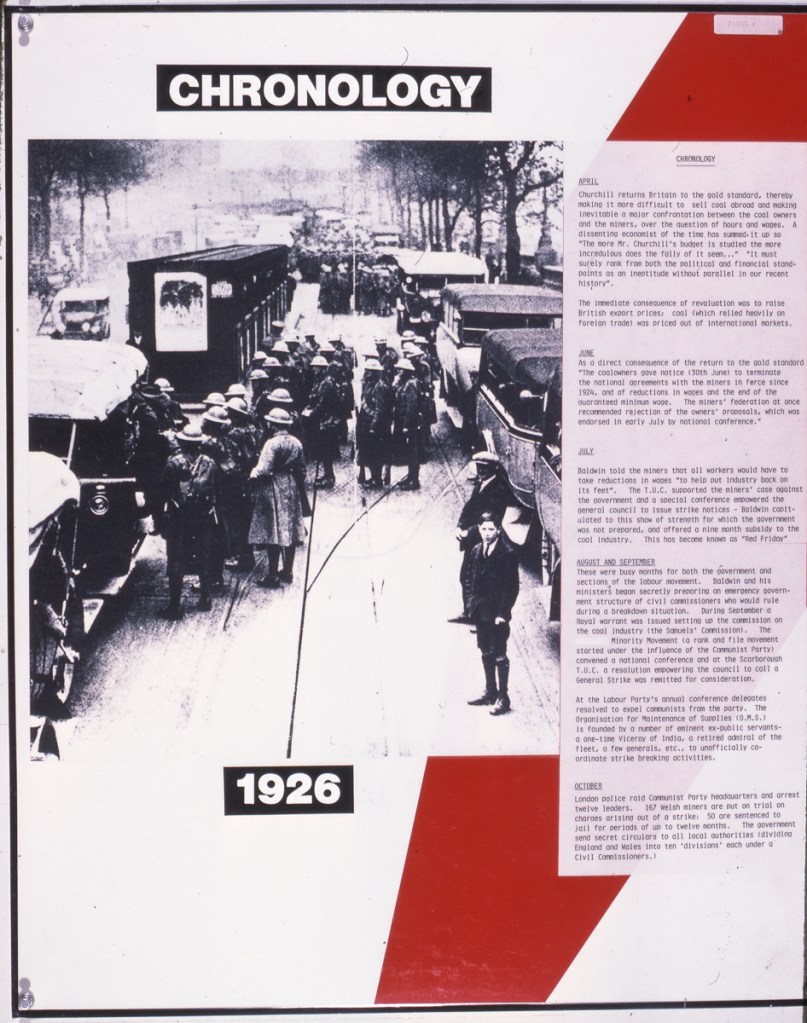
BY: TERRY DENNETT – HALF MOON PHOTOGRAPHY WORKSHOP LABOUR HISTORY GROUP.
DATE: 1976
SIZE: 16 panels
FUNDED: Self-funded
SYNOPSIS: “The General Strike 1926: How it affected London’s East End. A pictorial perspective (in conjunction with the Half Moon Theatre production ‘Strike ’26). Material from original newspapers, archives at Marx House, local historians and private collections and the Whiffen collection.
It was Half Moon’s first exhibition that was influenced by the design of German Graphics from the 1920’s.
WAS AVAILABLE FROM THE PHOTOGRAPHY WORKSHOP, 152 UPPER STREET, N1
Homeworking: Time For Change, London Wide Homeworking Group & Cockpit Gallery (1985)
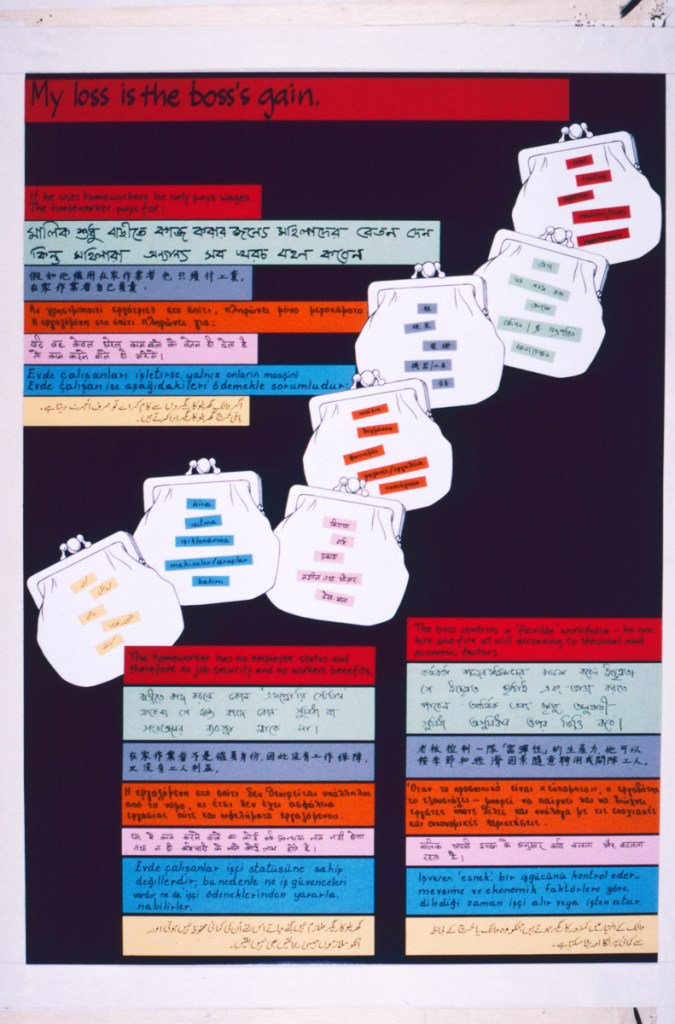
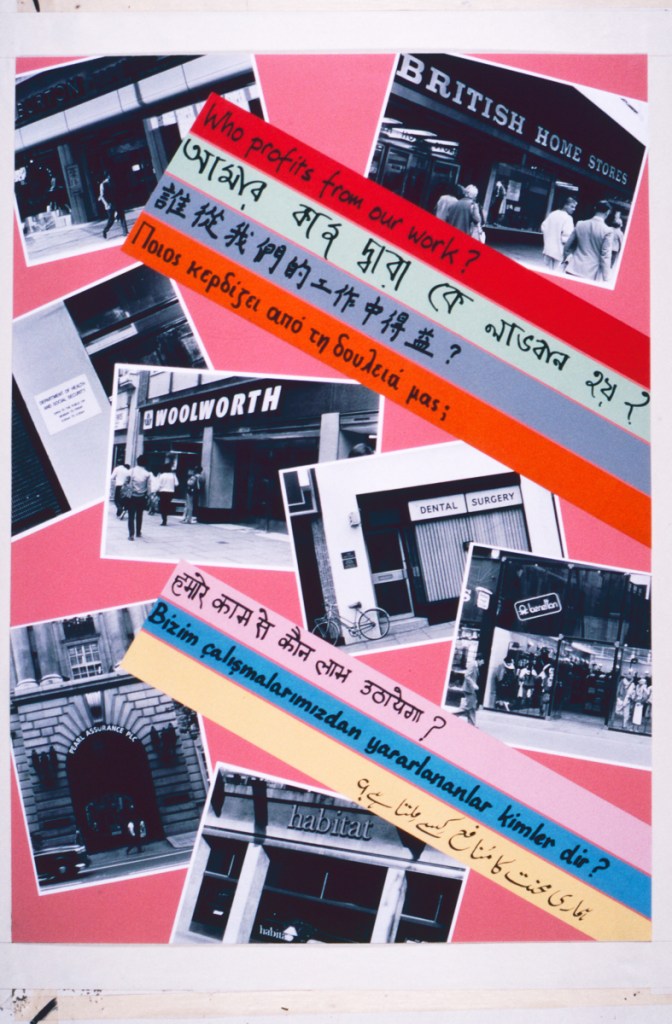
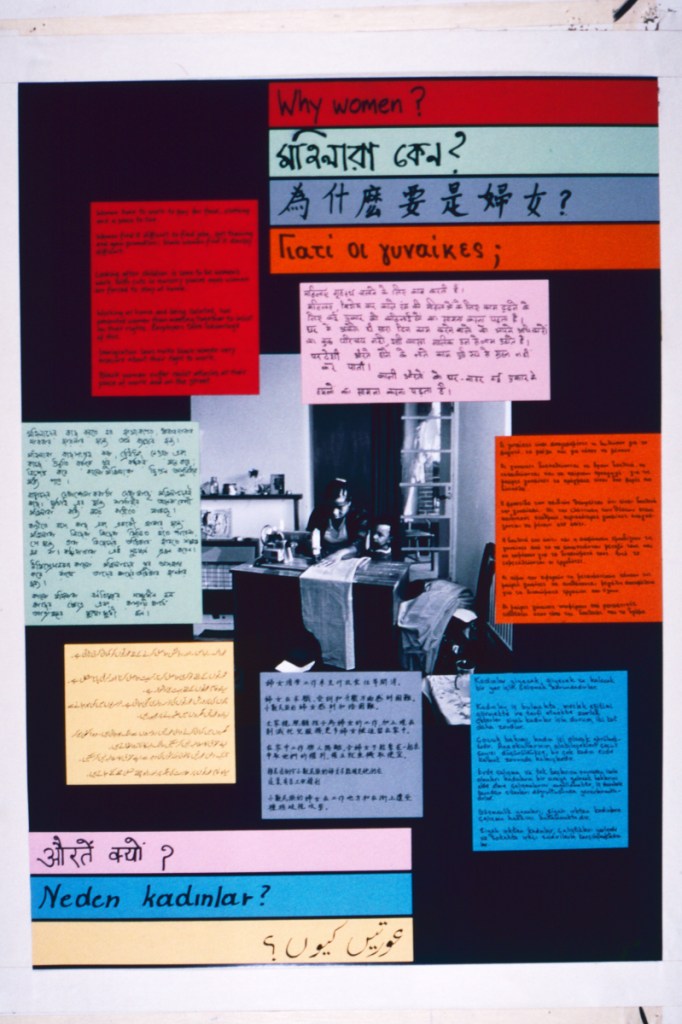
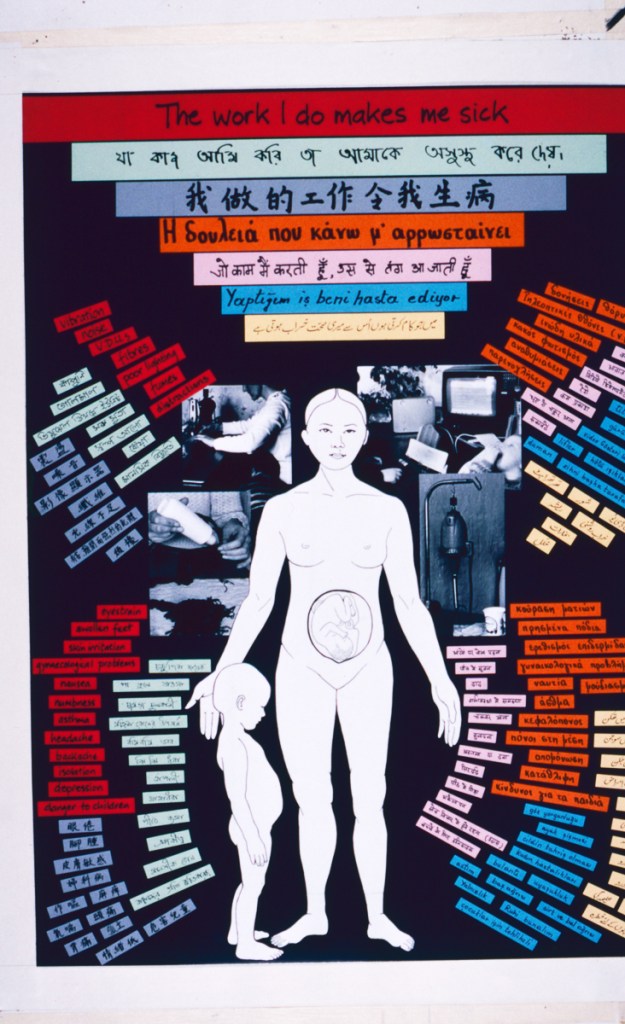
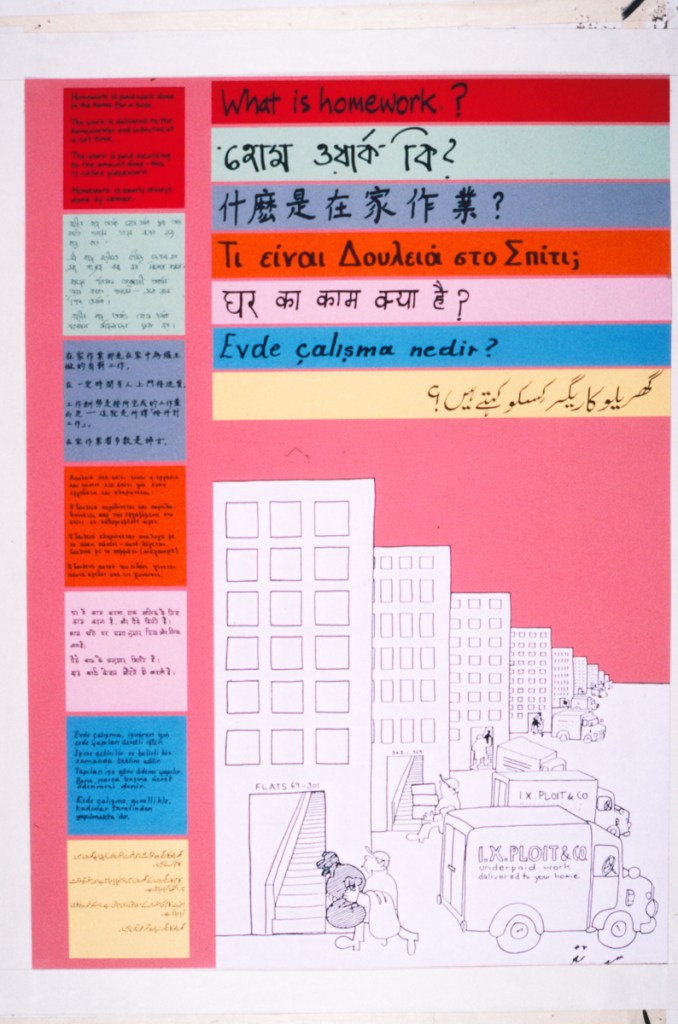
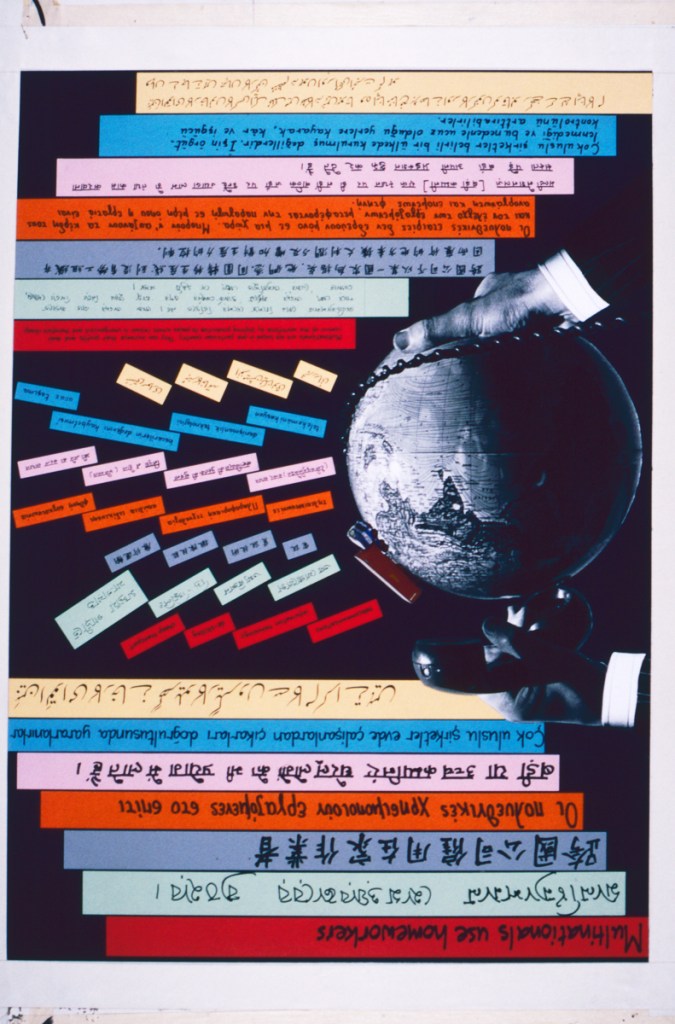
BY: LONDON WIDE HOMEWORKING GROUP AND COCKPIT GALLERY
DATE: 1985
SIZE: 17 laminated panels 20″x30″
FUNDED: Cockpit Gallery
SYNOPSIS: This exhibition looks at homeworking not as an outdated nineteenth-century phenomenon, but as an integral and increasing part of modern capitalist production. Using very simple text with photographs, cartoons, diagrams and newspaper cuttings, it explains who homeworkers are, and what they do and make.
The exhibition was designed to fulfil two functions;
a) It was to be used as a campaigning tool by homeworkers’ groups to reach both the general public and homeworkers themselves – many of whom speak English as a second language,
b) it was to be used as an educational resource for schools and colleges and was to be backed up by supplementary notes to develop the ideals and information it contained, which was necessarily limited by the repetition of text in seven languages.
Two copies were produced – one was toured initially for six months by the L.W.H.G.
WAS AVAILABLE FOR HIRE FROM THE COCKPIT GALLERY
London’s Health – Photo Co-Op (1984)
BY: FOUR MEMBERS OF PHOTO CO-OP
DATE: 1984
SIZE: AO and A1 heat-sealed panels on aluminium stands.
FUNDED: Commissioned by London Health Emergency.
SYNOPSIS: The exhibition uses photographs, text and graphics to document the rundown of the health service in London and to suggest alternatives. It was made to increase public awareness of cuts in health care. 4 copies were made and distributed by the GLC around London at various centres including South Bank events, ‘Jobs for a Change’ in Battersea Park and others. Seen by a large number of people, it didn’t prevent the rundown of the health service, but now a lack of anyone to distribute and mount it means that it goes unused. It is heavy and needs a van to transport it.
WAS AVAILABLE FROM PHOTO CO-OP, 61, WEBBS ROAD, LONDON SW11 6RX
No Access – Aylesbury Day Centre Photography, Camerawork (1981)
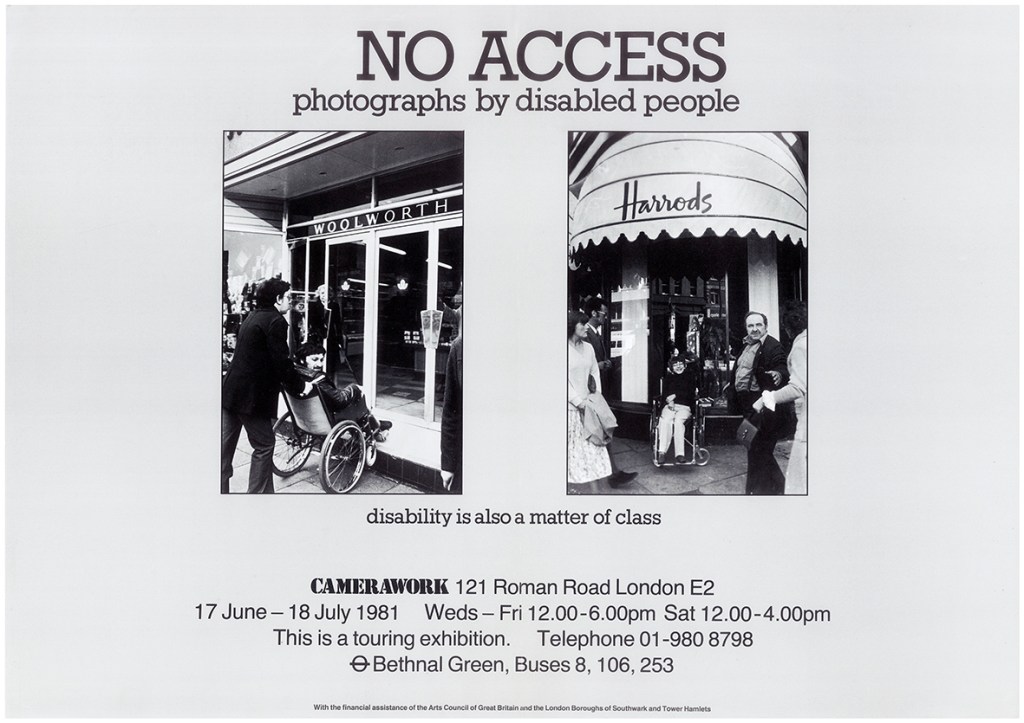
BY: MEMBERS OF THE AYLESBURY DAY CENTRE PHOTOGRAPHY PROJECT AND CHILDREN FROM AYLESBURY YOUTH WORSHOPS AYLESBURY ESTATE. CO-ORDINATED BY TISHA ZIFF WHO WAS EMPLOYED AS A HANDICRAFT TEACHER.
DATE: 1981
SIZE: laminated panels 16″x12″
FUNDED: Southwark Council for original project 1977, made into an exhibition for CAMERAWORK 1981. Funded by Arts Council.
SYNOPSIS: “We produced this exhibit in the late seventies at the time of cuts in public expenditure which directly affected the lives of the people who worked at the Aylesbury Day Centre. Their experience of disability was not only physical but related to their position in society. This exhibition came with discussions inside the group about class, disability and race”
It was originally produced as small prints with simple typed texts. Five years later it was used by CAMERAWORK as part of an exhibition called NO ACCESS. The section here deals with a ‘broader’ analysis of disability, part of the exhibition related to the immediate community of Southwark and illustrated the problems of daily life, shopping, making phone calls and simply getting about.”
“My overwhelming memory of the production of this exhibition was just how long it took to do and how painstaking it was to take the photos, print and type captions as well as the pleasure of sharing skills and completing something together.”
* Trisha was employed by Southwark Council for two years as a handicraft teacher with the elderly and disabled. While in the post she developed darkroom facilities in Southwark day centres working with elderly people, the disabled and children.
A CAMERAWORK EXHIBITION
Our Kids – Peckham Bookplace (1984)
BY: PECKHAM BOOKPLACE
DATE: 1984
SIZE: Print run of 5000 books
FUNDED: Southwark Race Equality Unit
SYNOPSIS: As well as having a publishing project, The Bookplace has a community education project, which has a creche. The woman who used the classes and the children in the creche were all black and wanted a book that would be suitable for under five. There were none available on the market at the time which portrayed black children in ordinary situations. The group decided it wanted pictures and no text and that all the children should be of West Indian origin. Blackfriars was approached to do the photography and given a list of everyday situations that the group felt they could talk to their children about. These were set up on a weekly basis and at weekly meetings the slides would be shown and selections made. The process took about 9 months. The group had originally wanted a board book, but they didn’t have enough money for thick card. They were however very happy with the way it turned out.
WAS AVAILABLE FROM PECKHAM BOOKPLACE
Our Way Of Rockin’ – Dave Hampshire, Cockpit (1984)
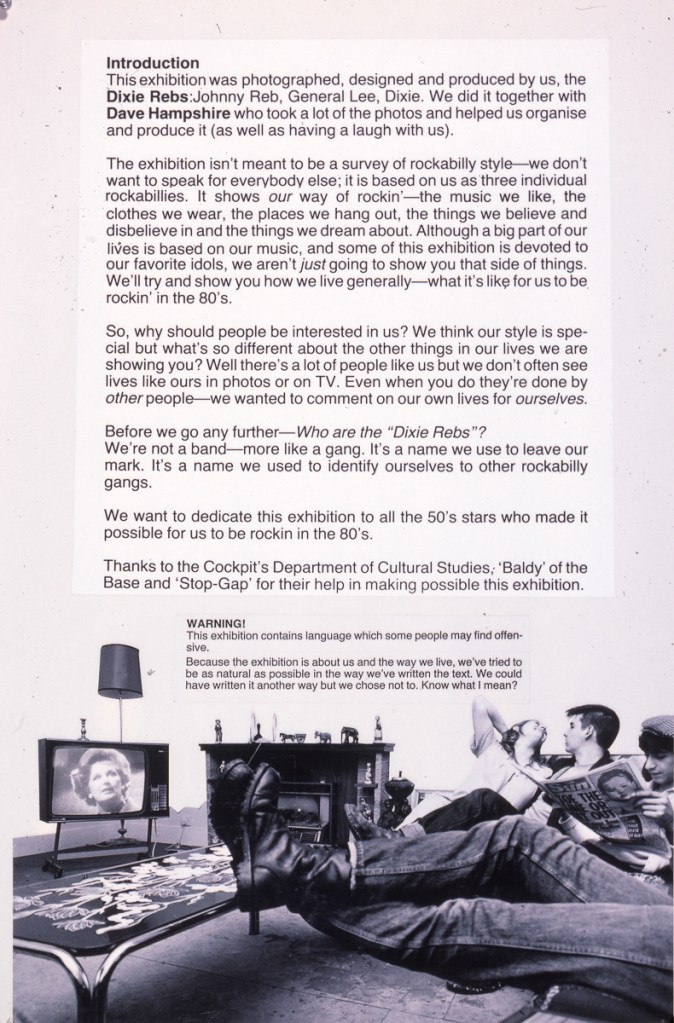
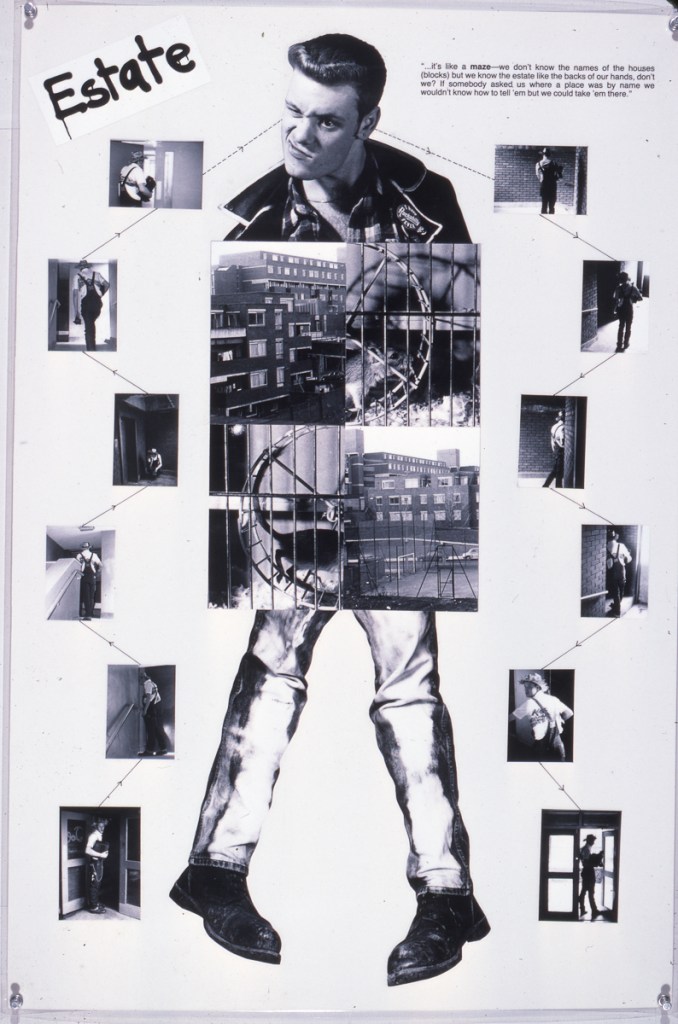
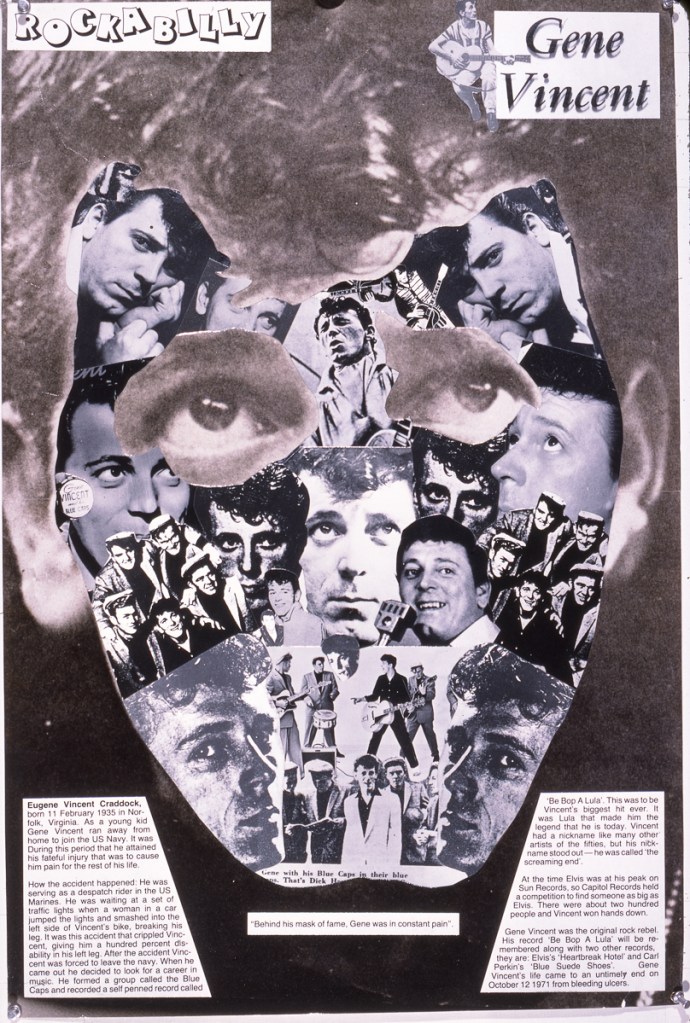
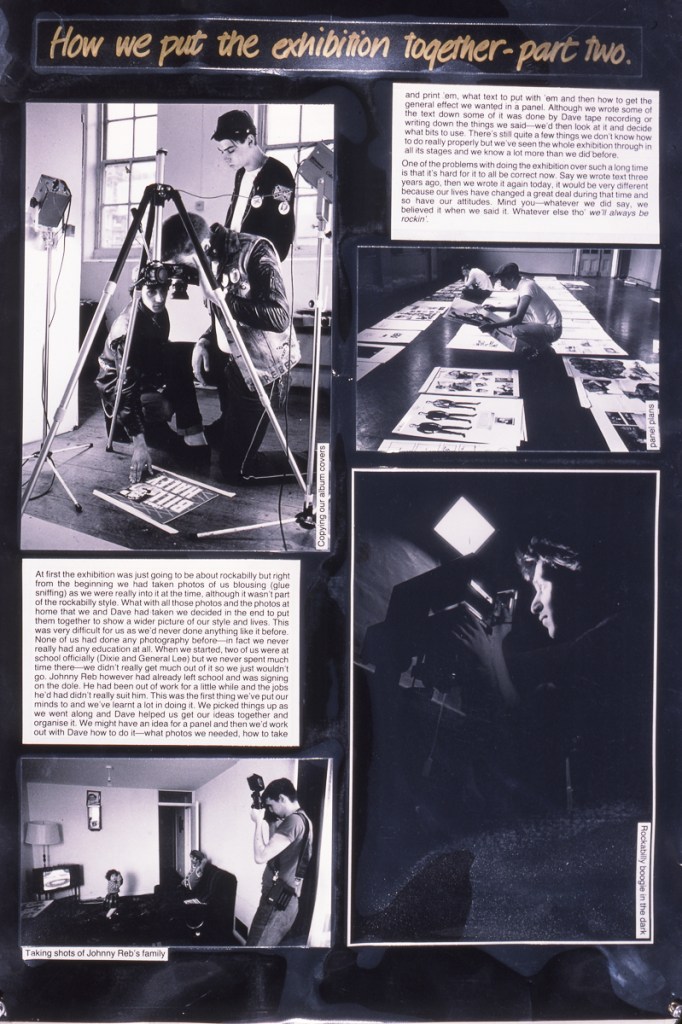
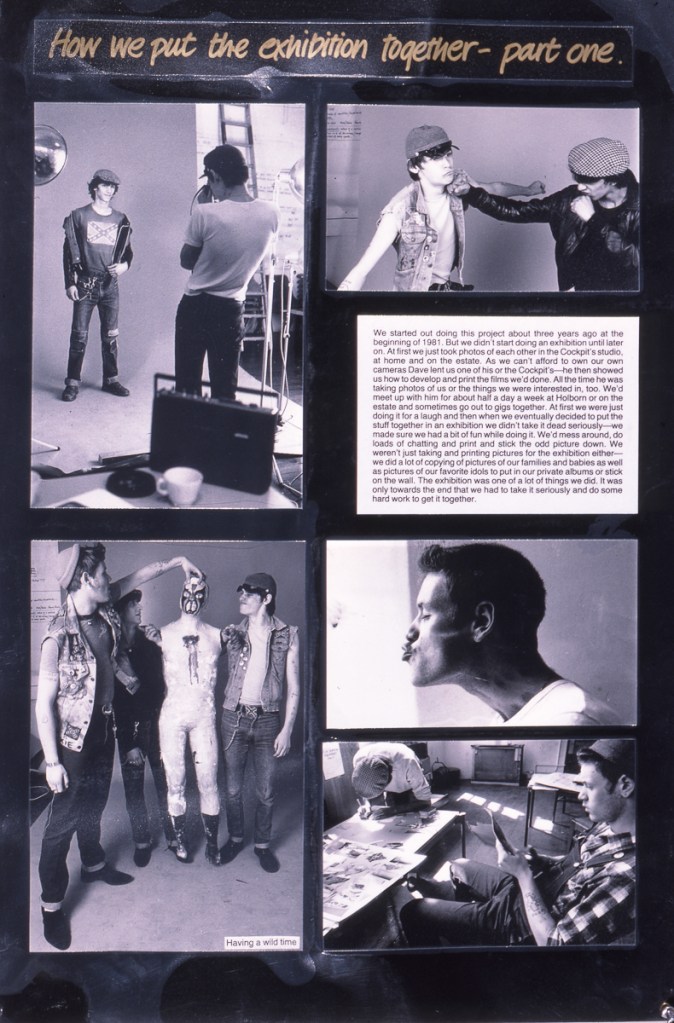
BY: DAVE HAMPSHIRE with TONY SINGH, EDMUND WORRALL and STEVE YEOMAN
DATE: 1984
SIZE: 59 panels 20″ X 30″
FUNDED: Dave Hampshire was paid by Greater London Arts and the project was funded through the Cockpit Gallery and the Cultural Studies Department.
SYNOPSIS: This exhibition is the product of a 31year collaboration between a group of Rockabillies and the photographer Dave Hampshire then photographer in residence in the Cultural Studies Dept. of the Cockpit Arts Workshop. ” This exhibition isn’t meant to be a survey of rockabilly style – we don’t want to speak for everybody else; it is based on us as three individual rockabillies. It shows our way of rockin’ – the music we like, the clothes we wear, the places we hang out, the things we believe and disbelieve in and the things we dream about. Although a big part of our lives is based on our music, and some of this exhibition is devoted to our favourite idols, we aren’t just going to show you that side of things. We’ll try and show you how we live generally – what it’s like for us to be rockin’ in the 80’s.
So why should people be interested in us? We think our style is special but what’s so different about the other things in our lives we are showing you? Well there’s a lot of people like us but we don’t often see lives like ours in photos or on TV. Even when you do they’re done by other people – we wanted to comment on our own lives for ourselves”
It was first shown at the Cockpit Gallery in April 1984 and has been toured nationally since.
WAS AVAILABLE FOR HIRE FROM THE COCKPIT GALLERY
Policing London – David Hoffman, GLC Police Committee Support Unit. (1984)
BY: DAVID HOFFMAN, DESIGNED BY ANDY DARK WITH HELP FROM THE GLC POLICE COMMITTEE SUPPORT UNIT.
DATE: 1984
SIZE: 16 heat-sealed free-standing panels, 40″x28″ on folding aluminium stands. 3 sets were produced.
FUNDED: GREATER LONDON COUNCIL POLICE COMMITTEE
SYNOPSIS: Photographs, texts and other material from freelance photographers, libraries, community groups and the metropolitan police, discussing particular aspects of policing in the context of the needs of London’s population. Produced to educate, enlighten and expose and to promote discussion on policing needs, strengths and weaknesses. It was shown at the GLC County Hall, Libraries, Schools, Colleges, open-air venues sponsored by the GLC, Trade Union meetings and Festivals.
WAS AVAILABLE FREE FROM THE STRATEGIC POLICY UNIT, ROOM 805, 20 VAUXHALL BRIDGE ROAD, LONDON SW 1.
Problem In The City – Ron Mccormick, Larry Herman, Nick Hedges, Royal Town Planning Institute (1975)

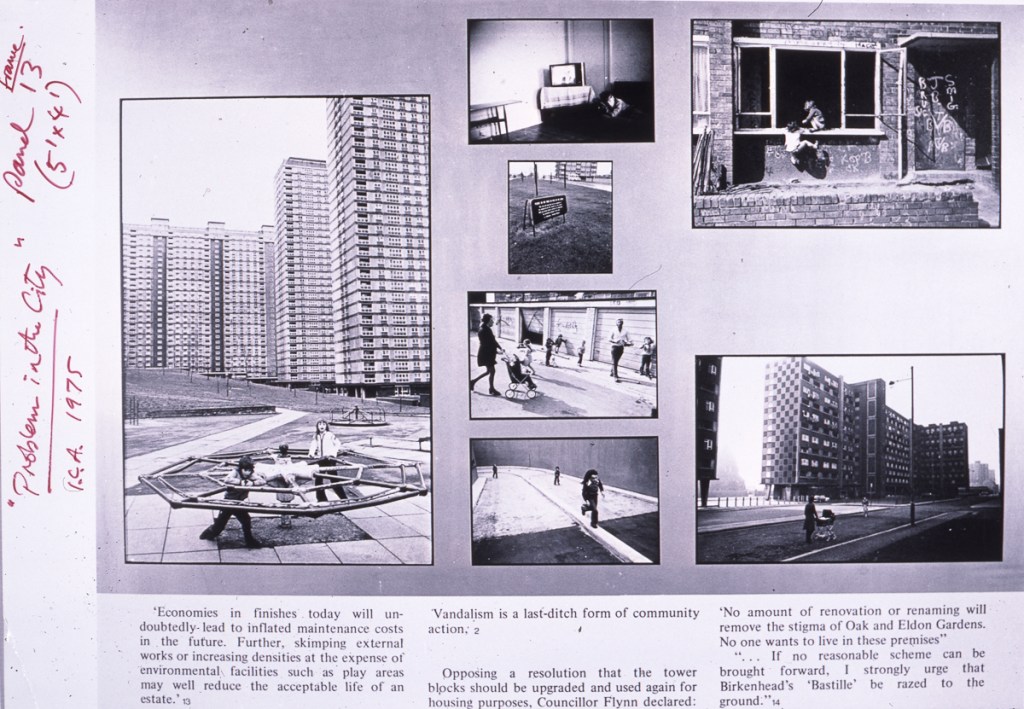
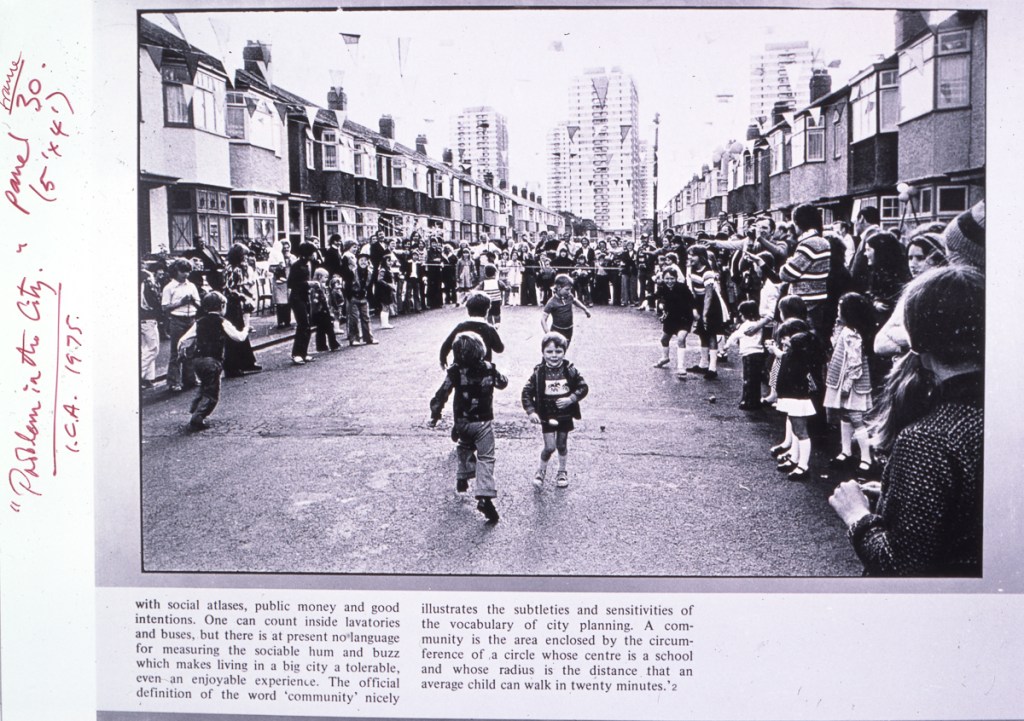
BY: Ron Mccormick, Larry Herman, Nick Hedges
DATE: 1975 – shown in 1975 at ICA and subsequently toured to non-gallery spaces – town halls and civic centres.
SIZE: 33 Panels each 5′ x 4′ on aluminium panels
FUNDED: Commissioned by ROYAL TOWN PLANNING INSTITUTE (with support from ARTS COUNCIL & LETCHWORTH GARDEN CITY CORPORATION) for 1975 Annual Conference.
SYNOPSIS: Combines photographs taken in many cities and locations with quotes from books, newspapers, Government reports and interviews.
Aimed at architects and town planners and the general public.
“The pressures of modern city life are documented along with the planner’s efforts to order and improve our situation. The mistakes are recorded and the motive behind much of modern development is questioned. The role of the Town Planner is seriously examined. It concludes the need for greater consultation and participation by the community in the planning process”
It caused some anger when shown at the Town Planners Conference because it was critical.
Promises, Promises, Growing Up In The Fifties And Sixties – Henry And Rose Grant, Cockpit, (1984)
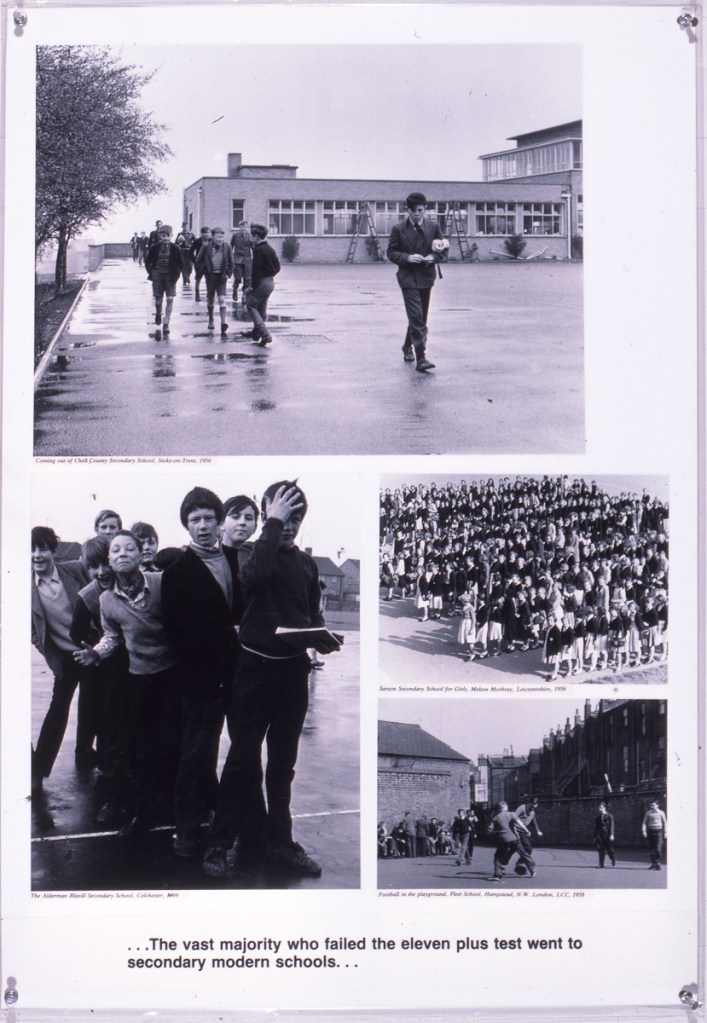
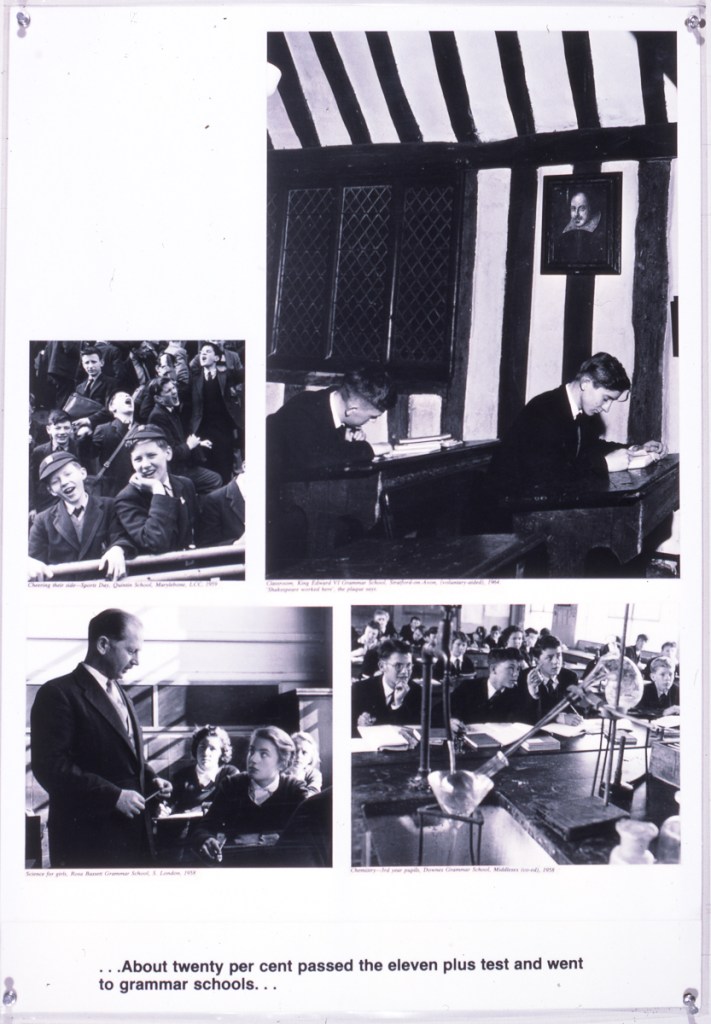
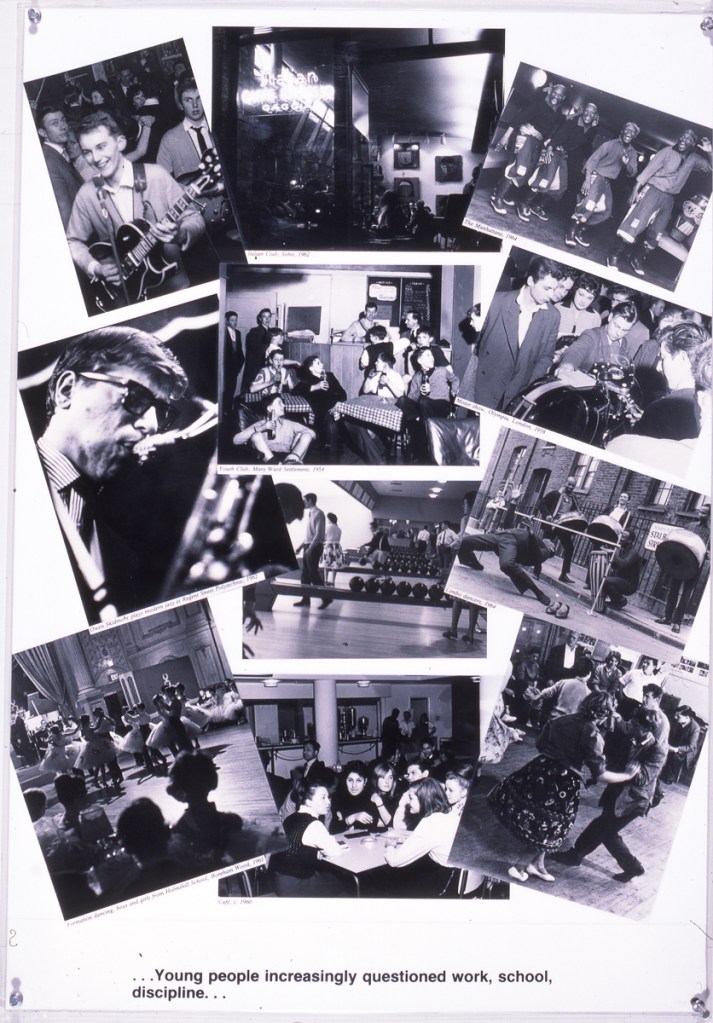
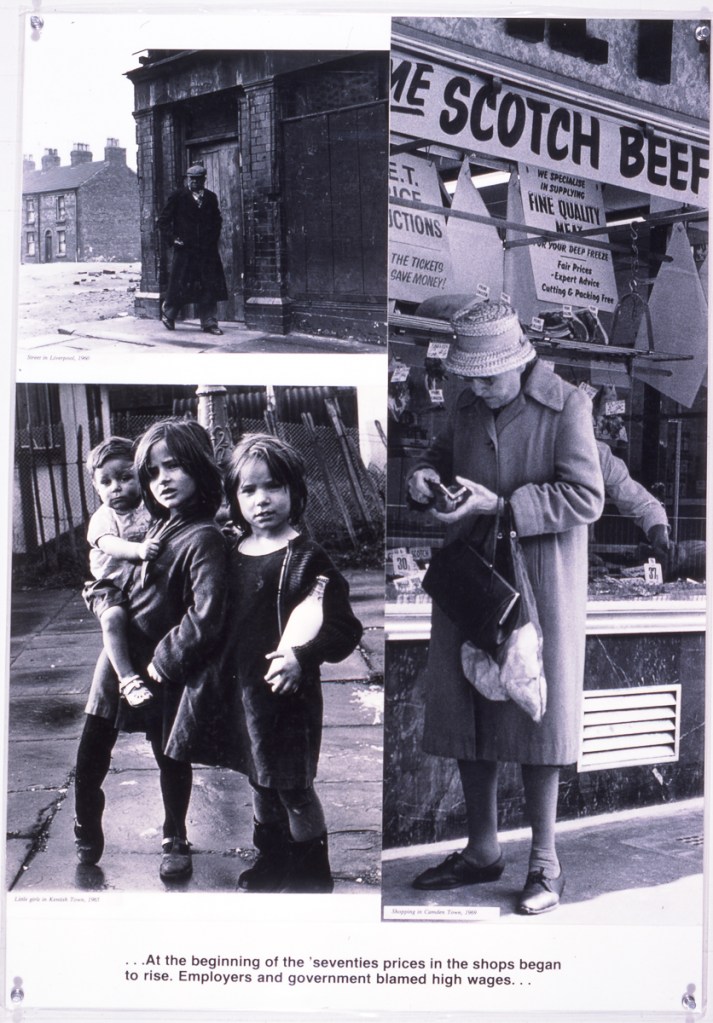
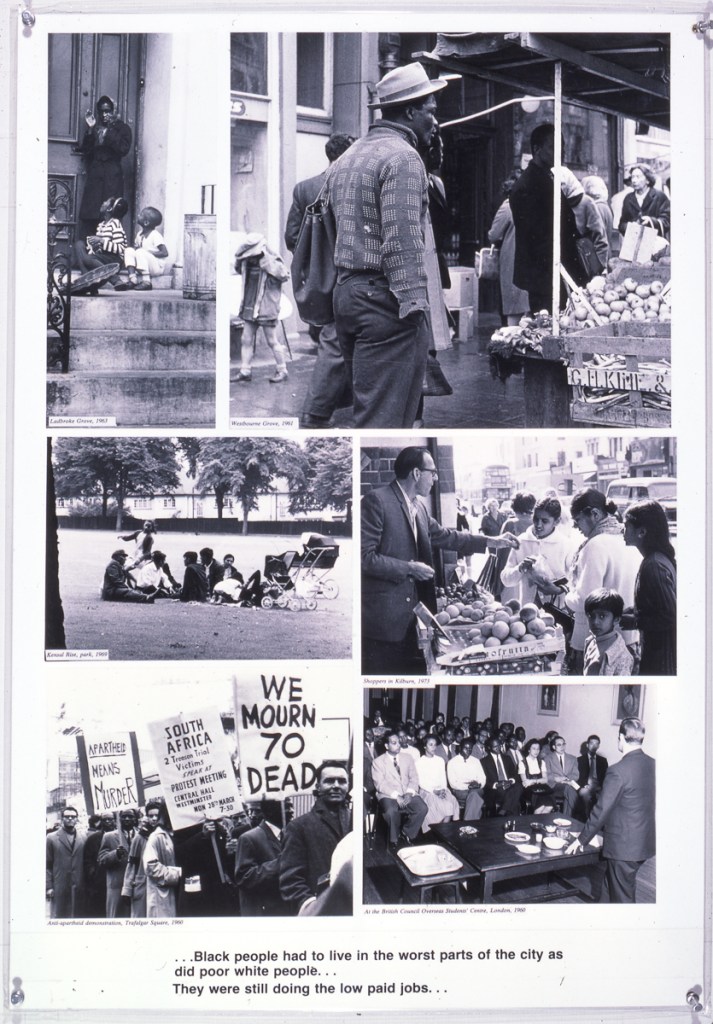
BY: HENRY AND ROSE GRANT IN COLLABORATION WITH THE DEPARTMENT OF CULTURAL STUDIES
DATE: 1984
SIZE: 57 Laminated Panels 20″x30″
FUNDED: Dept of Cultural Studies, Cockpit Gallery, GLAA.
SYNOPSIS: Henry Grant worked as a freelance photojournalist from just prior to the Second World War until the present day. He did a great deal of work for THE TIMES EDUCATIONAL SUPPLEMENT. In 1982 he approached the Department of Cultural Studies to see if. I was interested in using any of his pictures. His photographs of young people taken in the 1950’s were a unique historical find and only a small part of an archive of over a quarter of a million negatives. The Dept. subsequently worked with Henry and his wife Rose, who had been a journalist for THE WORKER, on a regular weekly basis for over a year to produce the exhibition.
The exhibition charts post-war developments in schooling and popular culture and was loosely based on the thinking of the CENTRE FOR CONTEMPORARY CULTURAL STUDIES, Education Group, as written in their book Unpopular Education. The panels contain selections of Henry’s photos with a simple narrative caption running through the exhibition. It was made with secondary pupils in mind.
WAS AVAILABLE FOR HIRE FROM THE COCKPIT GALLERY
South Island Children’s Workshop – Terry Dennett & Half Moon Photography (1975)
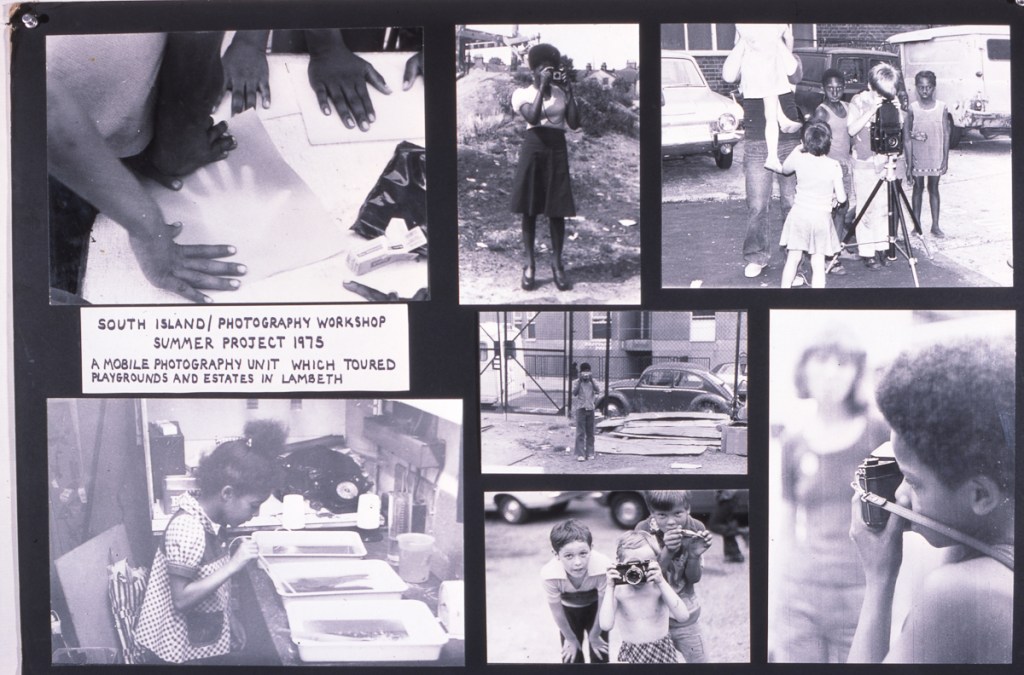
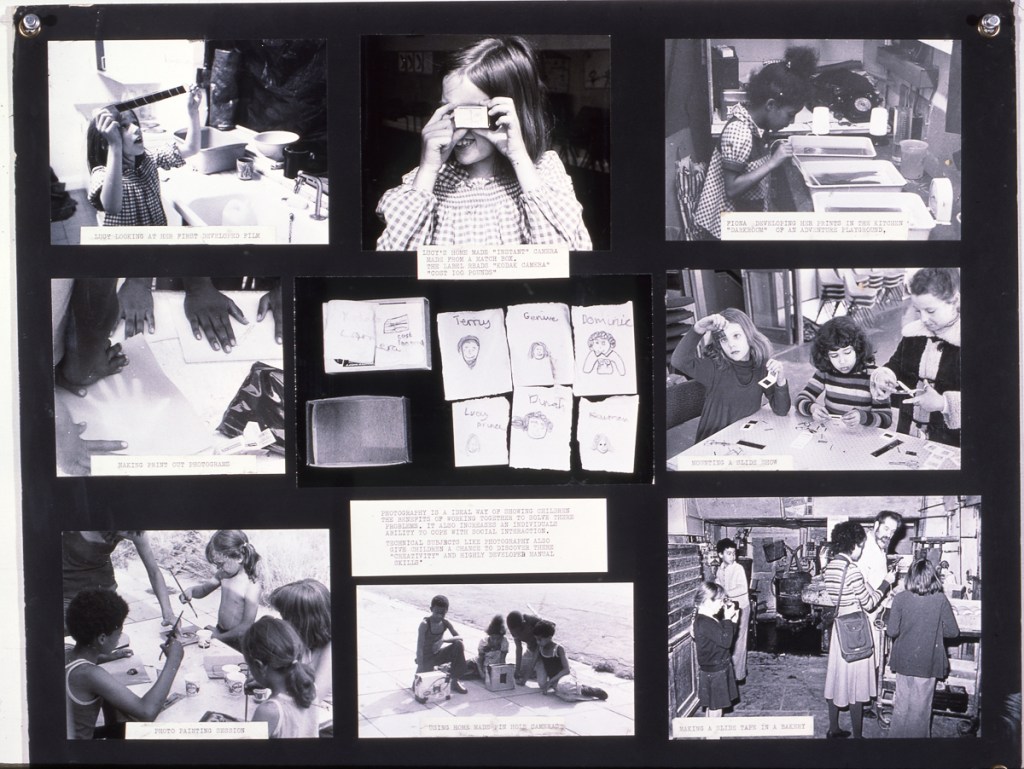
BY: TERRY DENNET AND HALF MOON PHOTOGRAPHY
DATE: 1975 WORKSHOP
SIZE: 20/30 panels
FUNDED: partly by Urban Aid
SYNOPSIS: “Photography Workshop was set up in 1974 and immediately became a programme of workshops to teach photography to children, outside of formal schooling. In those days most of this work was done at weekends within the adventure playground movement, in free schools and in independent children’s projects”.
“At South Island Workshop we are interested in photography and creativity. Creative approaches to problem-solving are still thought to be unorthodox even though this method of teaching turns kids (and adults) on. It is extremely important to stop kids from thinking in rigid hierarchical ways. If kids can do that in photography, they can do it socially, politically, and in many other ways”.
The exhibition was shown in adventure playgrounds and libraries.
WAS AVAILABLE FROM PHOTOGRAPHY WORKSHOP, 152 UPPER STREET, LONDON N1
Tanswell Action Group – Blackfriars Photography Project (1984)
BY: BLACKFRIARS PHOTOGRAPHY PROJECT AND TANSWELL
DATE: 1984 ACTION GROUP
SIZE: 8 hinged boards each 22″ X 32″
FUNDED: Tanswell Tenants Group
SYNOPSIS: Tanswell is a pre-war estate in Waterloo which has seen many campaigns to improve the estate and facilities. Black -friars Photography Project had been involved with many of these including two tape-slides and early documentation. In 1984 the Tanswell Action Group was campaigning to secure major improvements from Lambeth Council and the GLC. They needed a display they could show to councillors in support of their case. The display had to be reasonably portable and be able to make some impact on councillors who had seen it all before. Within the restrictions of a £50 budget, they went for a design that was colourful and quick to produce. The display was produced by Mike Steventon, a member of the project with the Tanswell Action Group. The background brickwork was photocopied and mounted on card. The text was photocopied and the display constructed using what was available from the local hardware store. The campaign as a whole was successful and estate improvements have been made. It was used at GLC and Lambeth Housing Committee meetings and at local meetings.
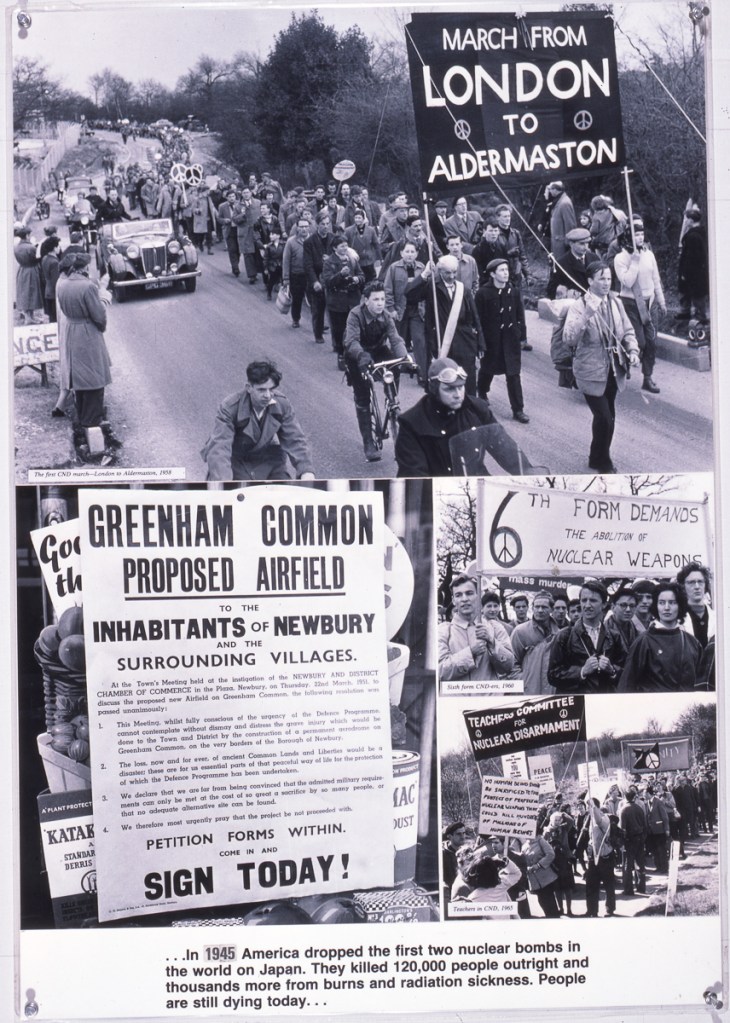
Target London – Peter Kennard (1985)
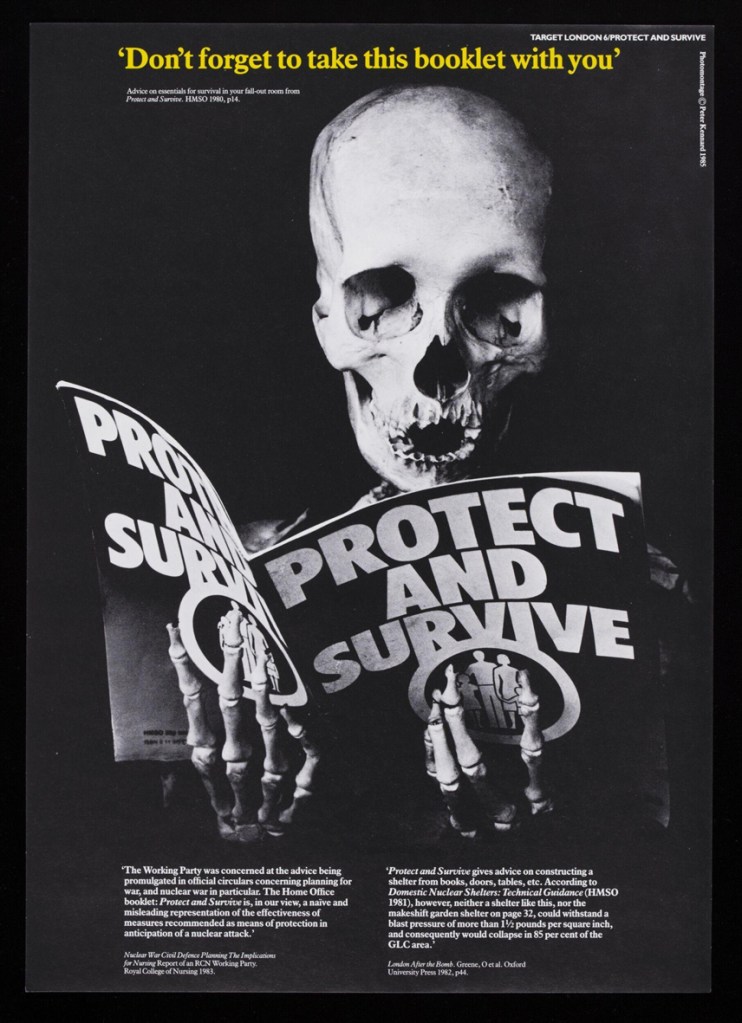
A Set of Photomontage Posters on Civil Defence
BY: PETER KENNARD
DATE: 1985
SIZE: Boxed set of 18 A3 posters 6000 sets produced. Each sold for £2.95.
FUNDED: By the GLC NUCLEAR POLICY UNIT
Distributed by TURNAROUND AND THE GLC
SYNOPSIS: The posters present, in an easily accessible form, factual information on Civil Defence and the possible effects of a nuclear war on London. All the texts quoted are by authorities on the subject, scientists, doctors, nurses and the government.
Government statements are set against statements by experts like doctors and nurses whose reports have not been made available to the public.
For £2.95 you get an informative exhibition which has been printed. It was bought by, or distributed to CND groups, youth clubs, community centres, labour clubs etc.
Sets were available from the Gallery Office for £1.
The Black Triangle – Ahmet Francis (1985)
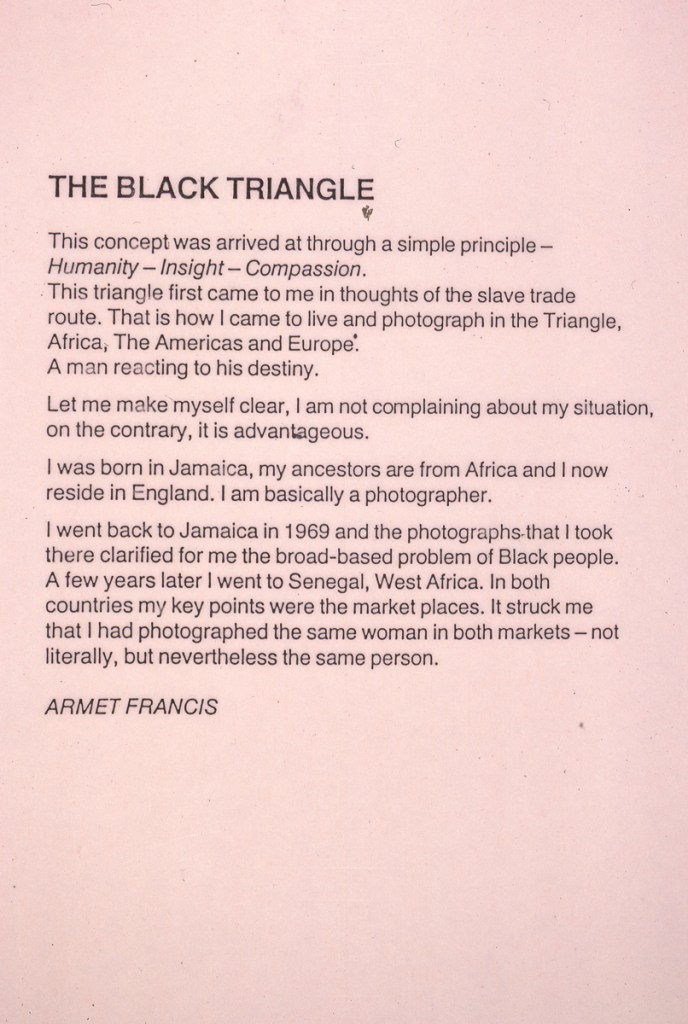
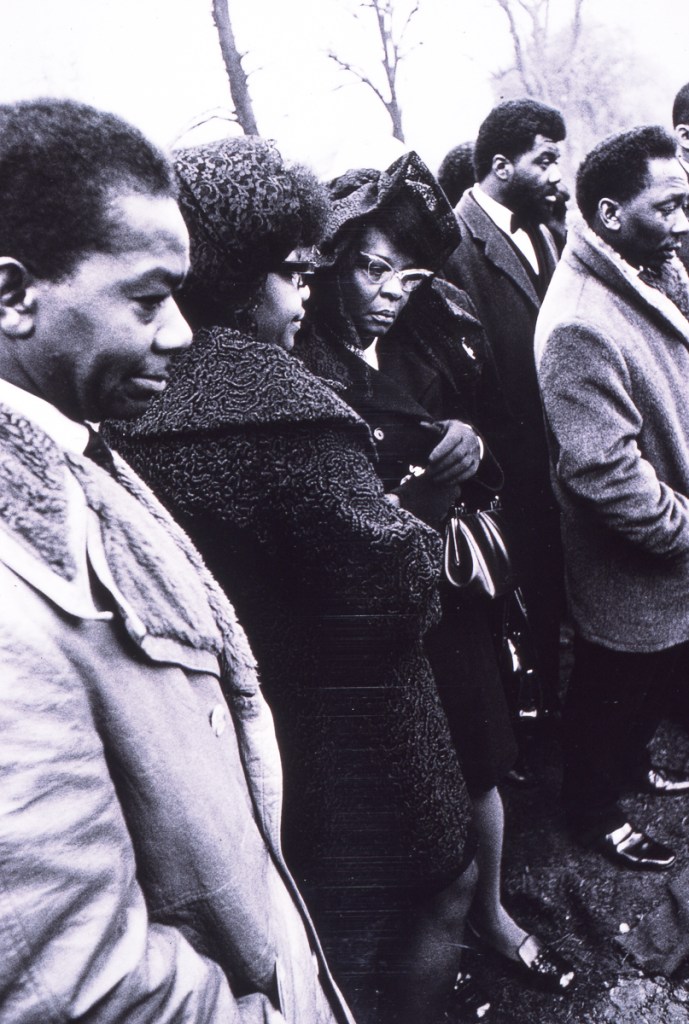
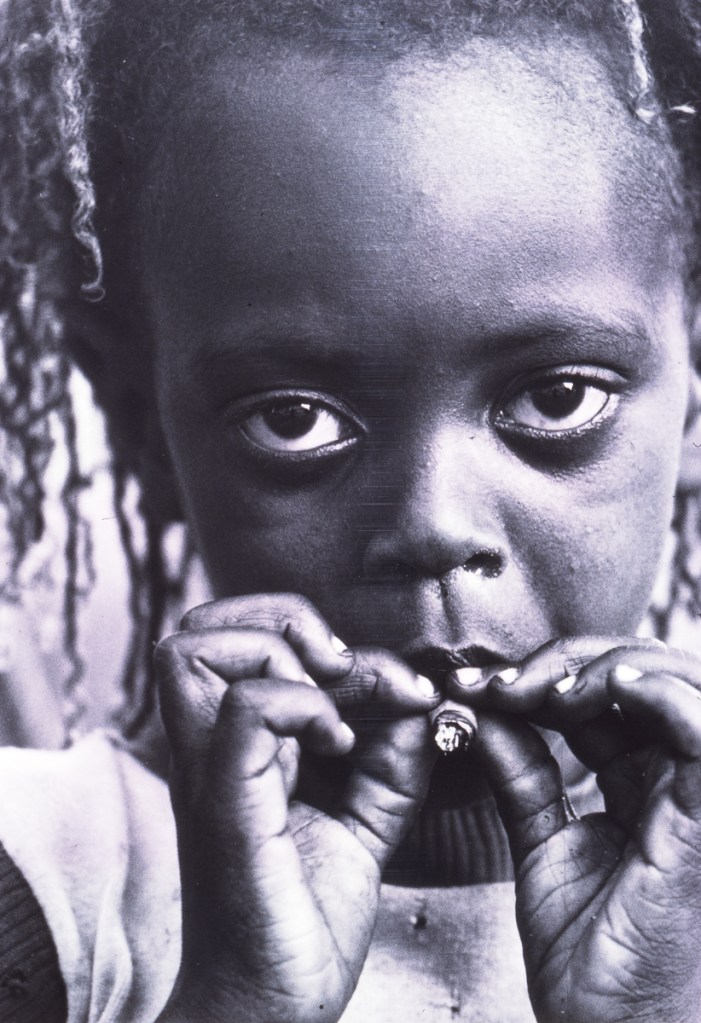
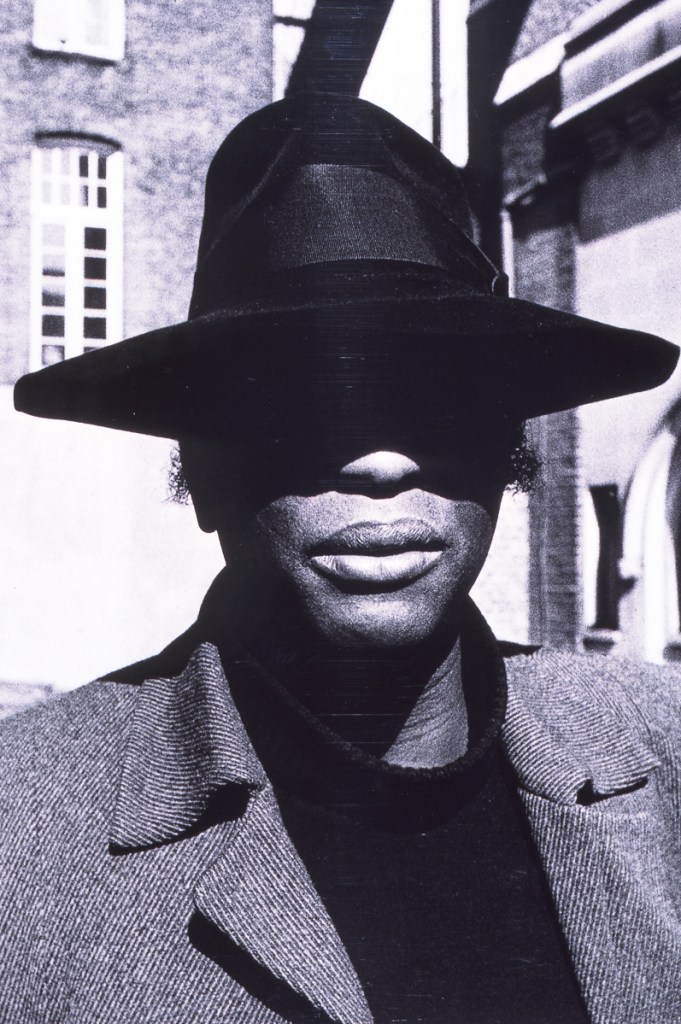
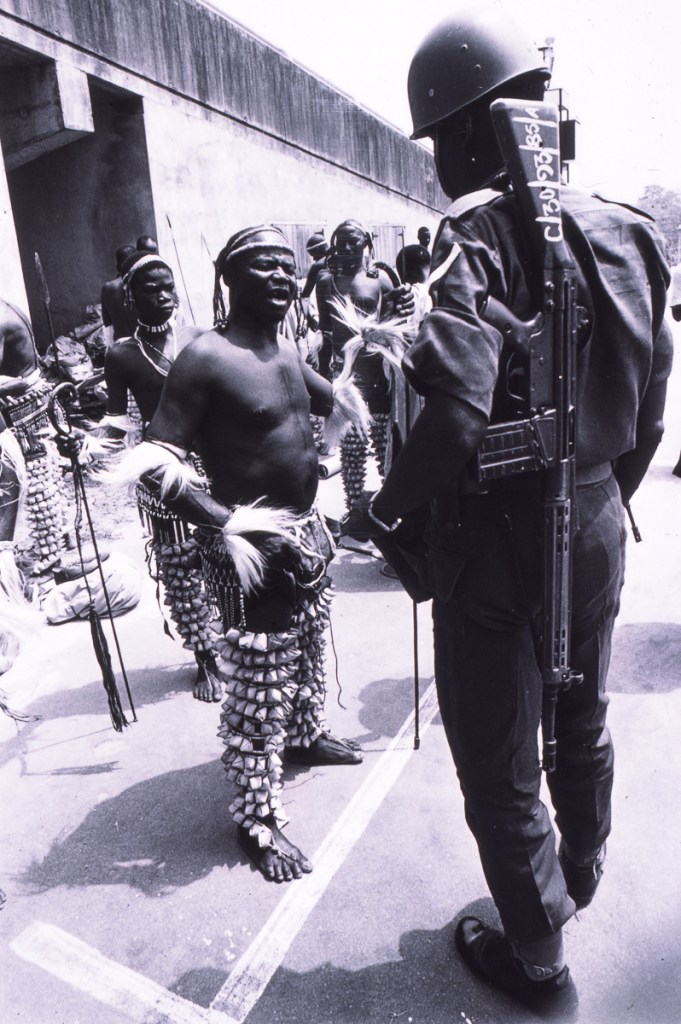
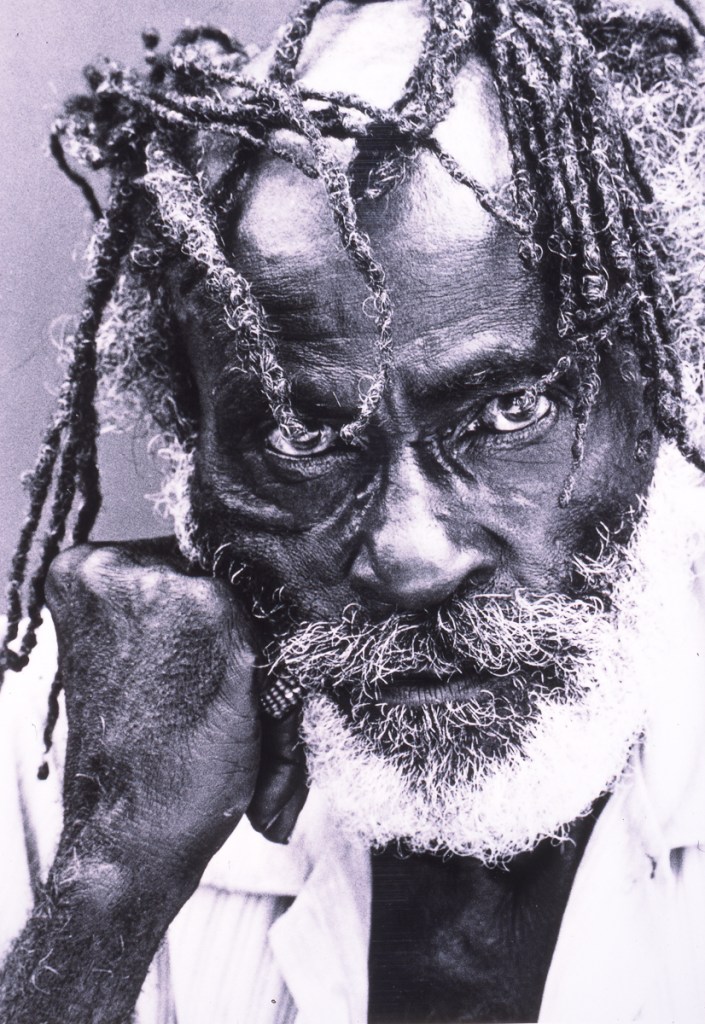
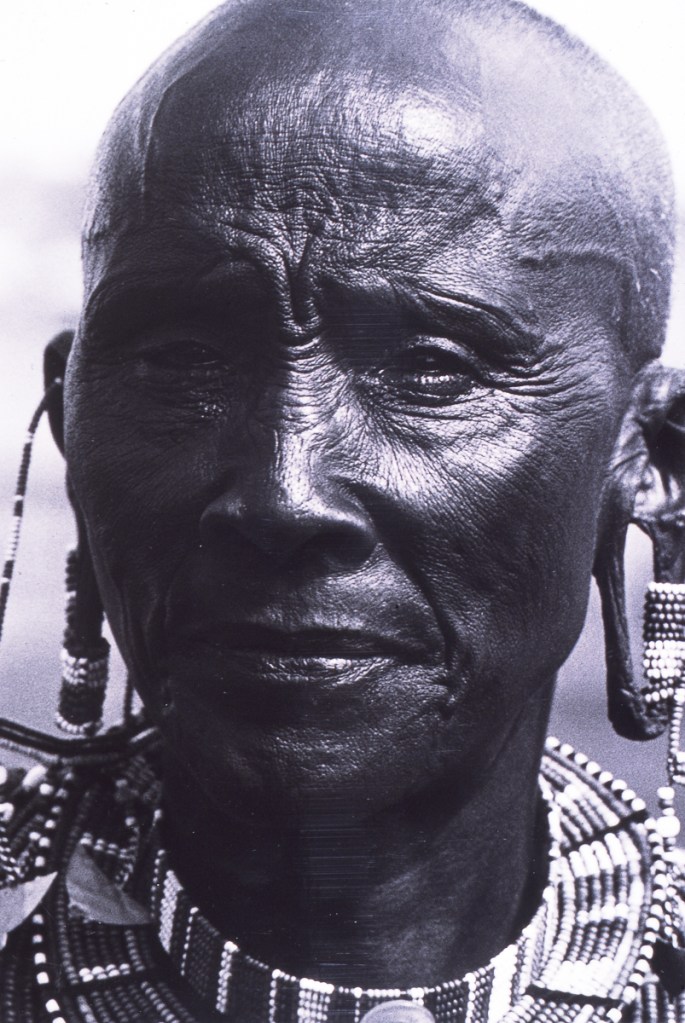
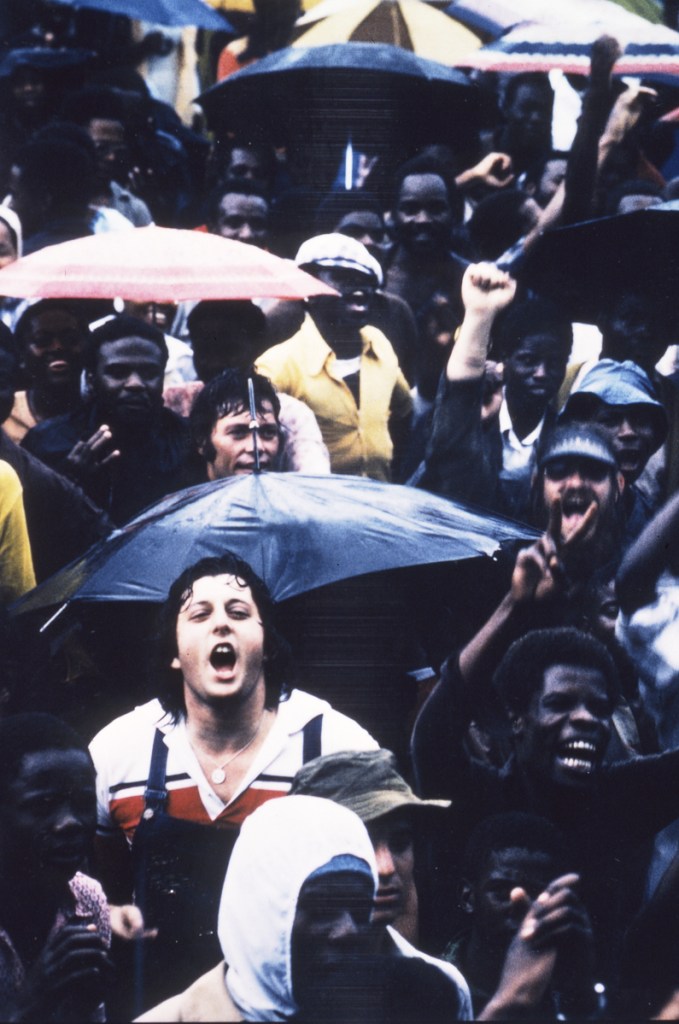
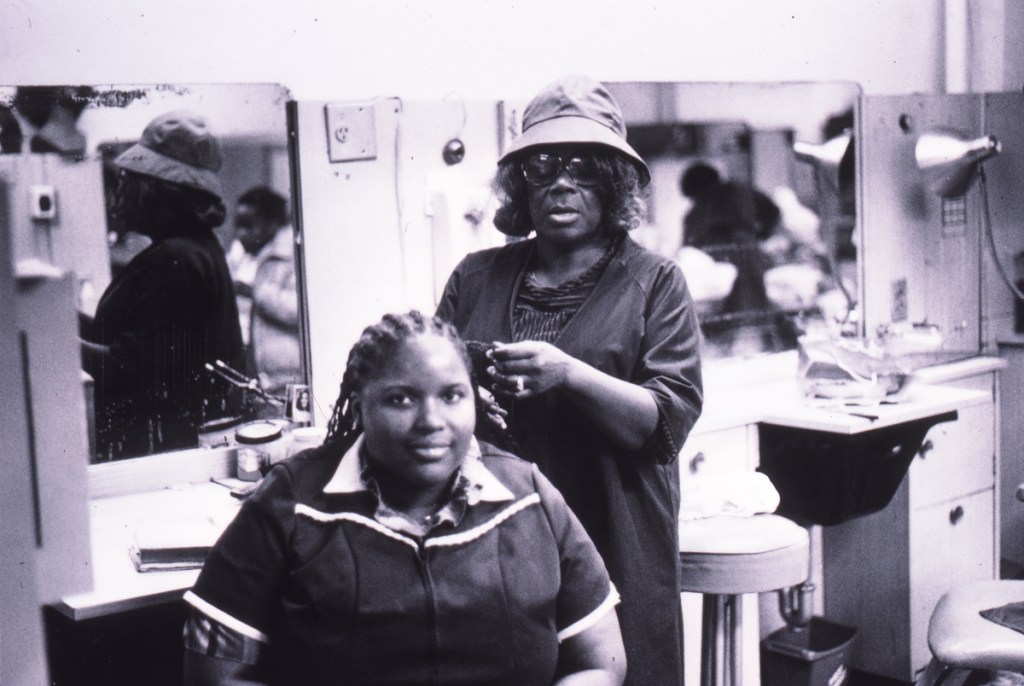
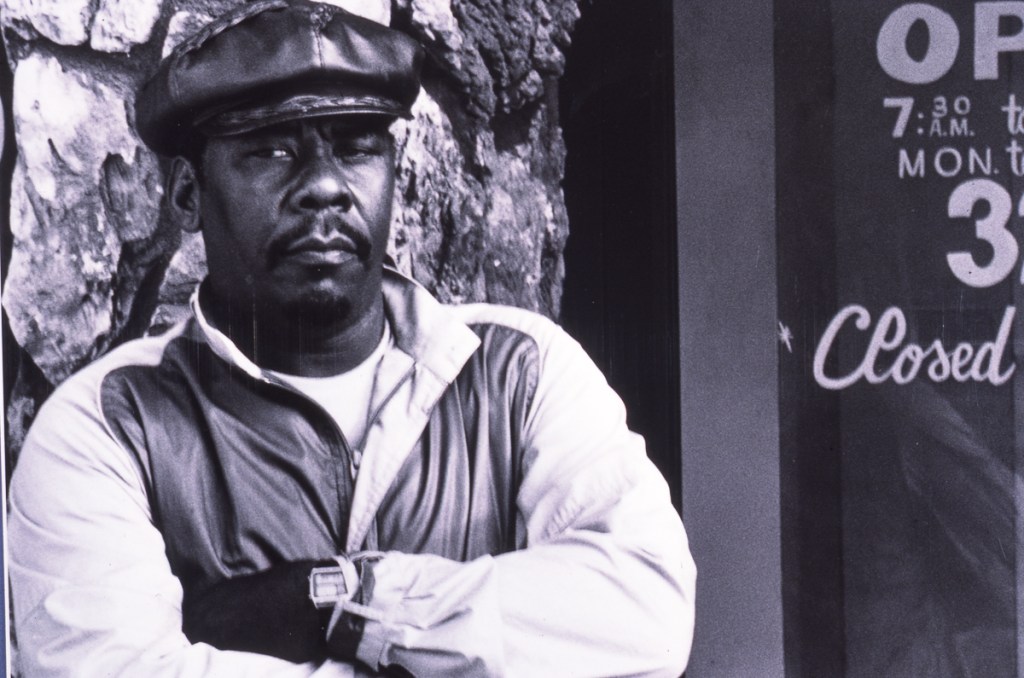
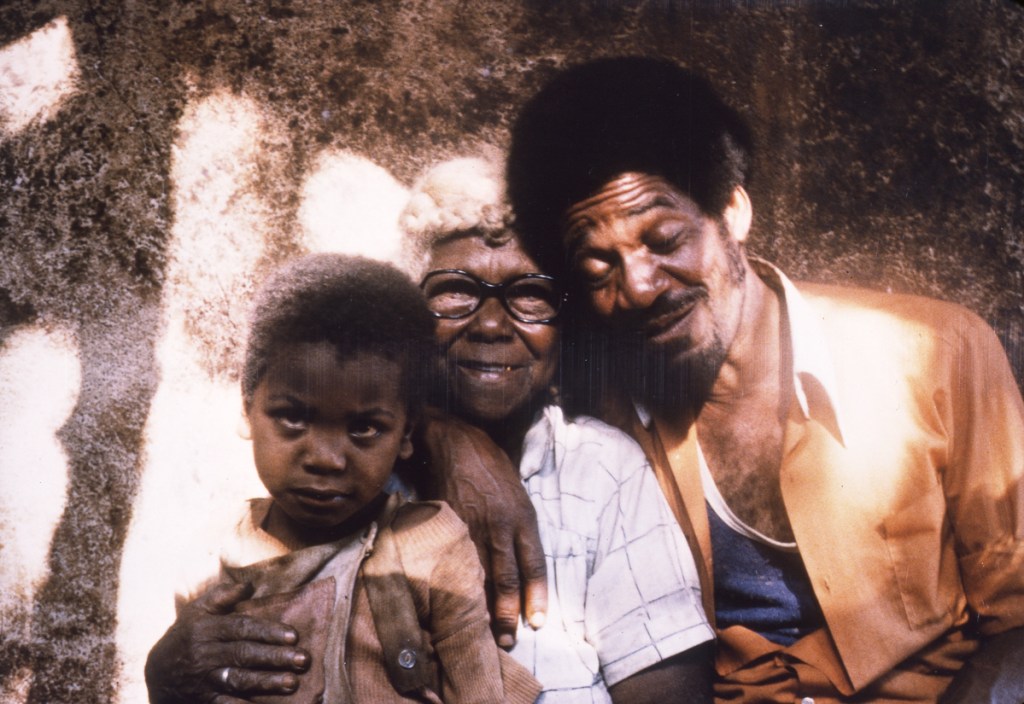
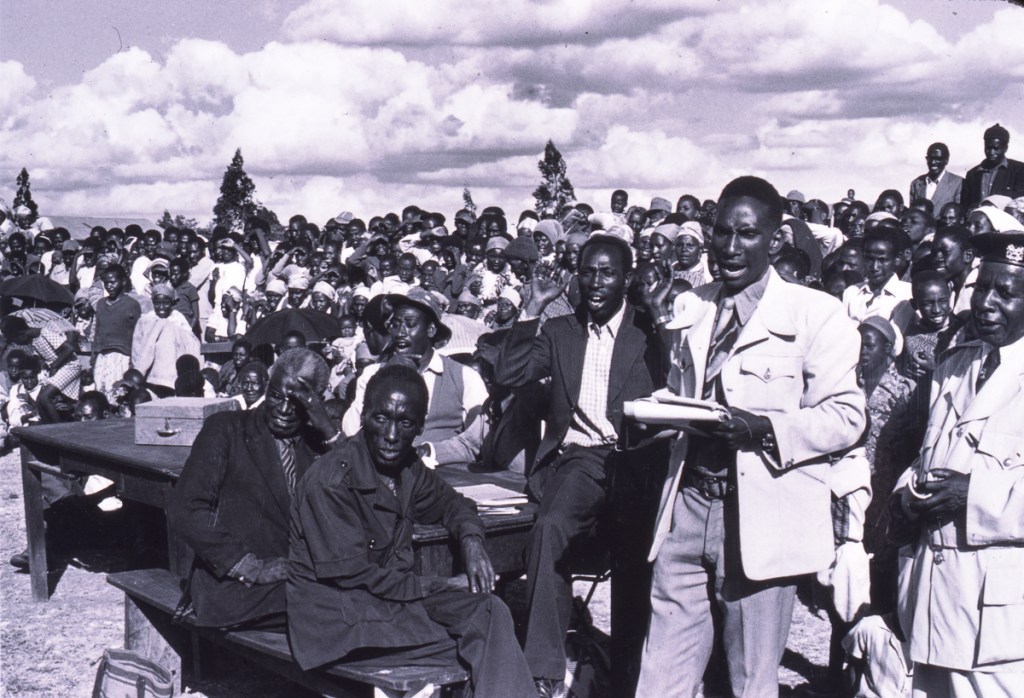
THE BLACK TRIANGLE
BY: ARMET FRANCIS
DATE: 1985
SIZE: 66 panels (40 x 30cms), laminated
FUNDED: GLC and Cockpit Gallery
SYNOPSIS: Photographs taken over a period of fourteen years in the West Indies, Africa, New York and London. Photographs that retrace the slave route, concentrating on showing the lives of Black People in ordinary situations.
“I’m aware as a black person that this society can easily present a negative image or give you a negative image – but I’ve passed through that – I’ve always felt it was my job to inform as many as possible, through my profession, of the position of black people wherever we’re scattered. That is the only legitimacy I have of photographing people.”
Armet Francis
WAS AVAILABLE FOR HIRE FROM THE COCKPIT GALLERY
The Camera As Domestic Item, Monocrone (1986)
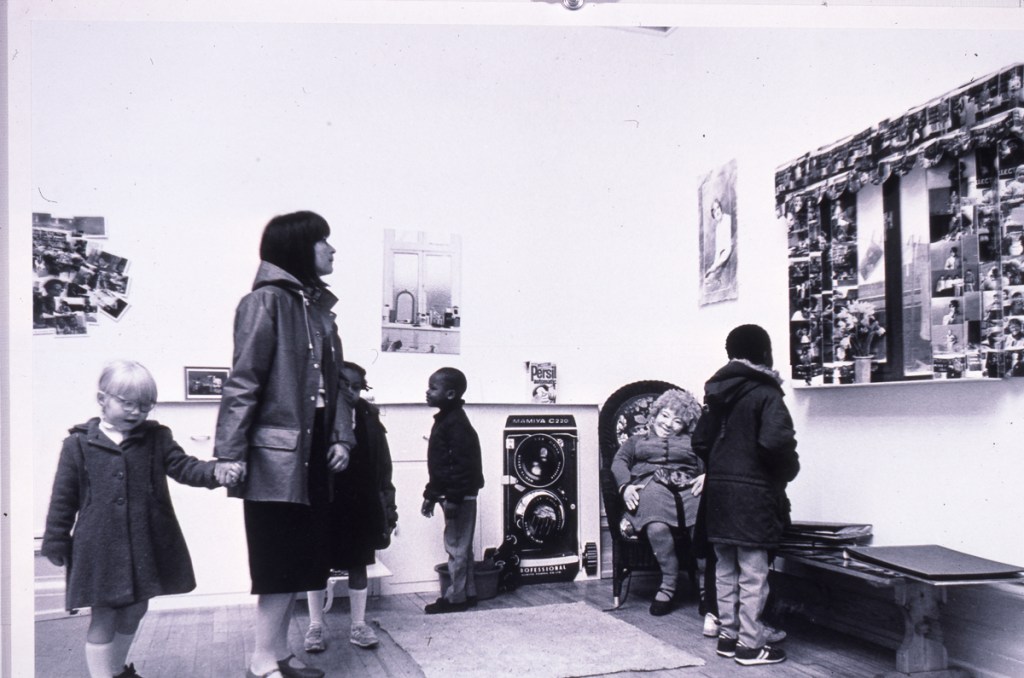
The Camera As Domestic Item
BY: Monocrone
DATE: 1986
SIZE:
FUNDED: GLC
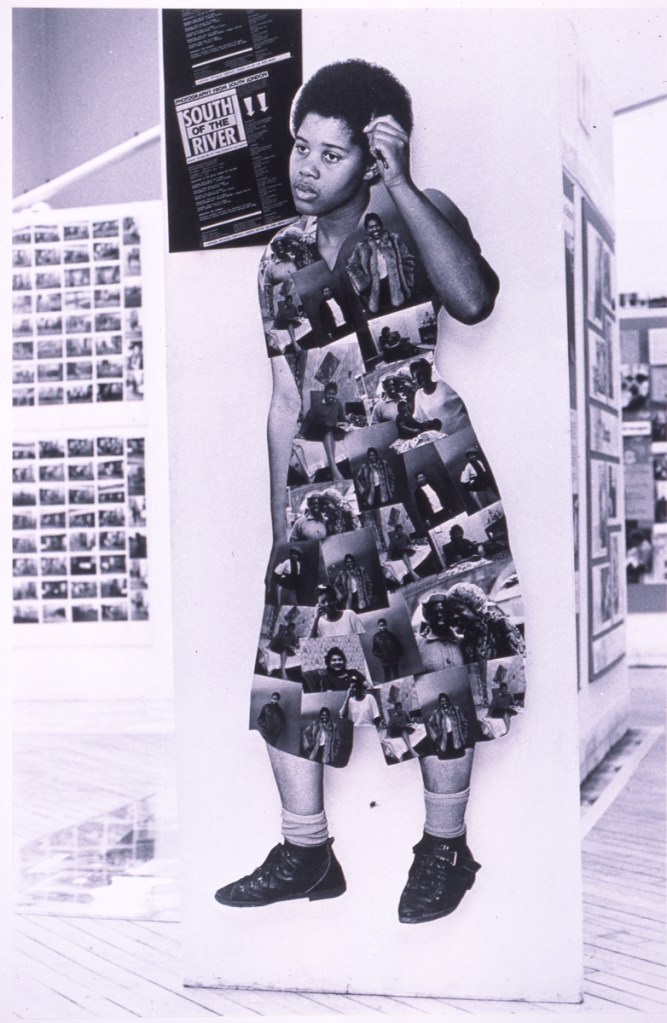
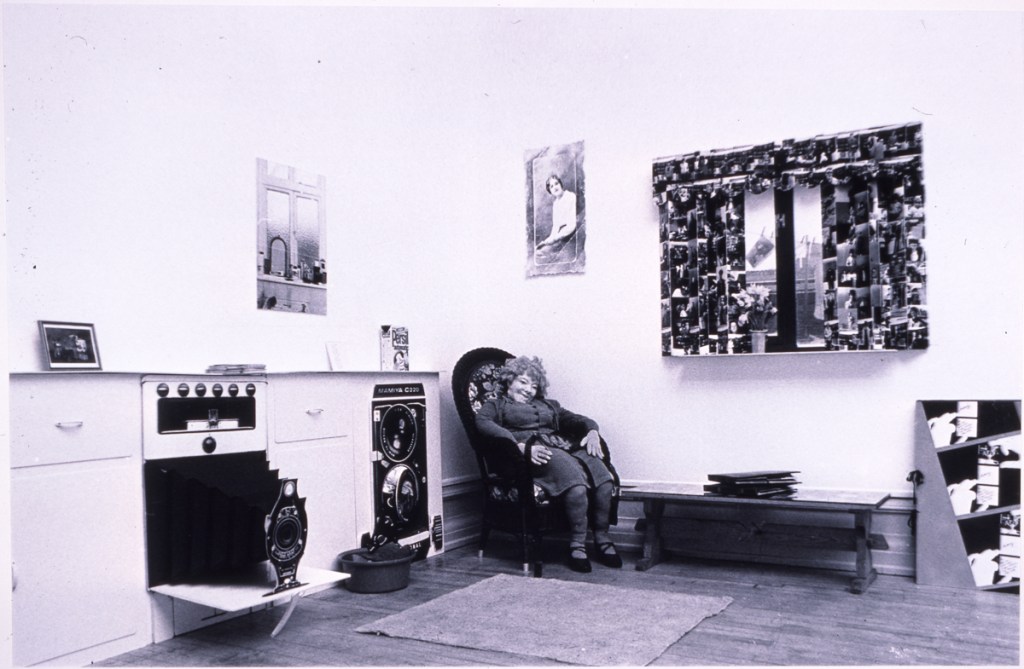
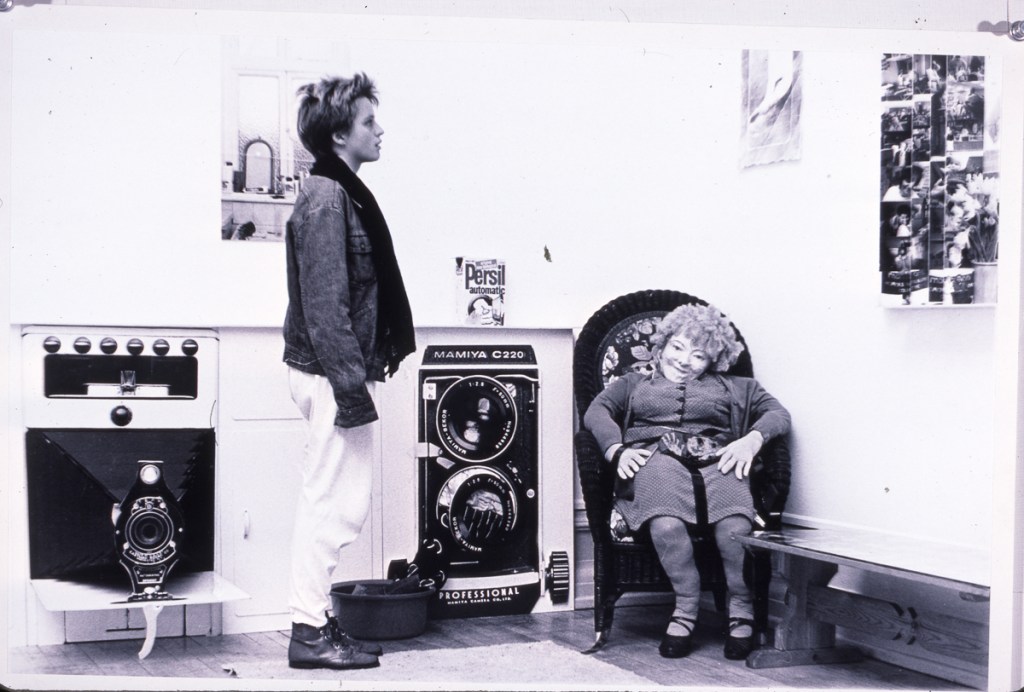
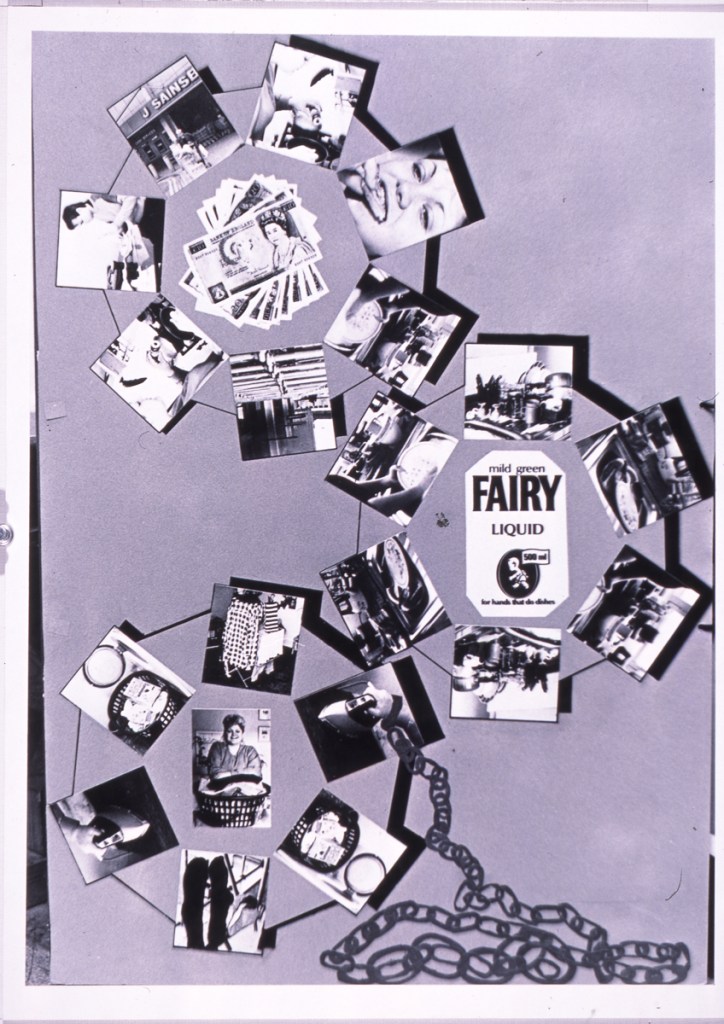
SYNOPSIS: We recently produced a series of images and constructions entitled ‘The Camera as a Domestic Item’, as Monocrone’s contribution to an exhibition of community photography called ‘South of the River’, in South London. We created a domestic corner where photographic equipment and materials are substituted for domestic appliances, and photography and film are turned into the actual fabric and furniture of home life: curtains and coffee tables are made of photographs: rolls of film knitted into a woollen picture: films and prints hang on the washing line: chemicals sit on the bathroom shelf: the oven and washing machine are actual cameras, with a lens becoming the front-loading door. The ideas behind these creations emerged more in the making of them than in the planning – it felt like an exhibition from the gut. We wanted, as we articulated afterwards, to acknowledge the energy that many women – who are still expected to carry responsibility for domestic life, whatever else they do – put into the home. We wanted the realities of this life to be seen more in the photographs that we take. We wanted to celebrate the value of the photographs that are already found in our homes, and we wanted to challenge the way that our creative and technical work in the home is undervalued, by drawing visual parallels with photography where those same skills, applied by men, are given status. Elsewhere in the exhibition, another stereotype is challenged: a life-size black woman photographed in black and white wears a dress of colour photographs of other black women. Turning the negative notion of the ‘black woman who is aggressive and wears a loud dress’ on its head, she becomes an expression and celebration in herself of the individuality of black women.
Reen Pilkington (monochrome menber)
MONOCHROME, CLAPHAM POOL, CLAPHAM MANOR SRTEET, LONDON SW4.
The Home Made Show – Terry Dennett With South Island Photography Workshop (1975)
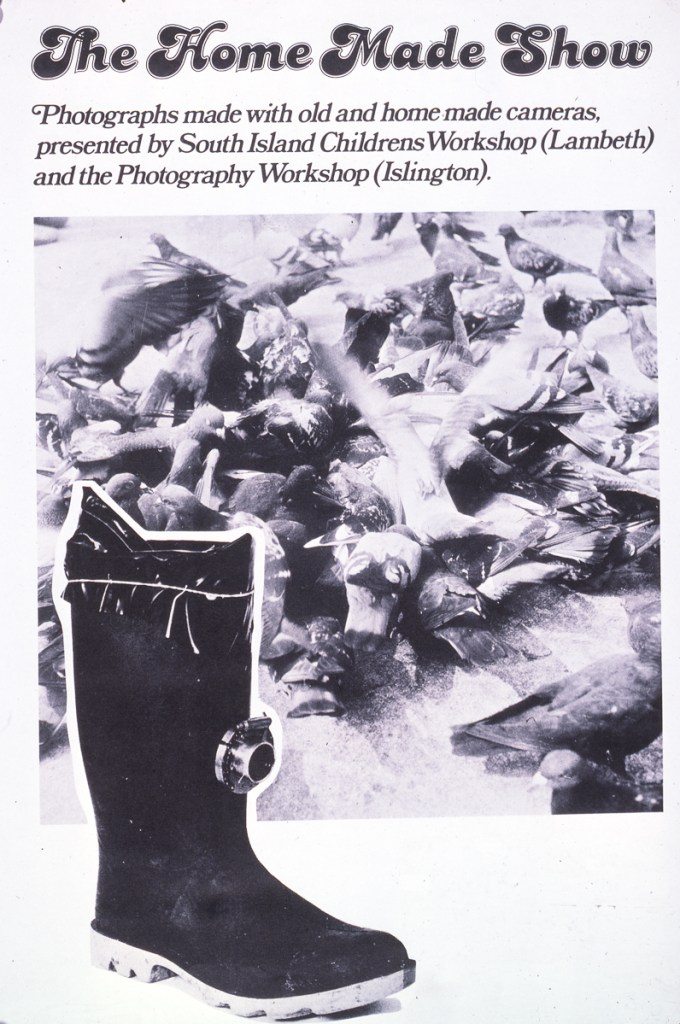
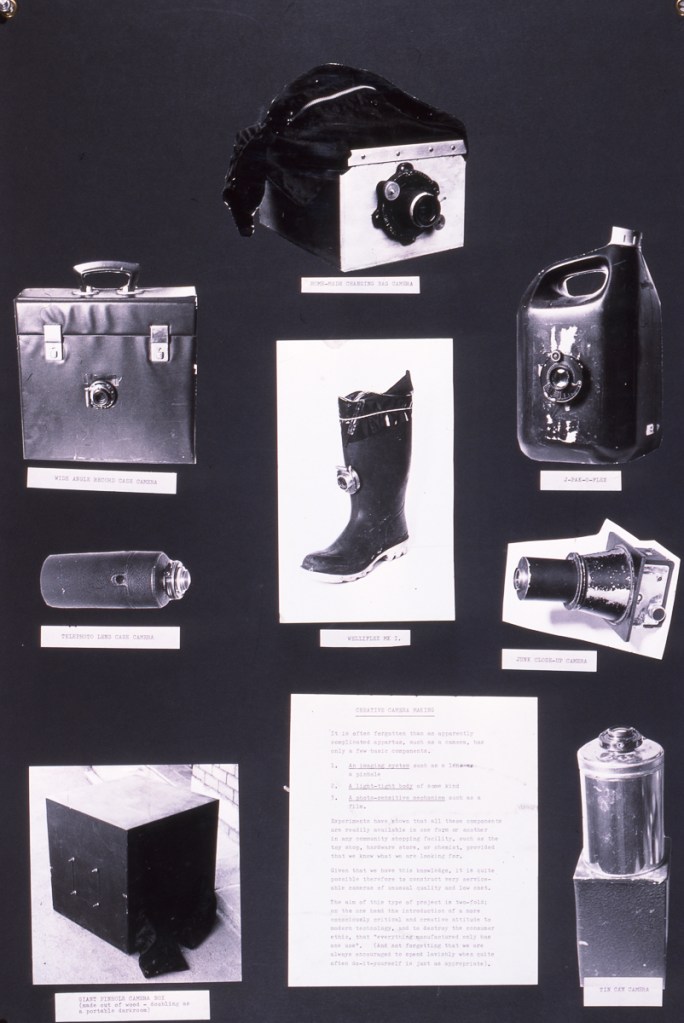
BY: TERRY DENNETT with SOUTH ISLAND PHOTOGRAPHY WORKSHOP
DATE: 1975
SIZE: 30/40 panels
SYNOPSIS: Terry worked with children, using old and do-it-yourself, home-built cameras, and photographic equipment. They used homemade lenses and alternative low-cost technologies. He believes their use demystifies professional quality and avoids dependence on large corporations.
The exhibition was shown in local libraries in Lambeth and S.E. London.
WAS AVAILABLE FROM THE PHOTOGRAPHY WORKSHOP, 152 UPPER STREET, N1.
The Miners’ Strike 84/85 – Dave & Theresa Dronfield & Crispin Hughes of Photo Co-Op (1985/6)
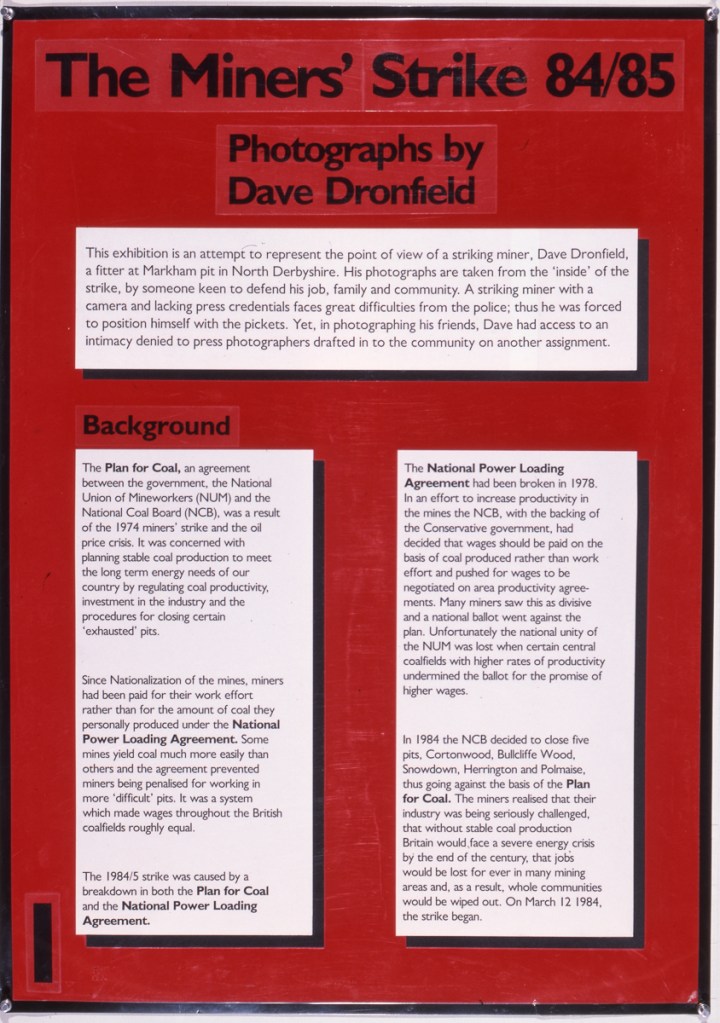
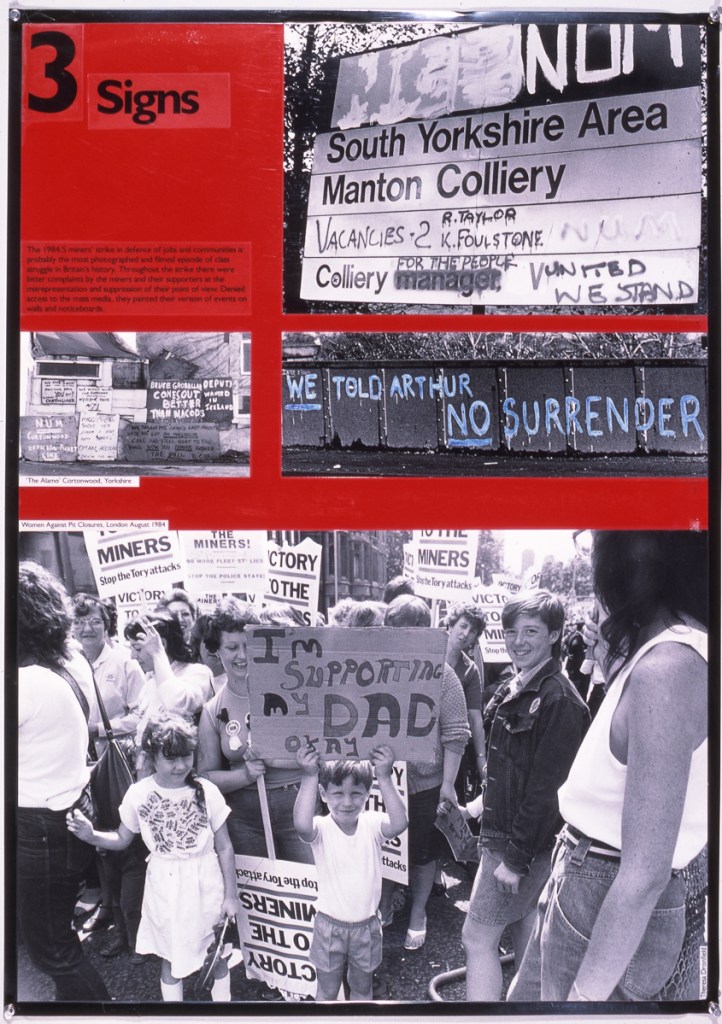
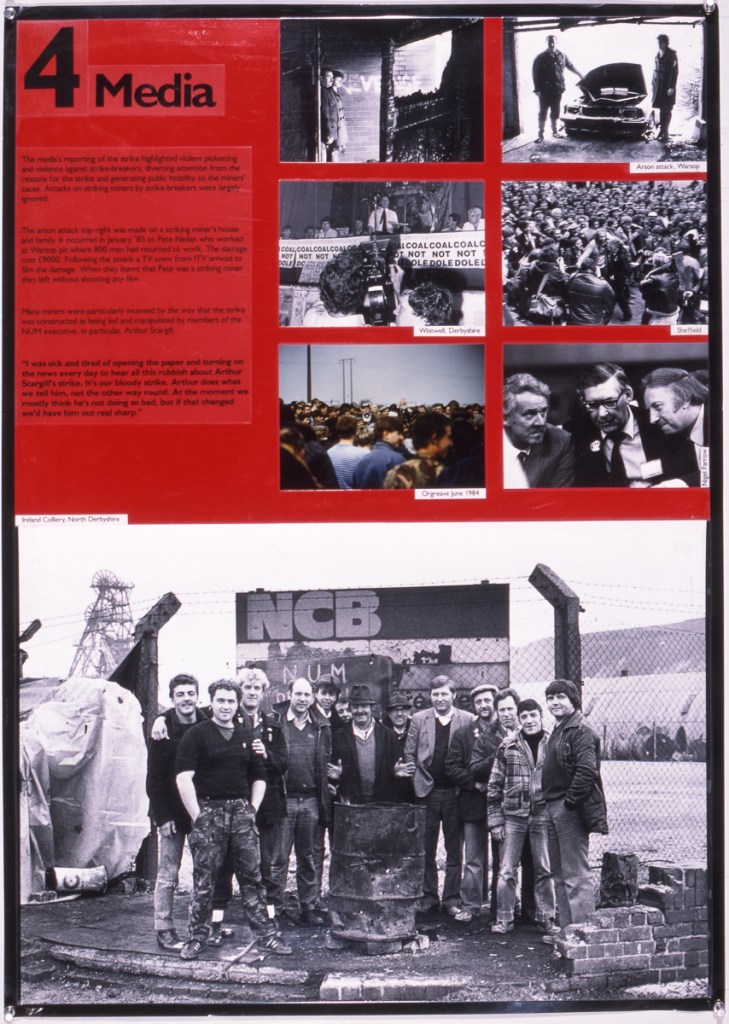
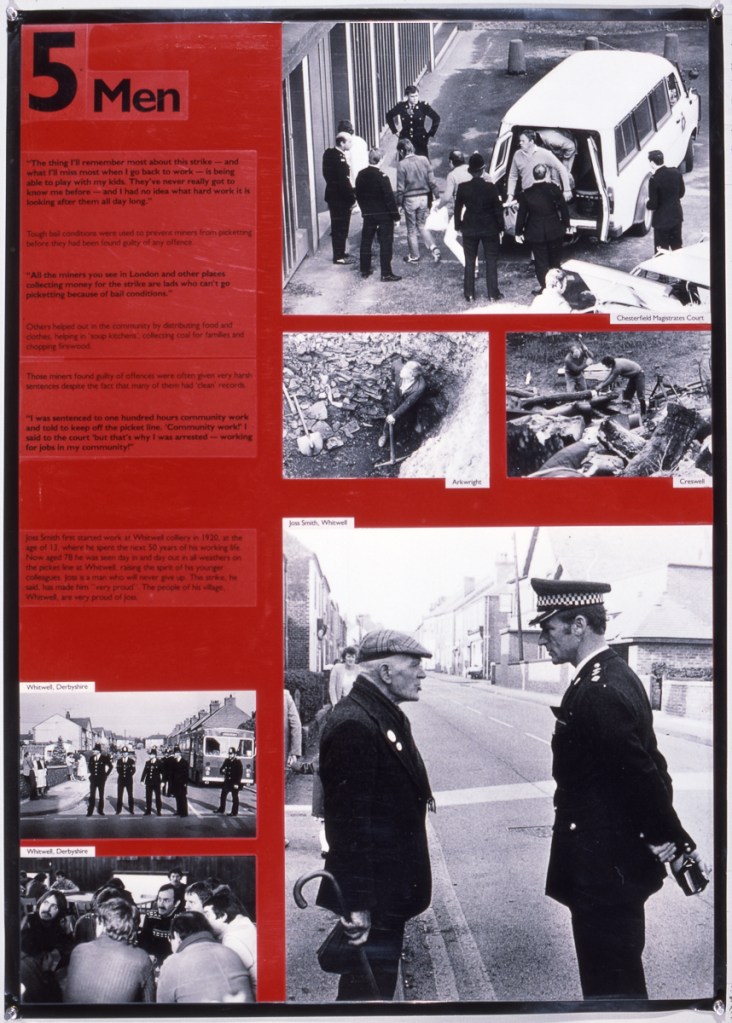
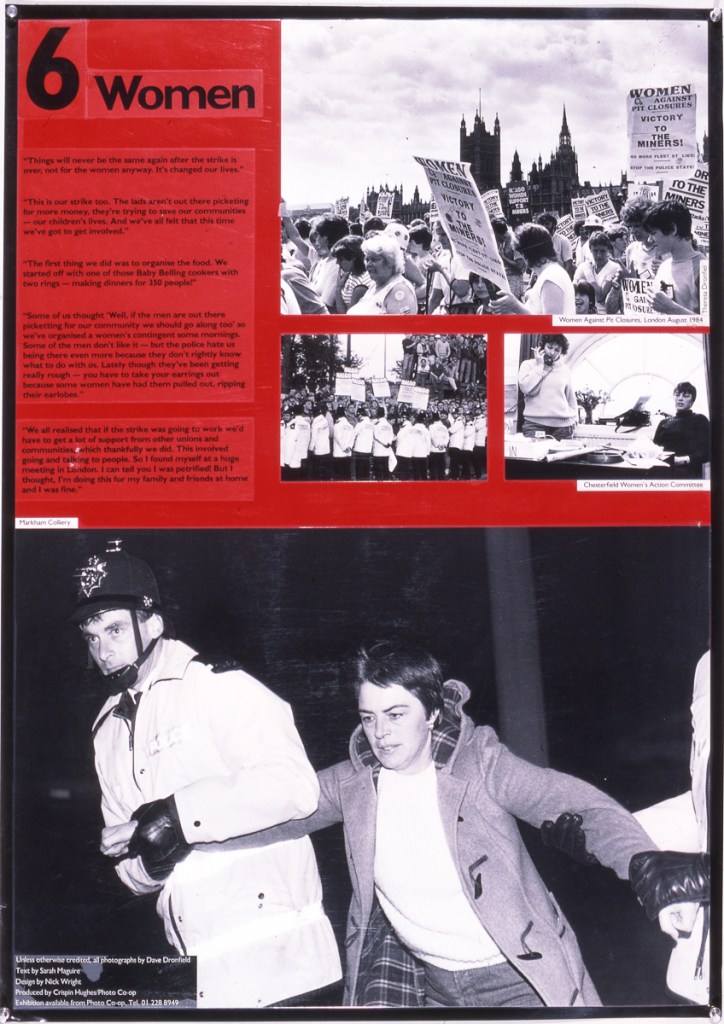
BY: DAVE & THERESA DRONFIELD (DERBYSHIRE MINER AND HOUSEWIFE) with CRISPIN HUGHES OF PHOTO CO OP Six Laminated Panels 24″ x 34″
FUNDED: GLC via PHOTO CO OP
SYNOPSIS: This exhibition was an attempt to represent the point of view of a striking miner, Dave Dronfield, a fitter at Marleham pit in North Derbyshire. His photographs were taken from the ‘inside’ of the strike, by someone keen to defend his job, family and community. A striking miner with a camera and lacking press credentials faces great difficulties from the police; thus he was forced to position himself with the pickets. Yet, in photographing his friends, Dave has access to an intimacy denied to press photographers drafted into the community for another assignment.
The exhibition was conceived as a campaign aid but was incomplete at the end of the strike, so the text shifted towards analysis. It was aimed at the general public and people with a general concern about the strike and its media coverage.
One copy in London has had limited use in libraries, community centres etc. A second copy has been used constantly around Derbyshire and Notts.
WAS AVAILABLE: For hire from PHOTO CO OP 61 WEBBS ROAD LONDON SW11 6RX
The Police, The Community And Colin Roach – David Hoffman & Shirley Read, Camerawork (1983)
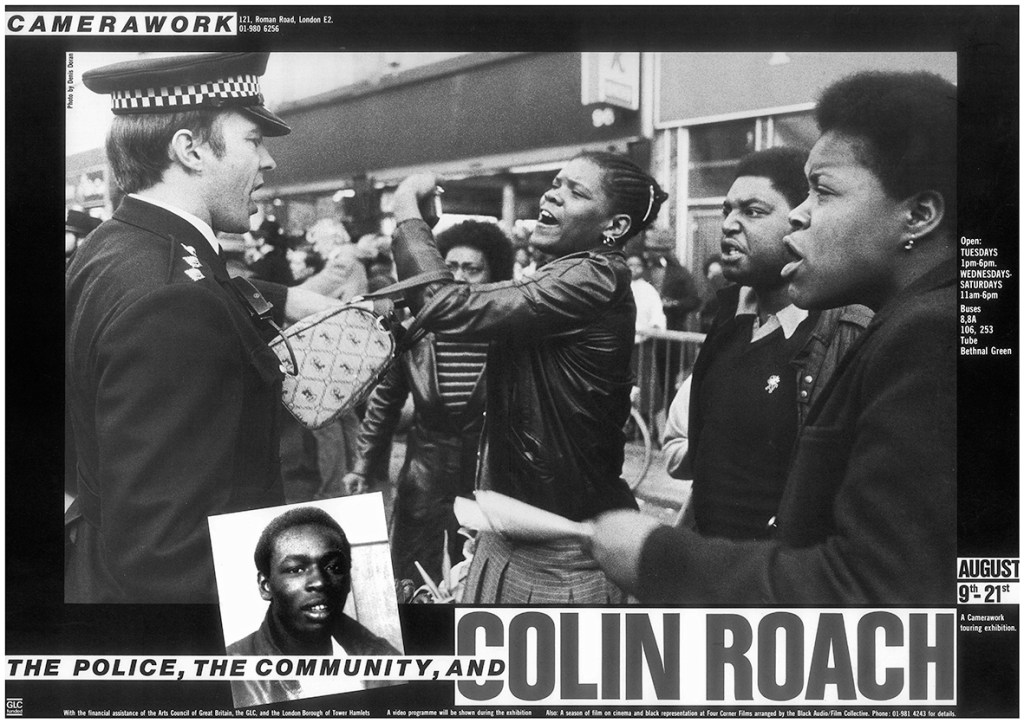
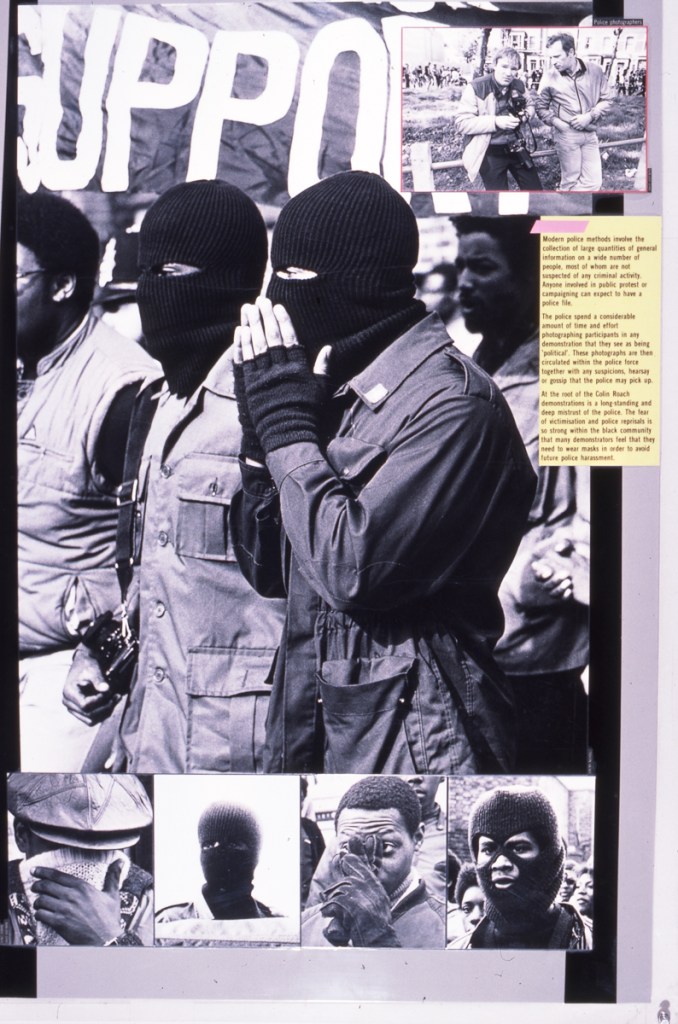
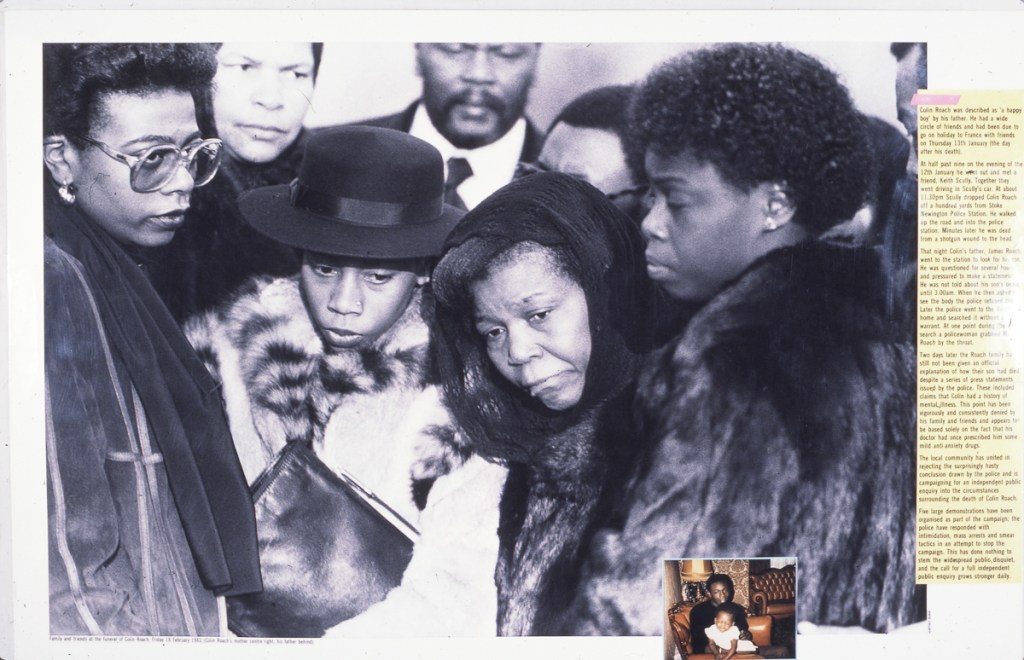
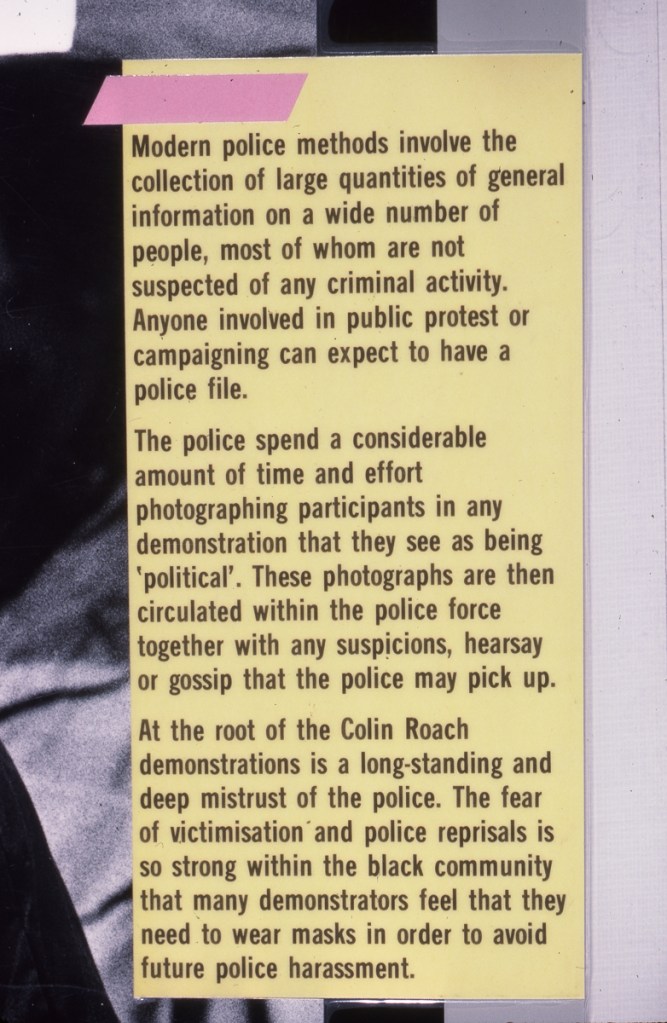
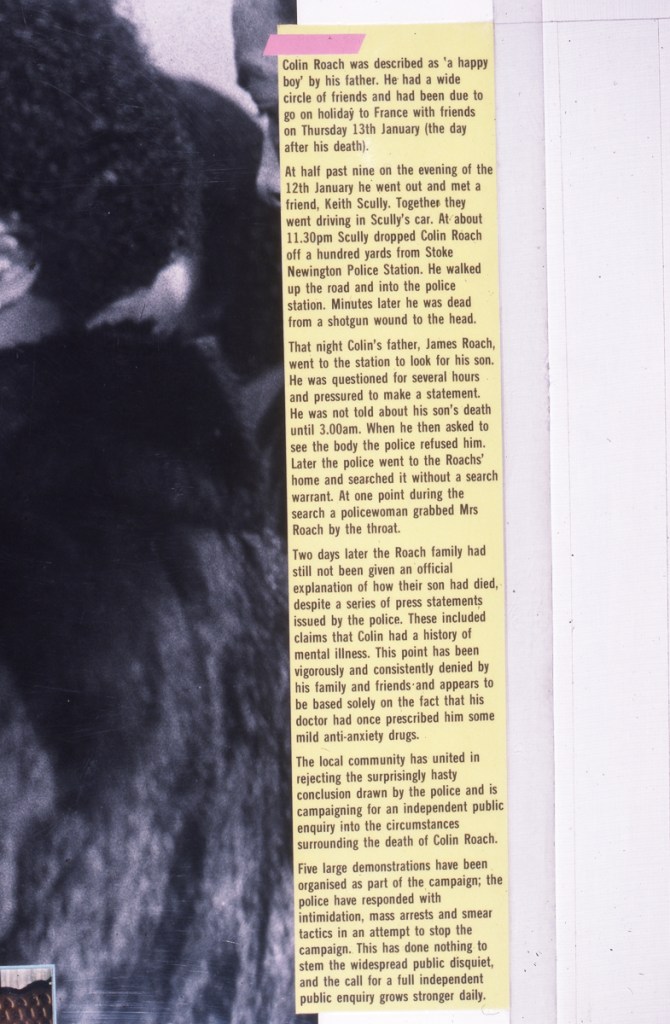
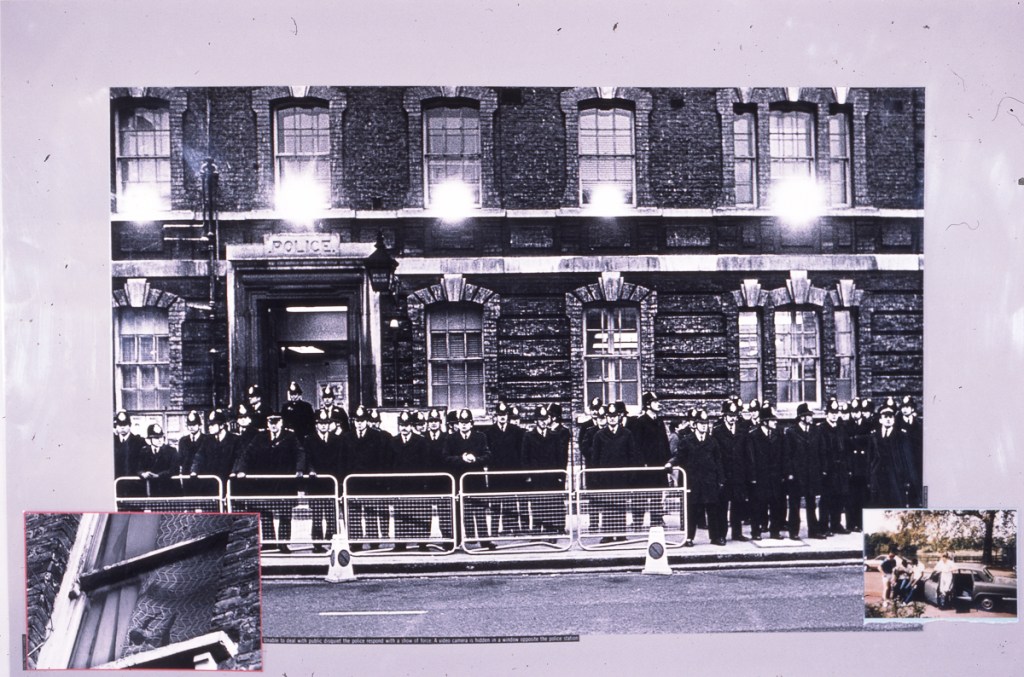
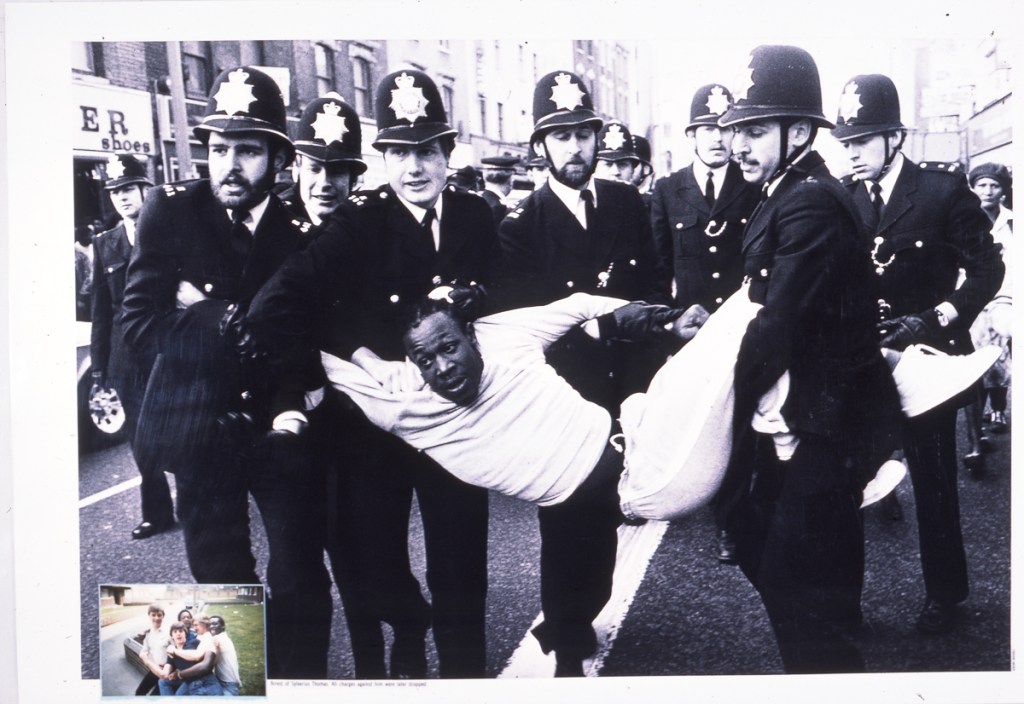
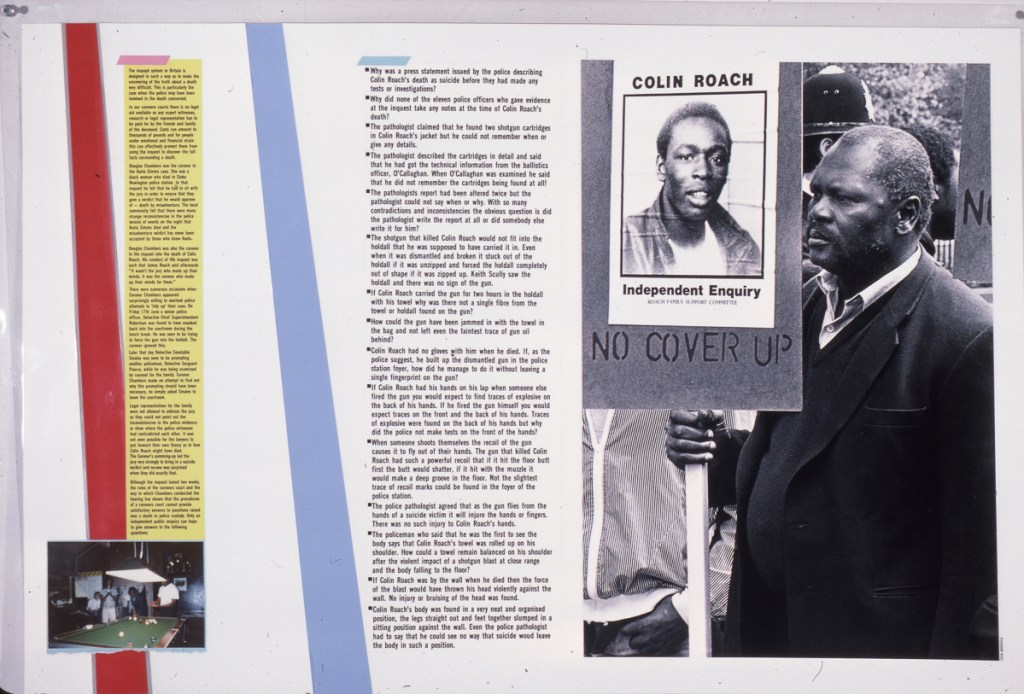
BY: DAVID HOFFMAN and SHIRLEY READ
DATE: 1983
DESIGNED BY ANDY DARK SIZE: 20 (approx.) laminated panels 22″x33″
FUNDED: THE ARTS COUNCIL
SYNOPSIS: Photographs by freelance photographers taken during protests over the unexplained death of Colin Roach in Stoke Newington police station in January 1983. Part of the campaign to make the police accountable for their actions, it gave a wider, deeper view of events than that found in the media, which only looked at one incident at a time and did not provide a context. Exhibited first at Camerawork and then toured galleries, youth clubs and community groups.
A CAMERAWORK EXHIBITION
The 30’s And Today – Social Struggle 1930-39 And Now. Half Moon, Photography Workshop (1977)
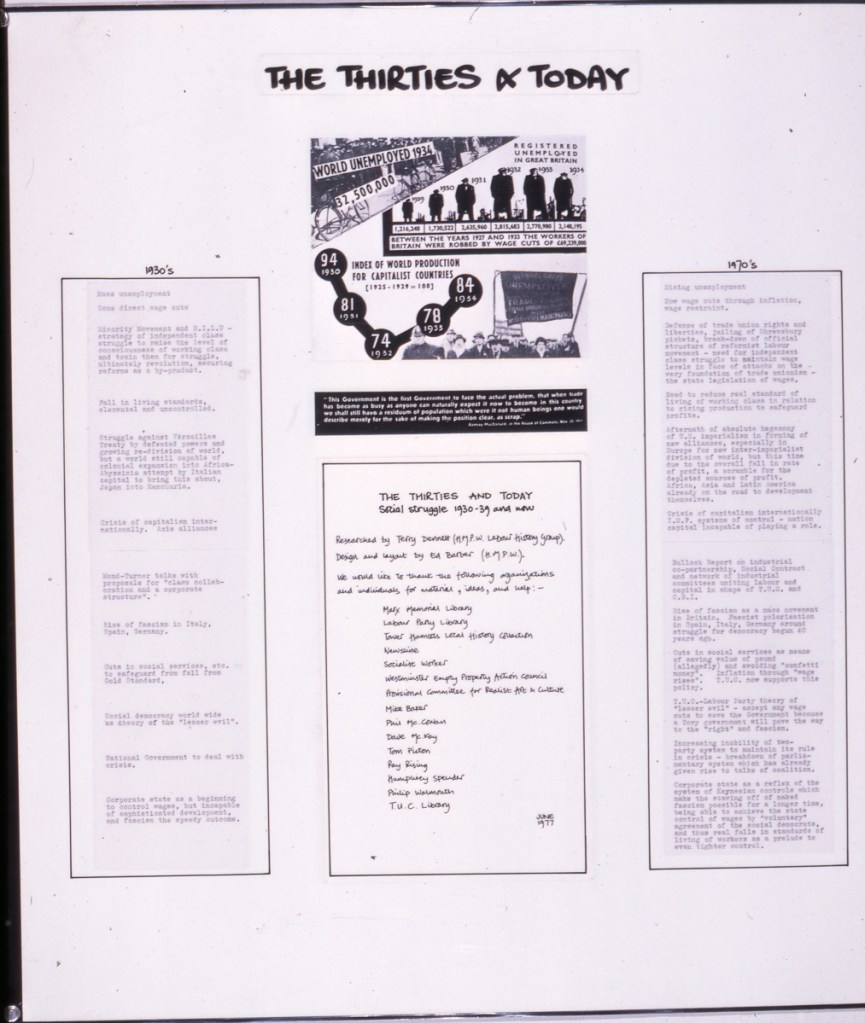
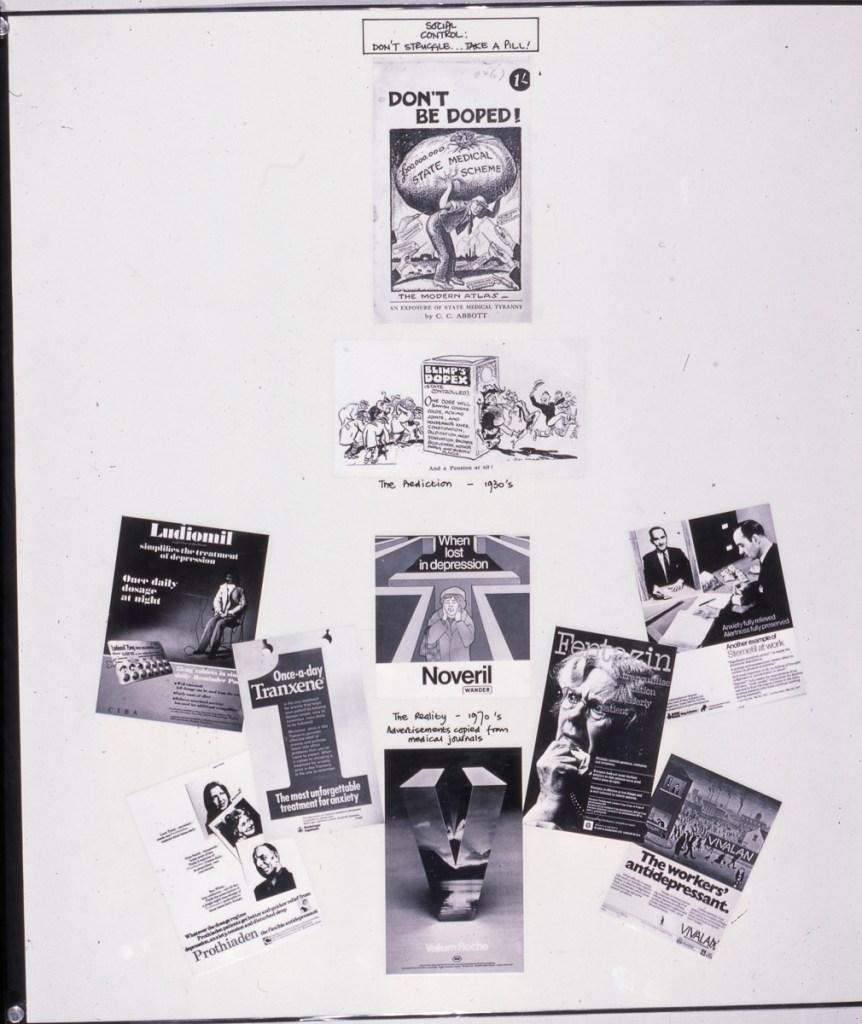
BY: THE LABOUR HISTORY RESEARCH GROUP of THE PHOTOGRAPHY WORKSHOP under the umbrella of THE HALF MOON PHOTOGRAPHY WORKSHOP.
DATE: 1977
SIZE: 30 panels
FUNDED: Self-funded by the projects involved.
SYNOPSIS: A lot of different groups contributed a panel each -groups like squatters’ rights and claimants union. The exhibition used cartoons and photographs to look at labour history. It could be hung on its own or split up into 3 or 4 panels on different themes – e.g. Fascism, The Jarrow Marchers.
Aimed at use within educational and trade union contexts Used at conferences, seminars, and history workshops.
WAS AVAILABLE FROM THE PHOTOGRAPHY WORKSHOP, 152 UPPER STREET, N1
The Worker Photographer – Terry Dennett And Ed Rosen, Photography Workshop (1978/9)
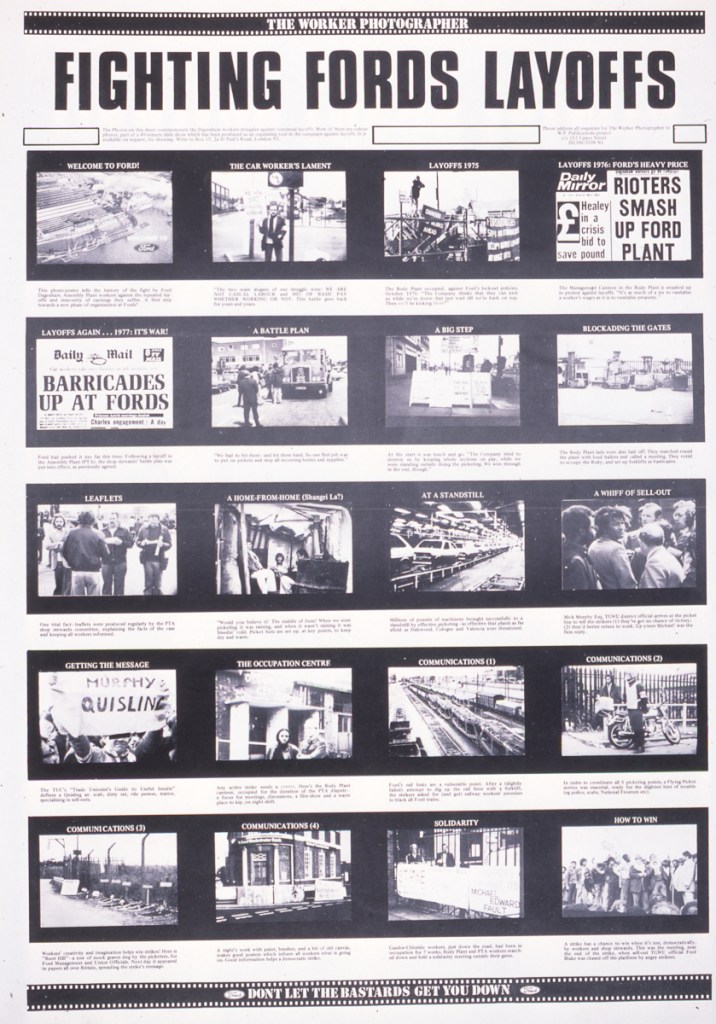
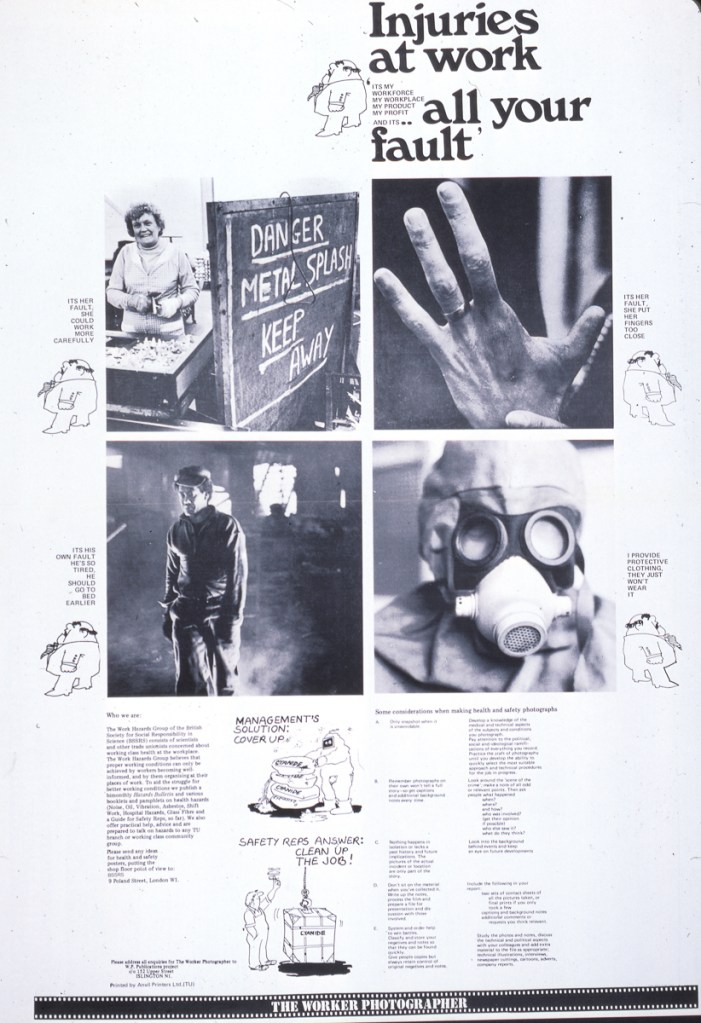
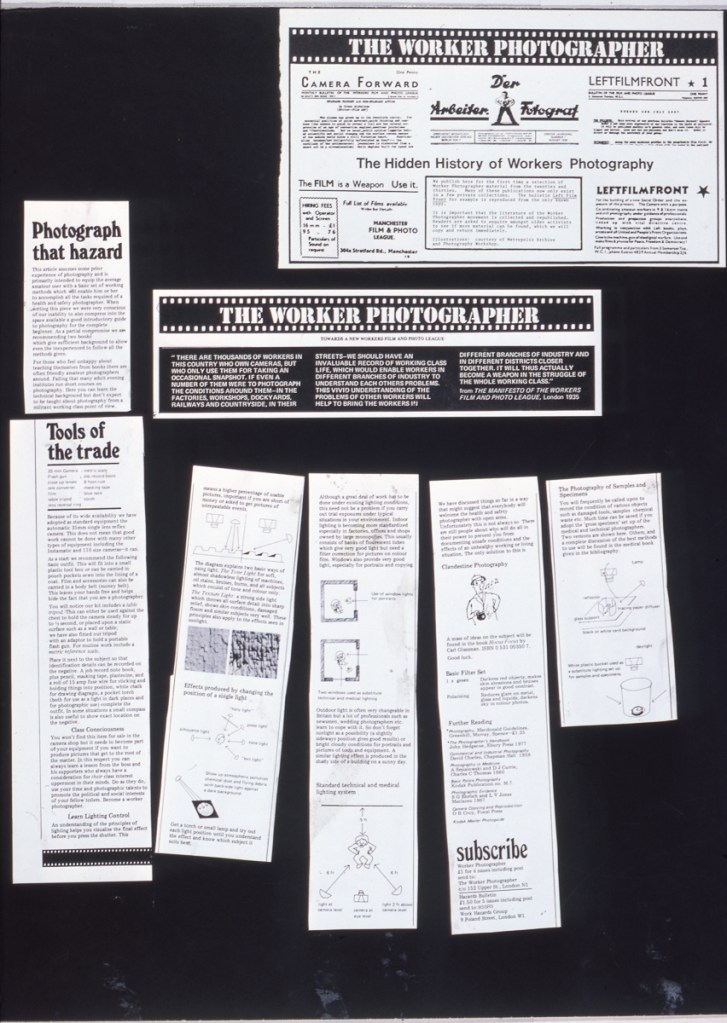
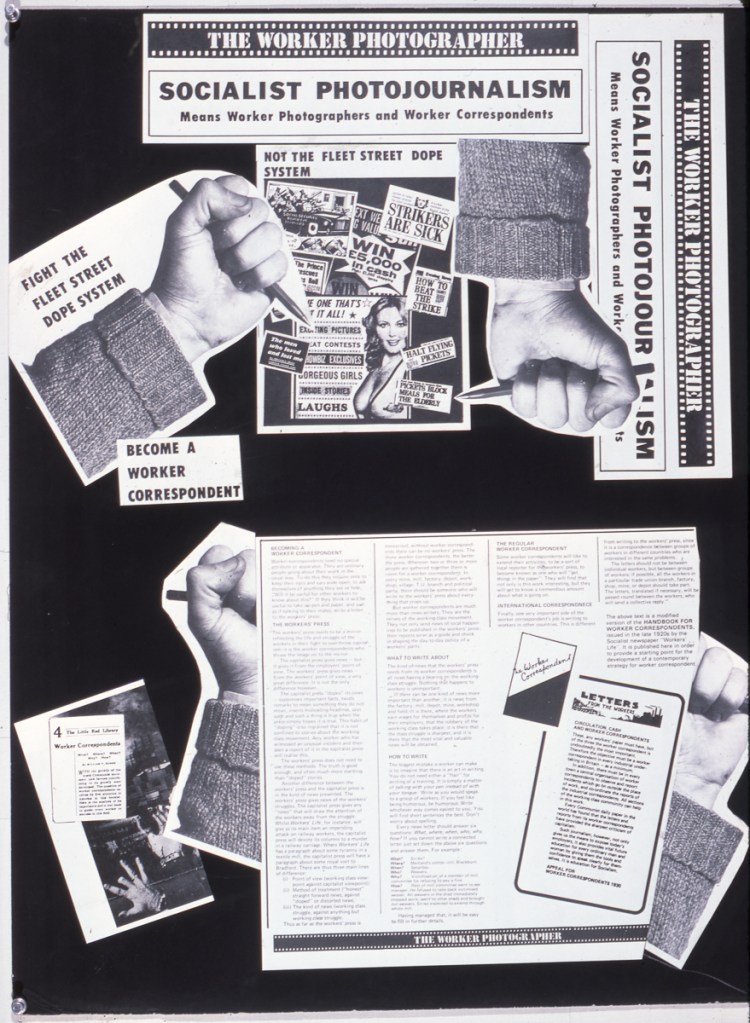
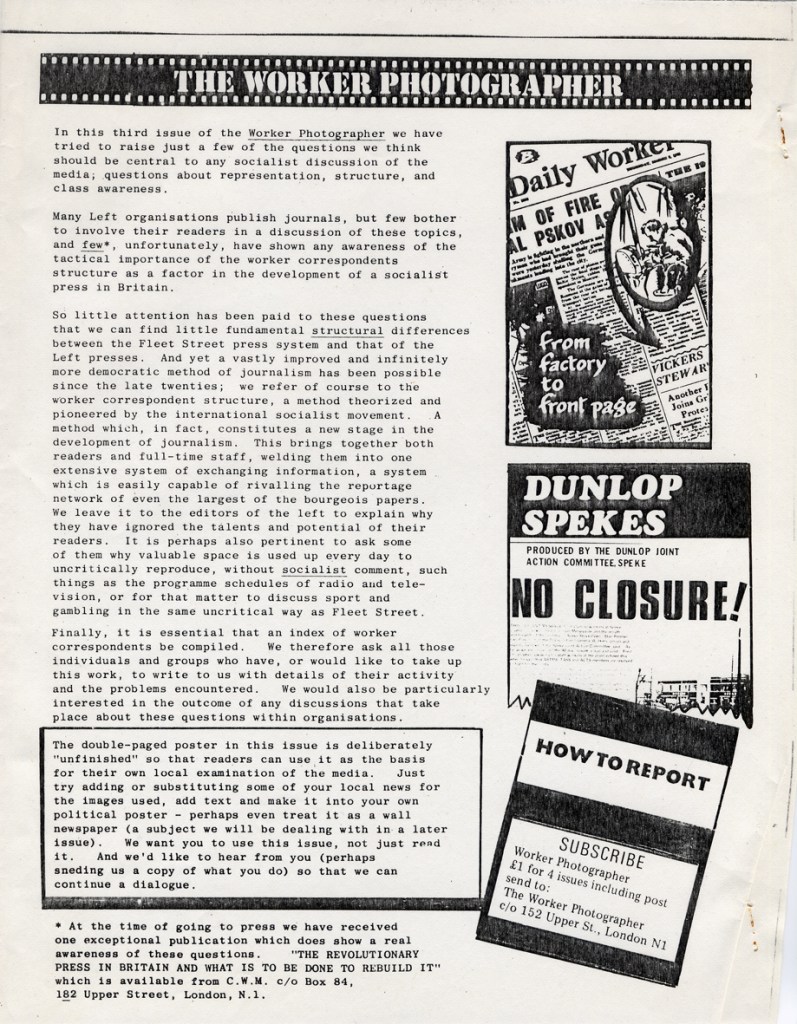
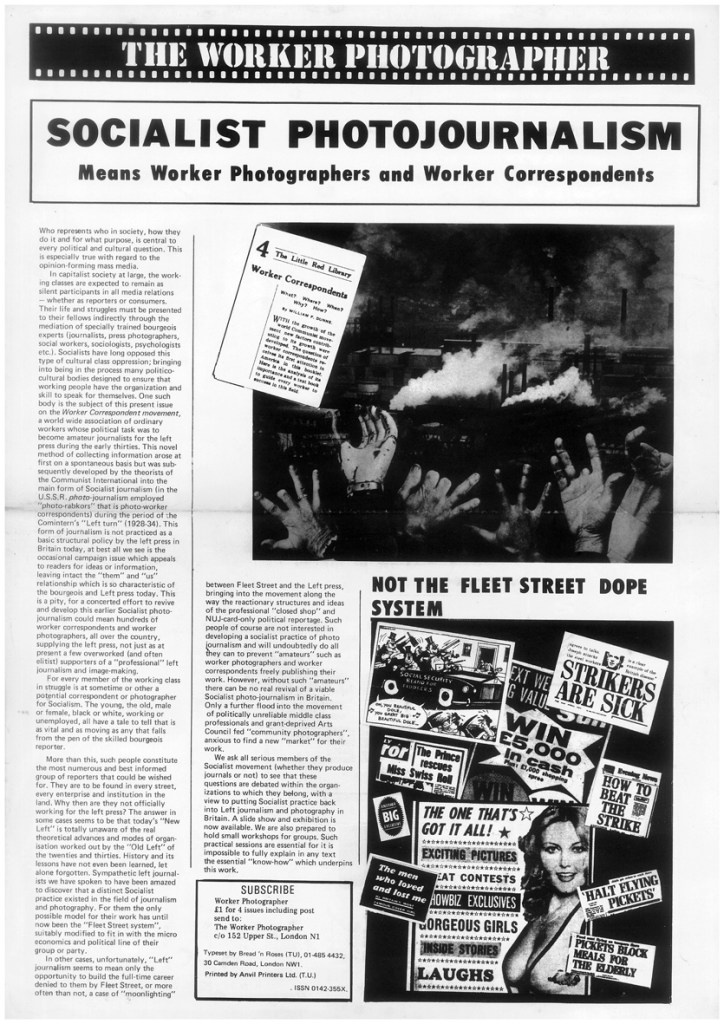
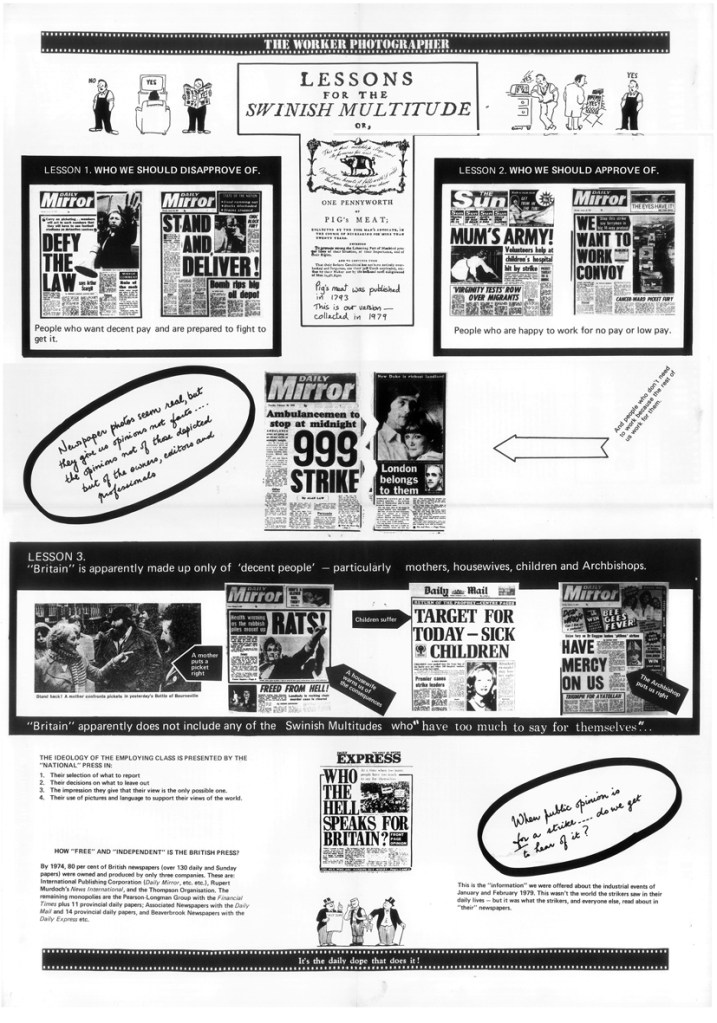
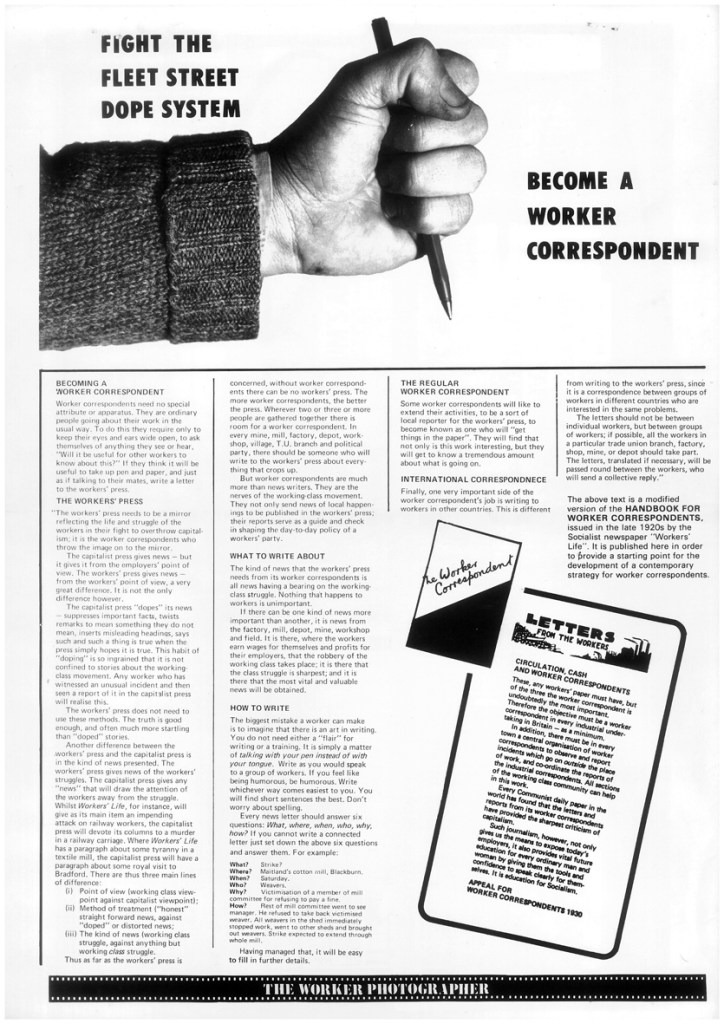
BY: TERRY DENNETT and ED ROSEN, under the umbrella of the Photography Workshop.
DATE: 1978/79
SIZE: 20 panels
FUNDED: Self-funded
SYNOPSIS: The Worker Photographer was a poster/broadsheet.
The idea was to take photography to the labour movement. The group had photographic skills and would invite other grassroots groups in the labour movement to work around an issue and leave these groups with photographic skills and understanding of how photography worked. “It was an attempt to open up once again discussions started within the socialist movement of the 1920’s and 1930’s about the class nature of photography and its specific forms and importance as a weapon of cultural struggle. It had some success in showing the ‘hidden story’ of labour photography and journalism exemplified by the concepts of the amateur ‘worker photographer’ and ‘worker correspondent and was responsible for the re-introduction of these concepts back into the language of the radical movement in Britain. On a practical level, however, it was a premature experiment from which no further journals or stable groupings developed, to our knowledge.”
WAS AVAILABLE FROM PHOTOGRAPHY WORKSHOP, 152 UPPER STREET, N1
Waterloo Hoarding – Blackfriars Photography Project (1986)
BY: BLACKFRIARS PHOTOGRAPHY PROJECT AND WATERLOO COMMUNITY DEVELOPMENT GROUP
DATE: 1986
SIZE: billboard 20′ x 10′
FUNDED: Lambeth Council Planning Committee
SYNOPSIS: Part of the Waterloo Community Development Group’s campaign against the siting of the Channel Tunnel Terminal at Waterloo, it was inspired by the work of the Docklands Poster Project and the impact of the GLC poster campaign. Sited in BaylissRoad, the hoarding was wrapped in black PVC and then carried two sequential messages. The unwrapping was timed to coincide with Lambeth Council and local residents giving evidence before the Select Committee drawing up the Channel Tunnel Bill. At the ceremony, local people laid wreaths and flowers.
What’s A Nice Girl Like You Doing In A Place Like This? – Monocrone (1983)
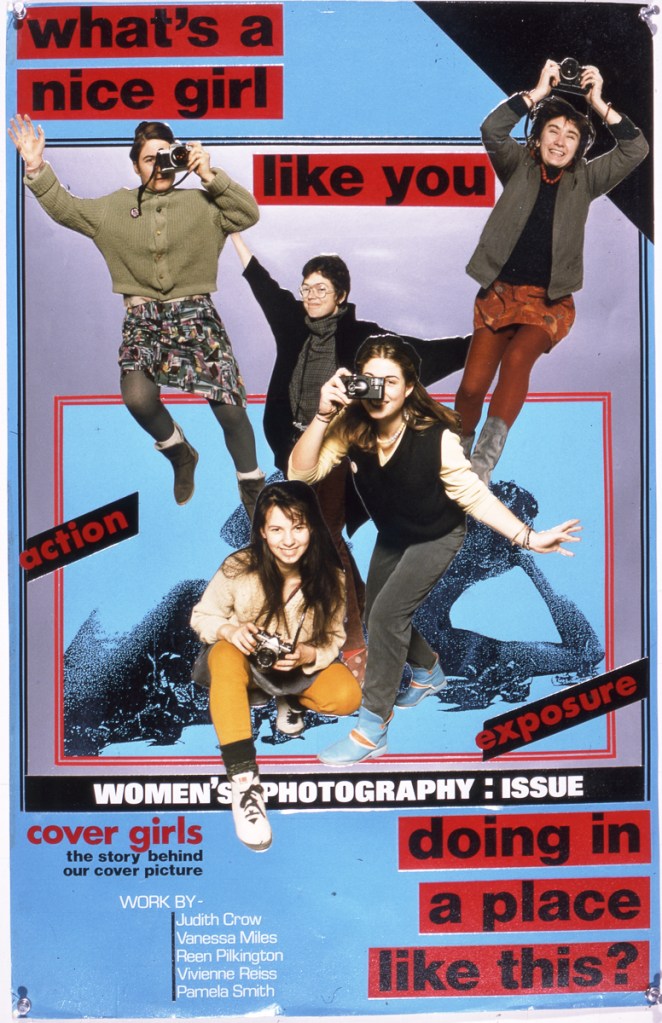
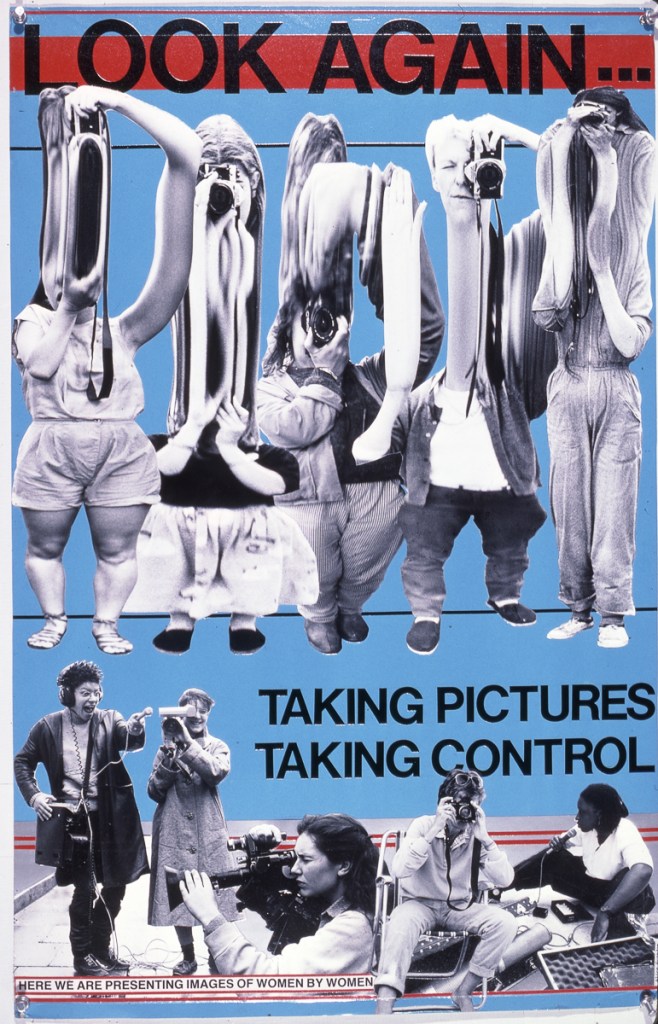
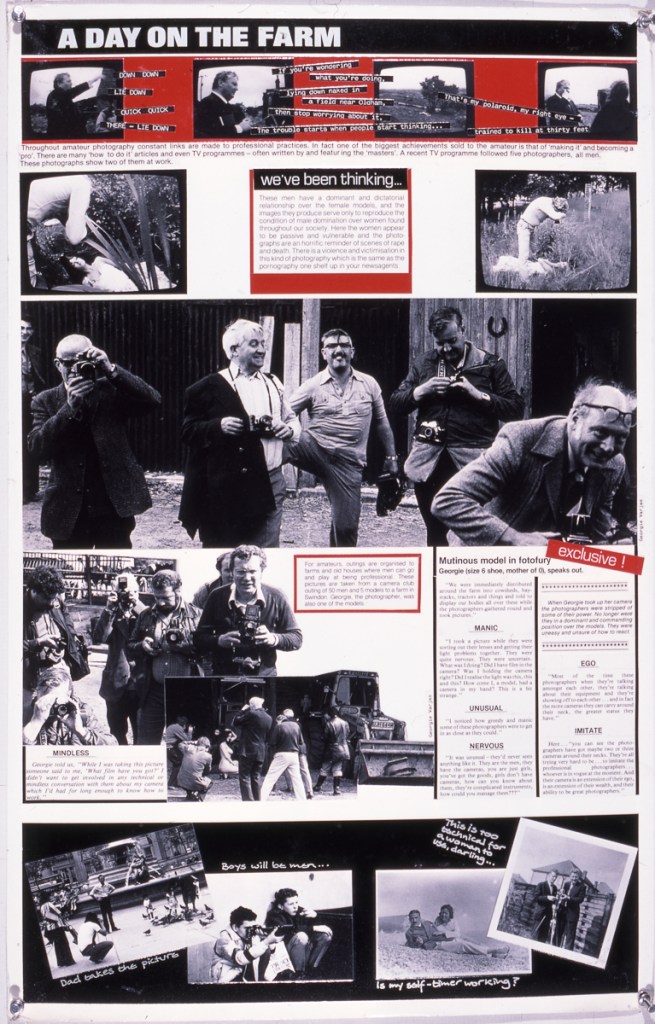
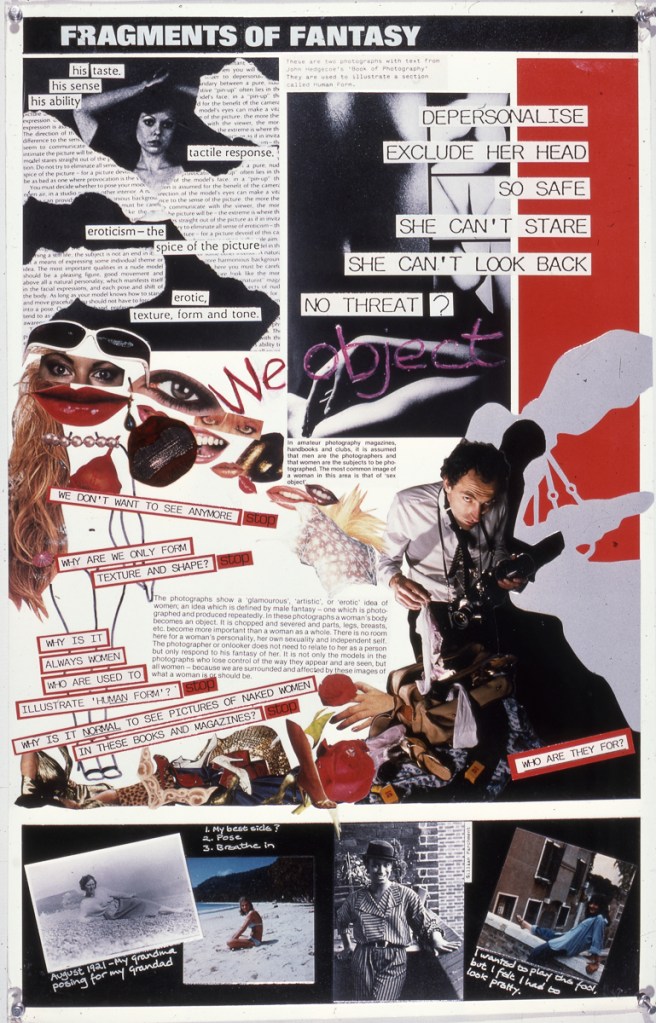
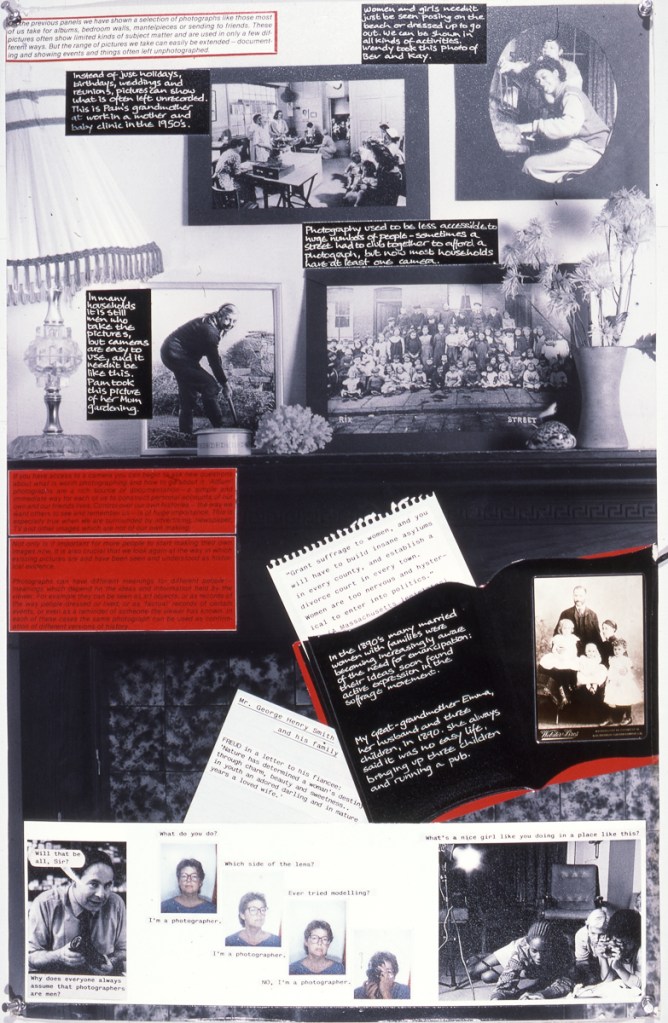
BY: MONOCRONE – JUDITH CROW, VANESSA MILES, REEN PILKINGTON, VIVIENNE REISS, PAMELA SMITH
DATE: 1983
SIZE: 14 panels 18″ x 28″
FUNDED: Small grants to cover costs
SYNOPSIS: “Our aim was to produce an exhibition that looked critically at amateur photographic practice, and particularly its limited and limiting expectations of women, and to challenge it by offering alternatives: in images, in ways of working, in ways of using and thinking about photography, in the content and style of the exhibition itself. We made it in two parts. The first takes the format of an amateur photography magazine and subverts it. Subsequent panels present a series of arguments about the way women are represented and used. The nature of the relationships of power between men and women in amateur photography, fetishism, voyeurism and the objectification of women operate to produce the idealised and fantasy images of women pedalled in the amateur photography world. The second half turns the tables to show women using cameras themselves to make a wealth of different more positive images of women”.
12 copies circulated to local libraries and it has been hired by a range of women’s and girls’ groups, colleges, schools, teachers’ centres, photography projects and community centres.
WAS AVAILABLE FROM MONOCRONE, CLAPHAM POOL, CLAPHAM MANOR STREET, LONDON SW4
Whose World Is The World? – Poster Film Collective, (1979)


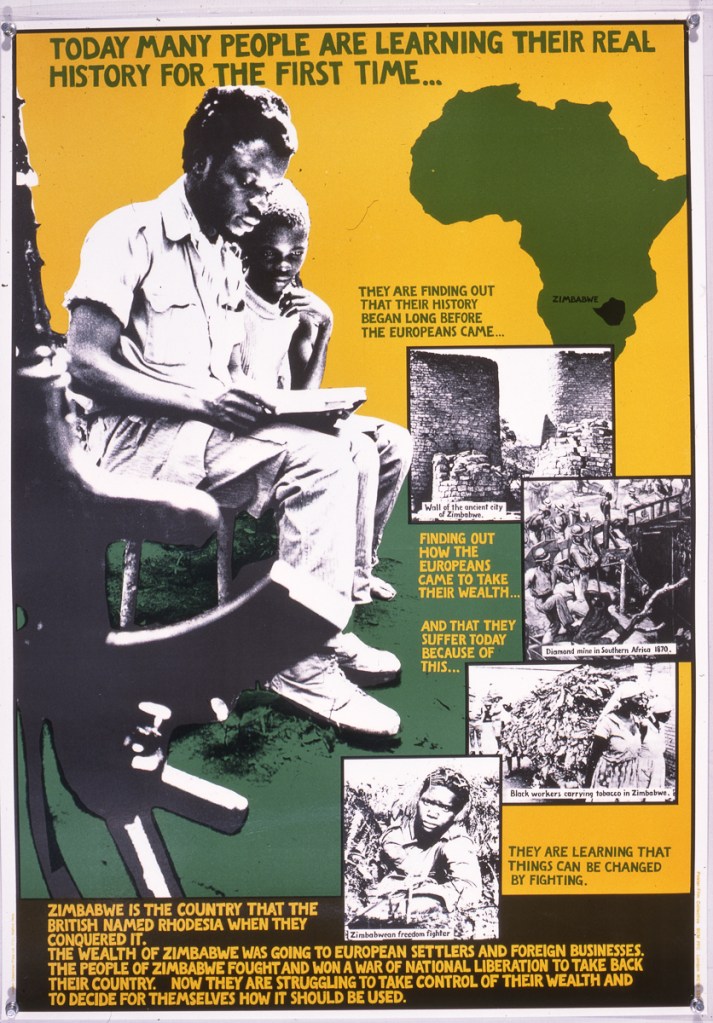

BY: POSTER FILM COLLECTIVE – with a group of London Teachers
DATE: 1979
FUNDED: Original 1979 silkscreen version (500 sets) produced with no grant aid.
Reprinted on litho in 1982 (2000 sets) with funding from the GLC.
SYNOPSIS: In attempting to develop a political poster culture in Britain the Poster Film Collective, whilst still creating single image/text relations in posters, recognised the limitations of this form, and tried to develop a new form more akin to ‘wall newspapers’.
By 1979 when “Whose World is the World?” was produced they had already made a number of series of posters designed to work in relationship to each other and to carry quite complex information or ideas.
This poster set was made primarily for use in secondary schools. It attempted to provide a historical perspective for teaching in multicultural schools, showing the links between the question of racism and the worldwide development of Western economic power.
Unlike other ‘exhibition’ forms poster sets could be mass-produced and sold cheaply. This set has been used widely in schools and colleges throughout the country.
WAS AVAILABLE FROM: THE POSTER FILM COLLECTIVE, BCM PFC, LONDON WC1N3XX
Who’s Still Holding The Baby? – The Hackney Flashers Collective (1978)
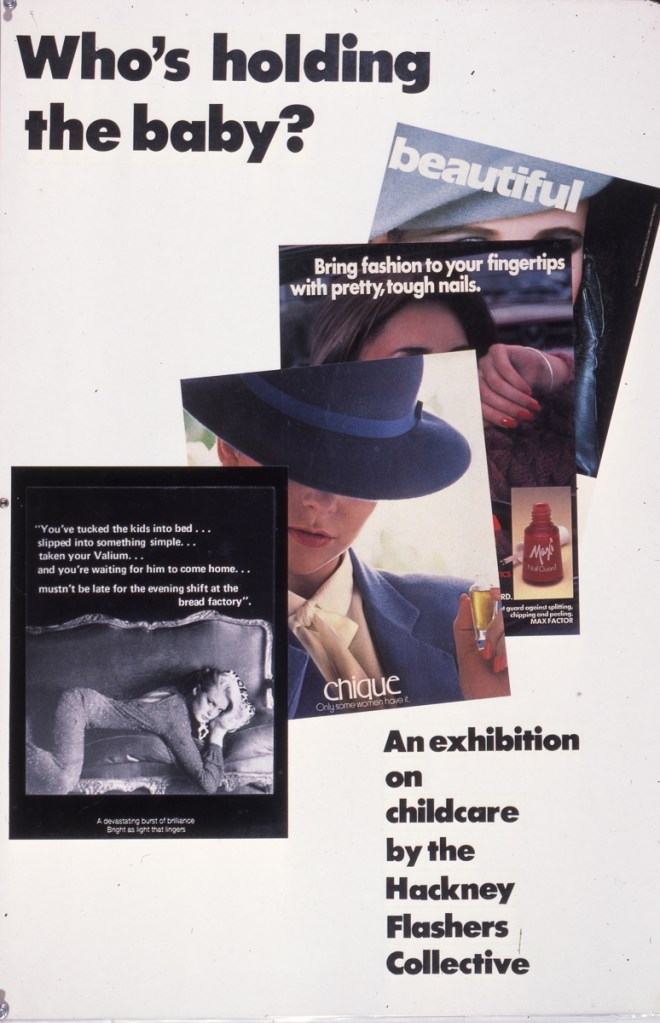
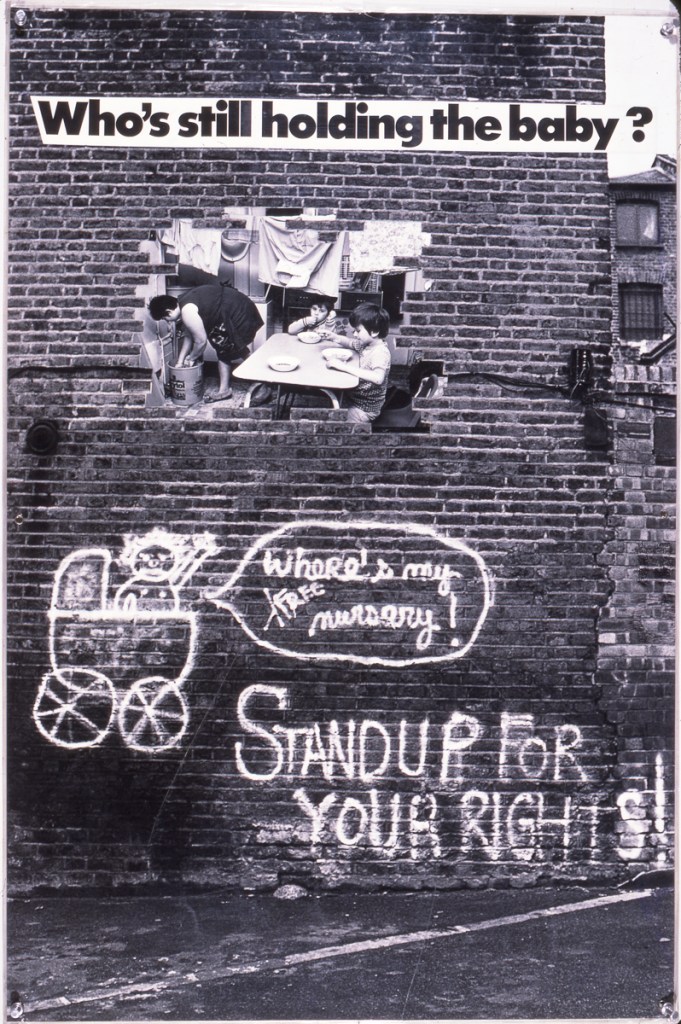
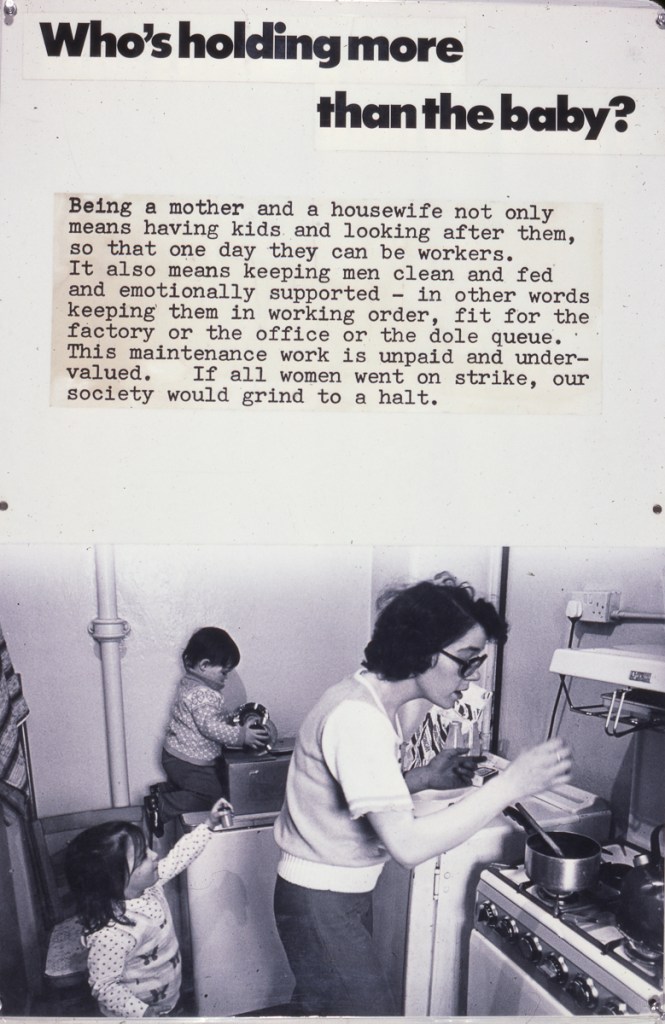
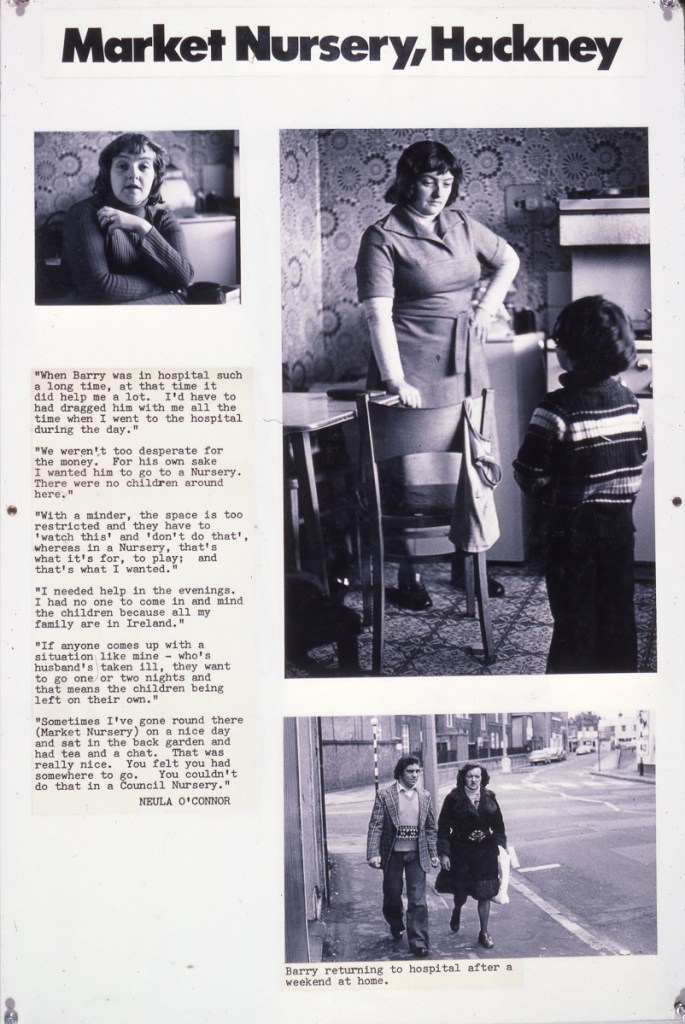
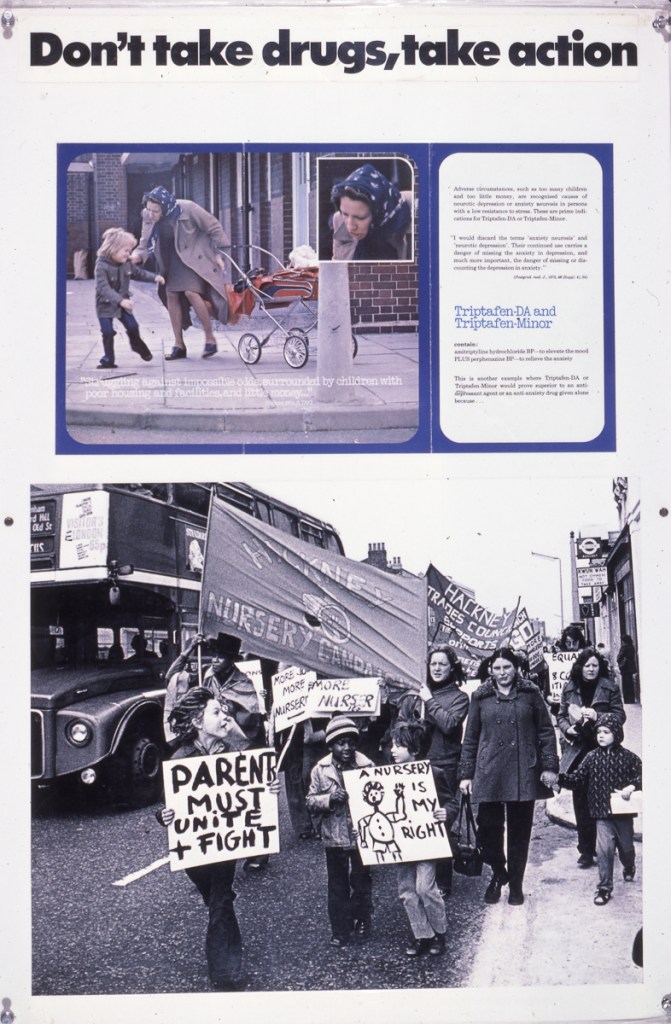
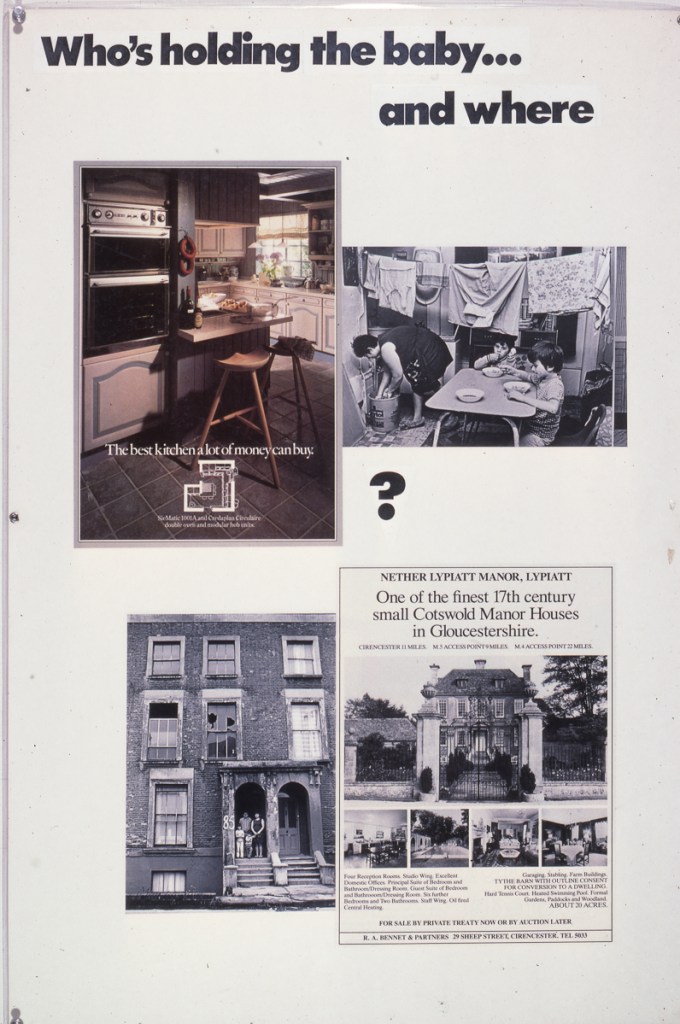
BY: THE HACKNEY FLASHERS COLLECTIVE
DATE: 1978
SIZE: 36 panels
FUNDED: Retrospectively funded by THE GULBENKIAN FOUNDATION
SYNOPSIS: The Hackney Flashers was a collective of ten women working in education and the media. It was formed in 1974 and its work was centred in Hackney because most of its members lived in or near the borough, and also because like many other working-class inner-city areas with a high immigrant population, Hackney’s hospital, housing and other services were coming increasingly under attack through cuts in public spending.
Who’s Still Holding the Baby? took two years to complete. “The limitations of documentary photography became apparent with the completion of the ‘Women and Work’ exhibition. The photographs assumed a ‘window on the world’ through the camera and failed to question the notion of reality rooted in appearances. The photographs were positive and promoted self-recognition but could not expose the complex social and economic relationships within which women’s subordination is maintained. We began to juxtapose our naturalistic photographs with media images to point to the contradictions between women’s experience and how it is represented in the media. We wanted to raise the question of class, so much obscured in the representation of women’s experience as universal.”
First exhibited at Centerprise Community Centre in Hackney.
A tape/slide show based on the exhibition, entitled “Domestic Labour and Visual Representation” is available from S.E.F.T. at 29 Old Compton St.Wl.
This exhibition could be viewed at the Cockpit Gallery although it was no longer available for hire.
Women – Work In Hackney, The Hackney Flashers Collective 1975)
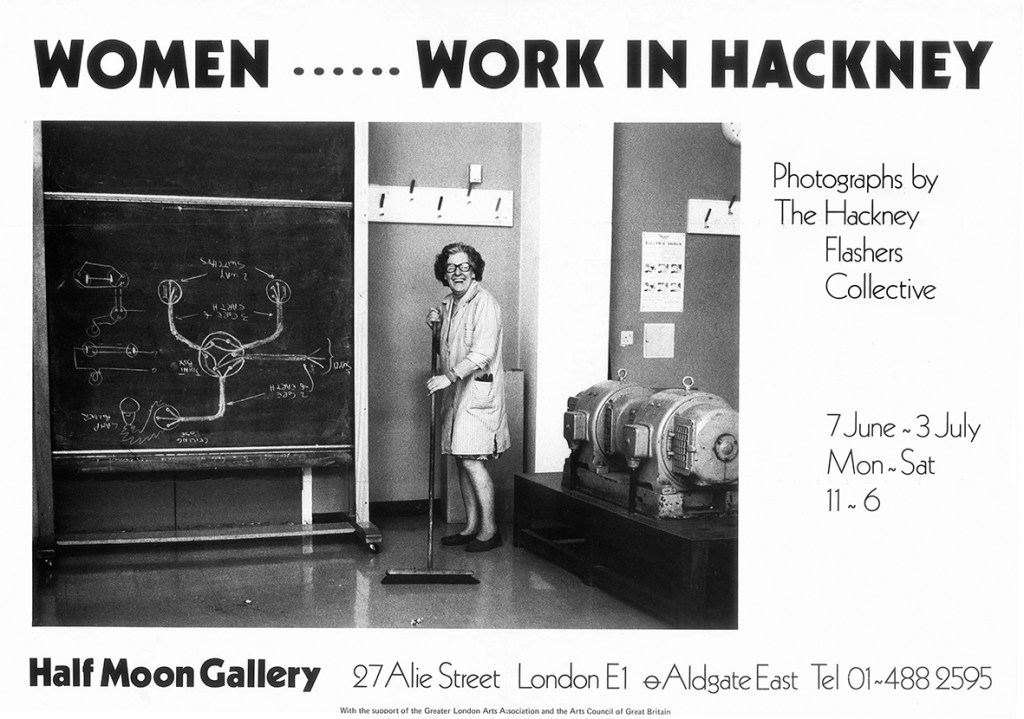
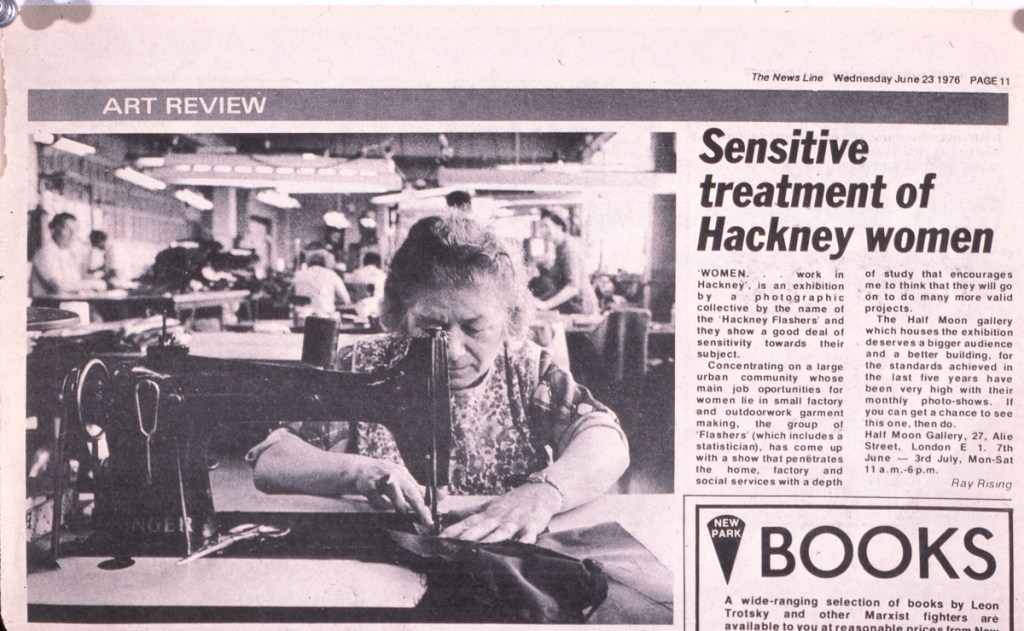
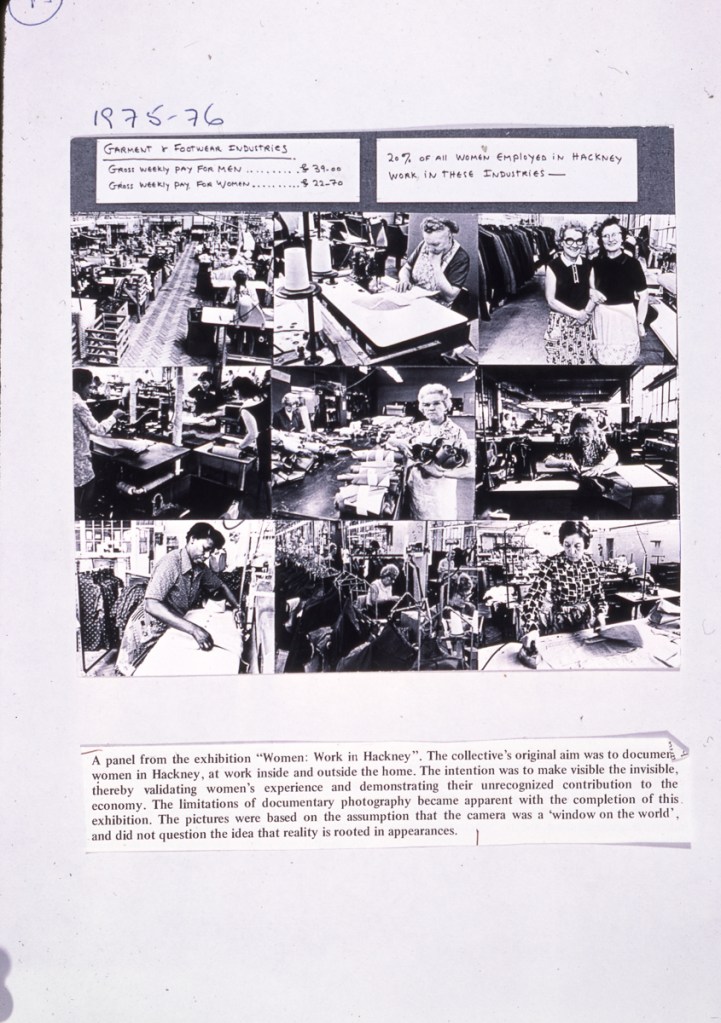
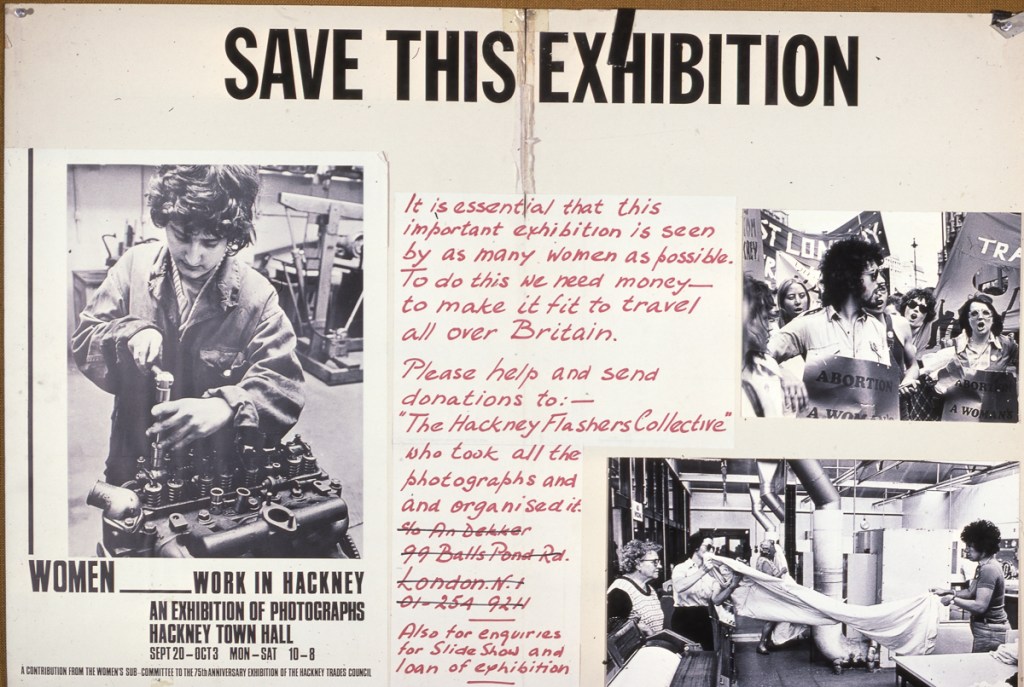
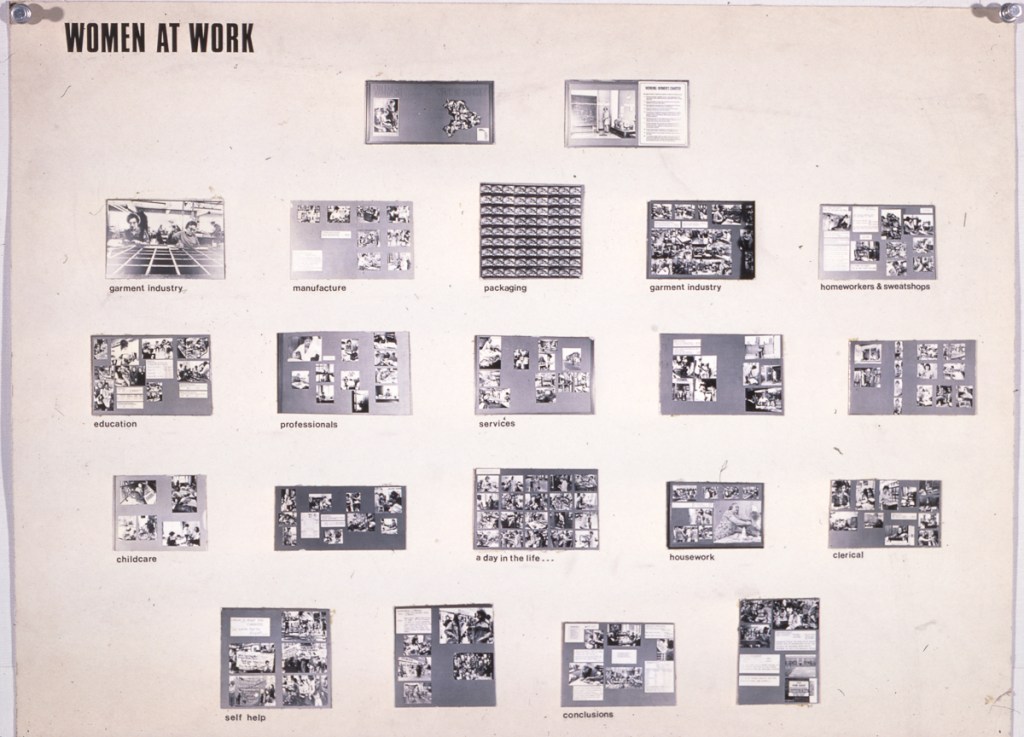
BY: THE HACKNEY FLASHERS COLLECTIVE
DATE: 1975
SIZE: ORIGINALLY PASTED ONTO 4′ SQUARE HARDBOARD 21 panels
FUNDED: HACKNEY TRADES COUNCIL
SYNOPSIS: The Hackney Flashers was a collective of ten women working in education and the media. It was formed in 1974 and its work was centred in Hackney because most of its members lived in or near the borough, and also because, like many other working-class inner-city areas with a high immigrant population, Hackney’s hospital, housing and other services were coming increasingly under attack through cuts in public spending.
” The collective’s original aim was to document women in Hackney, with the intention of making visible the invisible, thereby validating women’s experience and demonstrating women’s unrecognised contribution to the economy”. The collective photographed a cross-section of working women in Hackney, in factories, nurseries, shops and sweatshops; including Home-workers, childminders, school teachers and parents. The pictures were linked with text which gave the current unequal pay statistics and showed how women were fighting back.
Produced as part of Hackney Trades Council’s 75th Anniversary Celebrations.”75yrs. of Brotherhood”(sic)
The panels no longer exist, but photographs could be seen at the Photography Workshop archive, 152 Upper Street, N1.
Work In Progress – Cockpit Arts Workshop (1981)
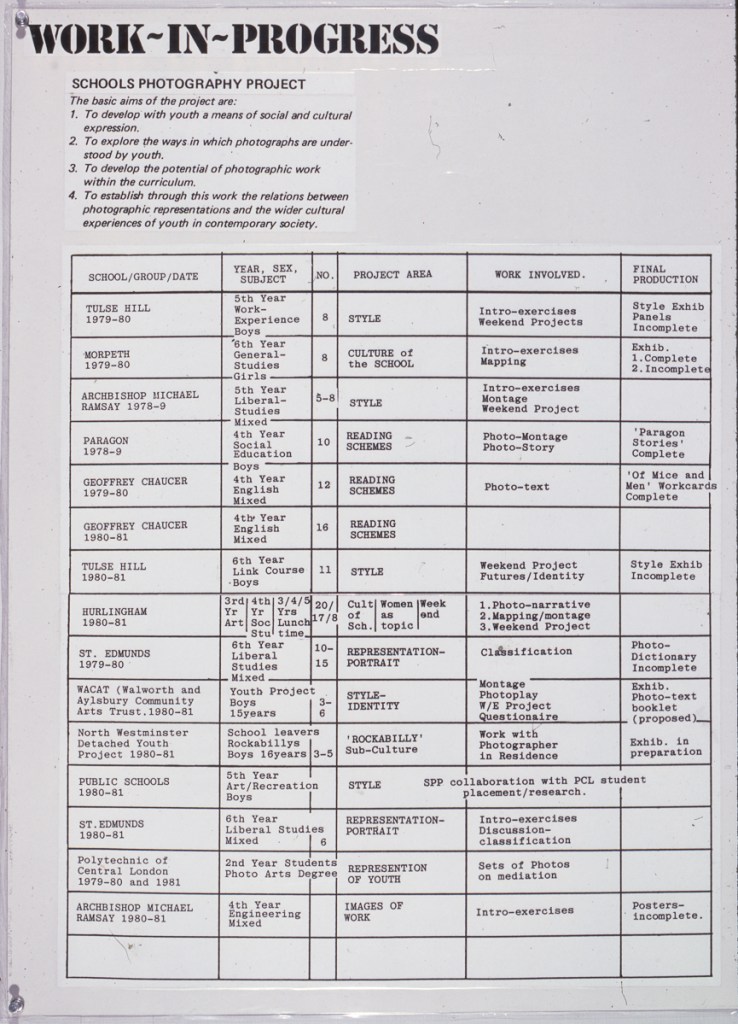
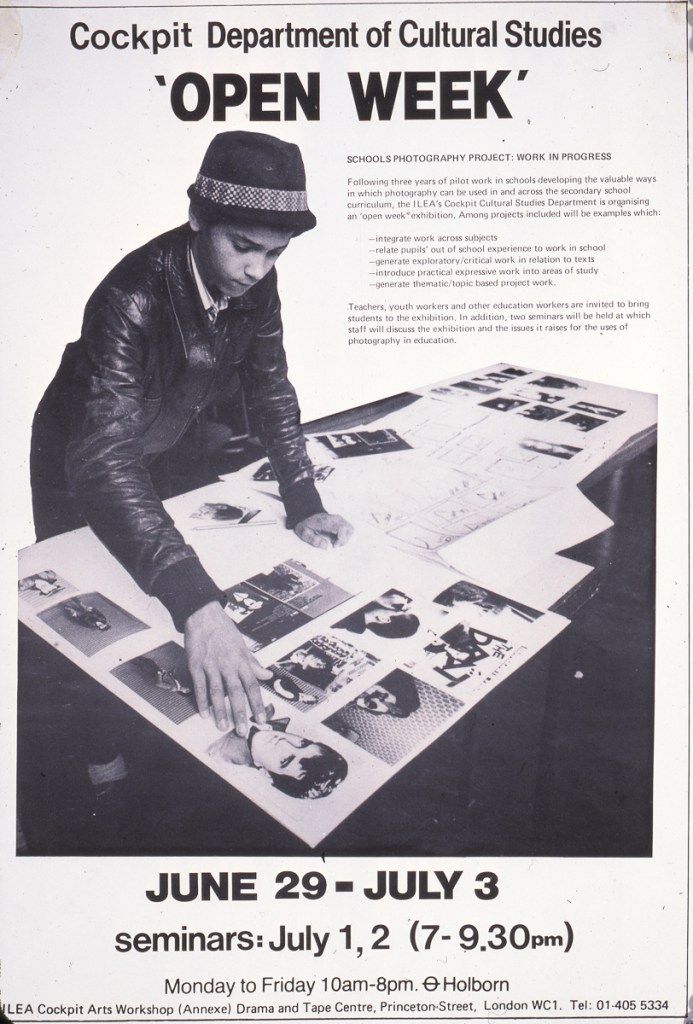
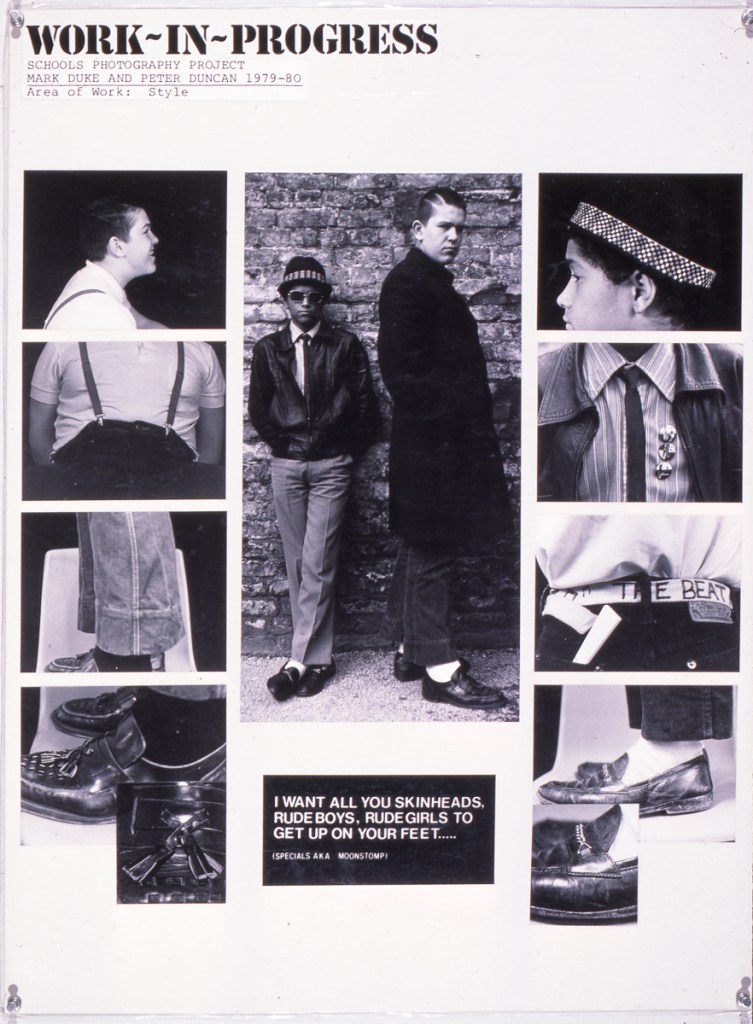
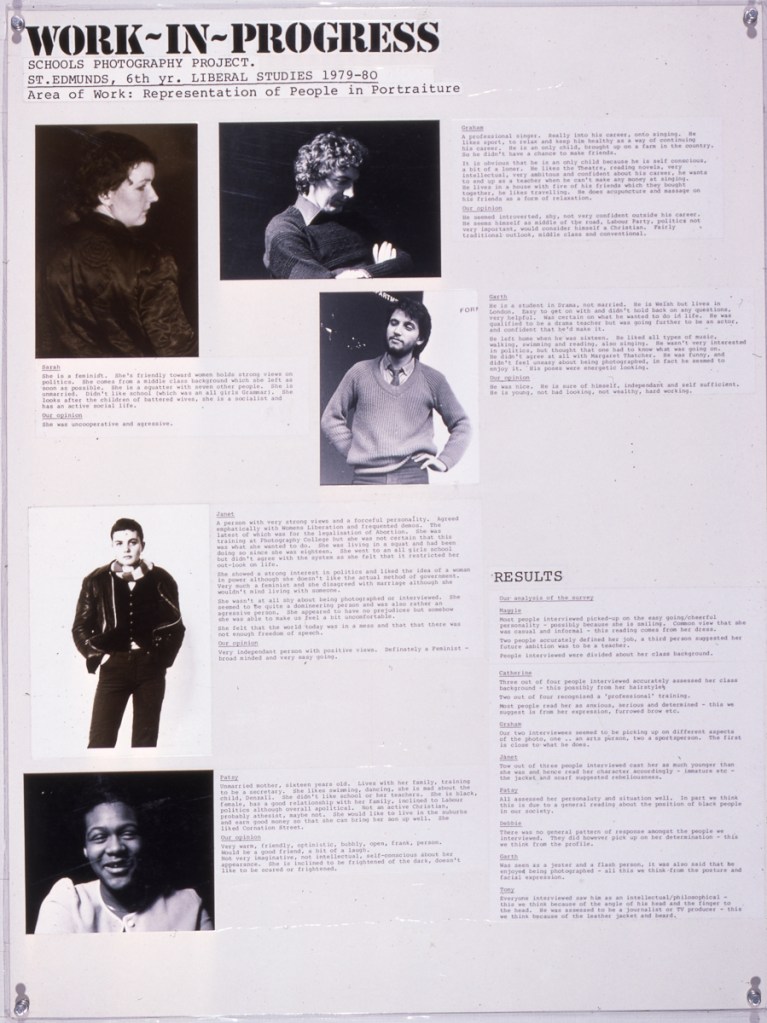
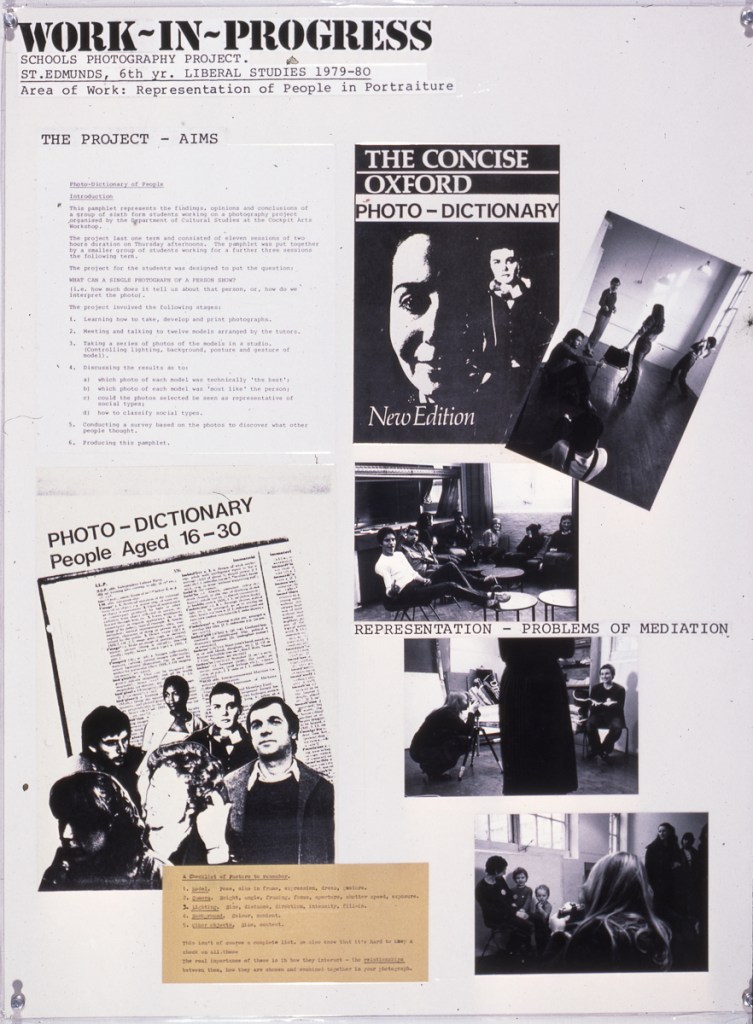
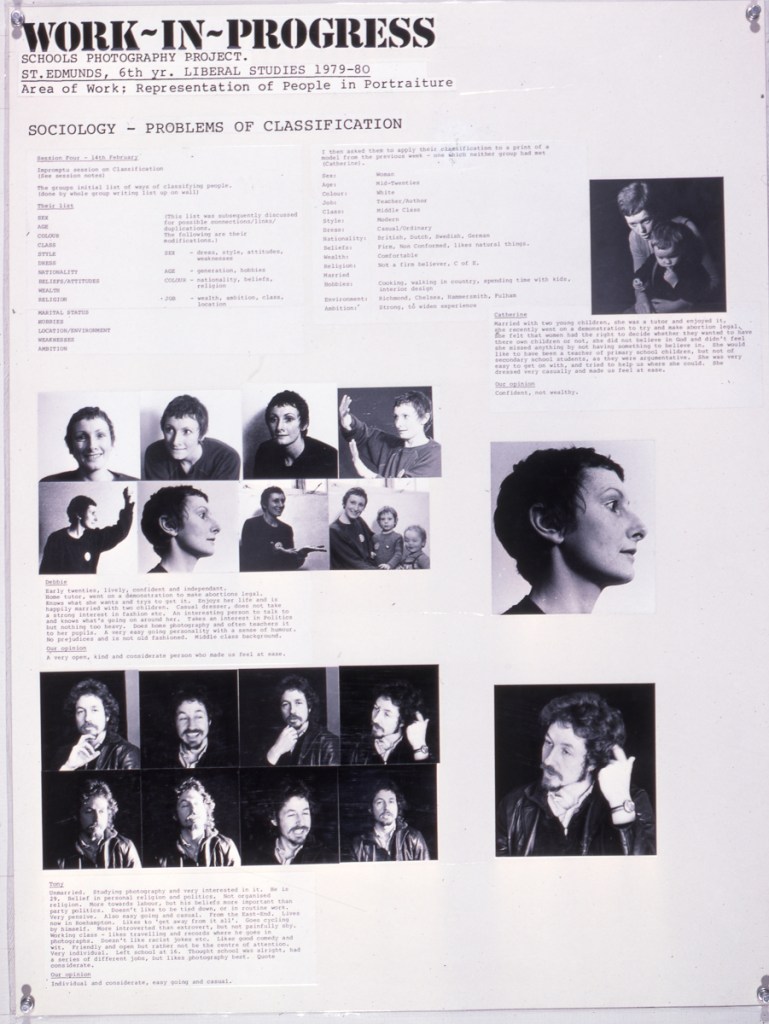
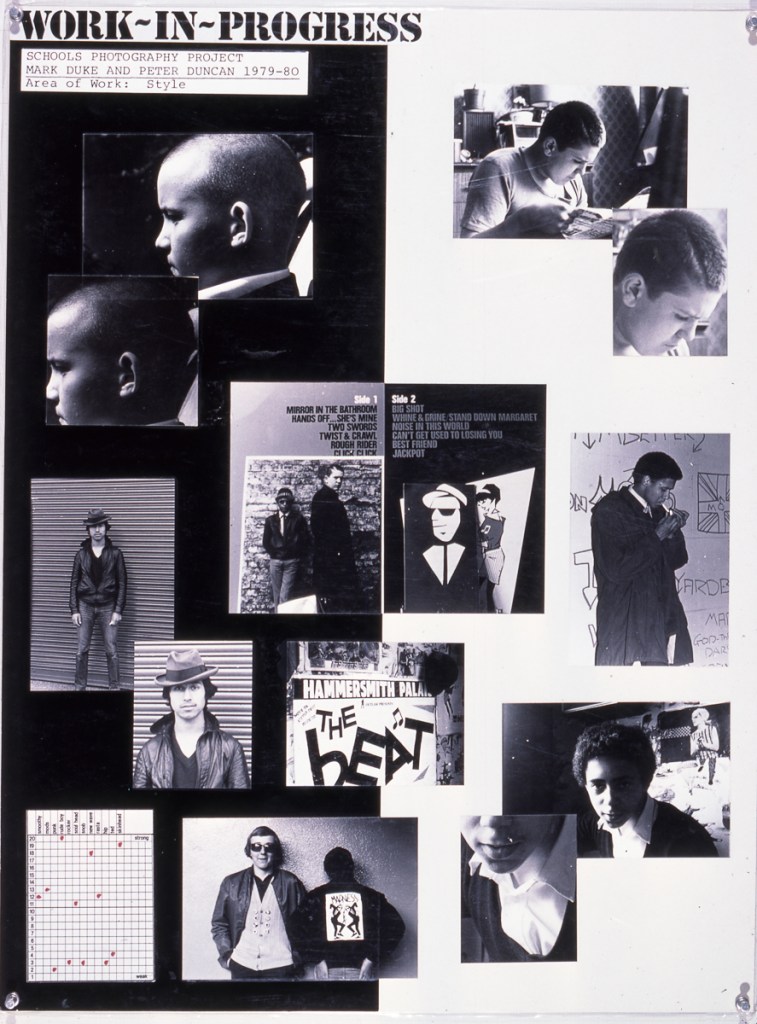
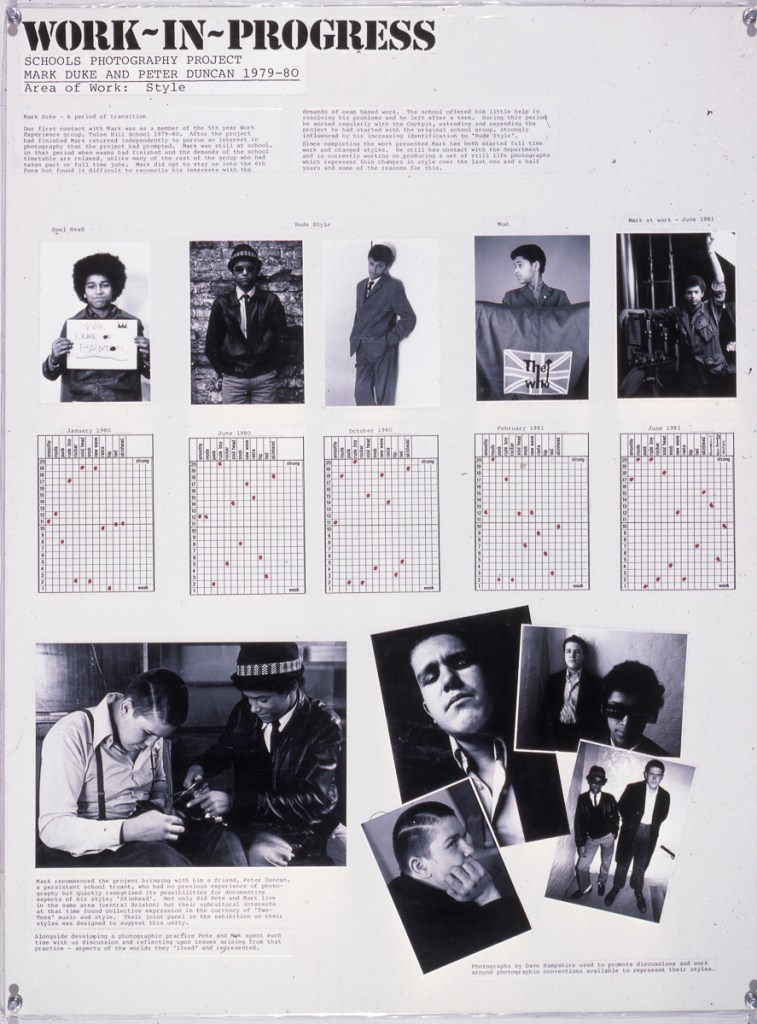
BY: DEPARTMENT OF CULTURAL STUDIES COCKPIT ARTS WORKSHOP
DATE: 1981
SIZE: 75 Laminated panels 20″x30″
FUNDED: By the Department of Cultural Studies.
SYNOPSIS: EXAMPLES OF THE RANGE OF PHOTOGRAPHIC AND WRITTEN WORK PRODUCED BY STUDENTS OF THE SCHOOLS PHOTOGRAPHY PROJECT WHICH RAN IN FOURTEEN ILEA SCHOOLS BETWEEN 1979 AND 1981. IT WAS PRODUCED PRIMARILY FOR TEACHERS AND THOSE INTERESTED IN PROMOTING PHOTOGRAPHY IN EDUCATION TO SHOW THE DIFFERENT APPROACHES ADOPTED BY CULTURAL STUDIES WORKERS IN DEVELOPING PRACTICAL PHOTOGRAPHY PROJECTS ACROSS THE SECONDARY CURRICULUM.
The exhibition typically carried a lot of typed text which attempted to give some of the educational thinking behind each project. Exhibited at the Cockpit Gallery under the title of ‘Cultural Studies Open Week’ it has never been shown again. A booklet was produced to coincide with the exhibition which was the Pilot report of the Schools Photography Project, entitled Youth, Class and Schooling.
WAS AVAILABLE FOR INSPECTION THROUGH THE DEPARTMENT OF CULTURAL STUDIES AND ON SLIDE THROUGH THE COCKPIT GALLERY
Text from the Hang Ups exhibition catalogue.
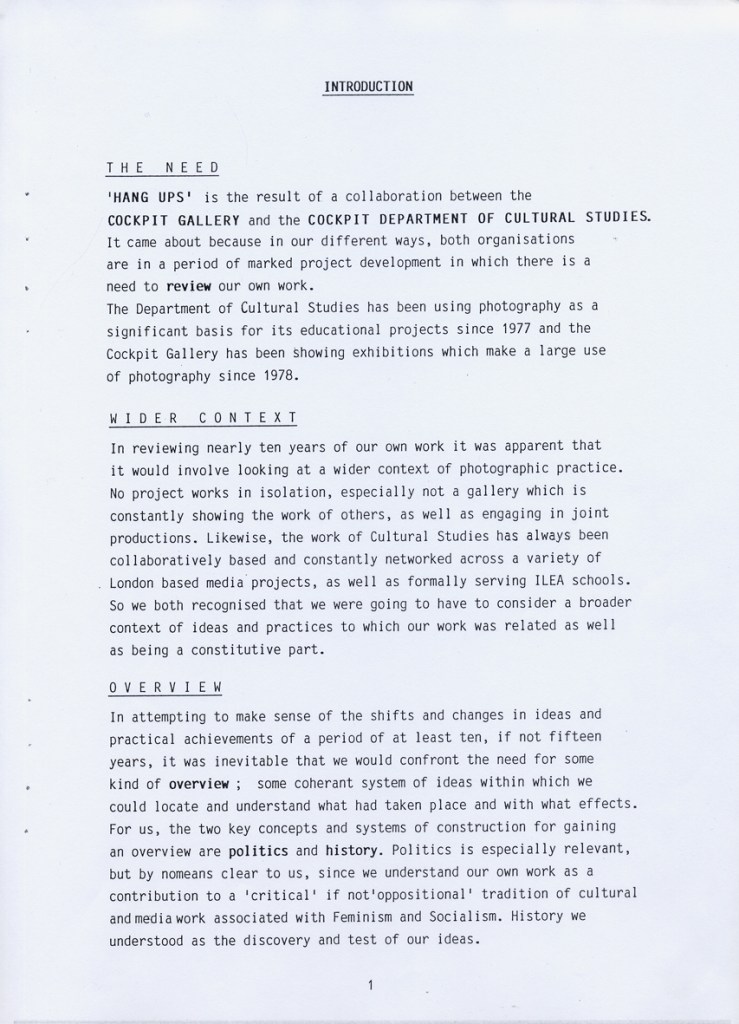
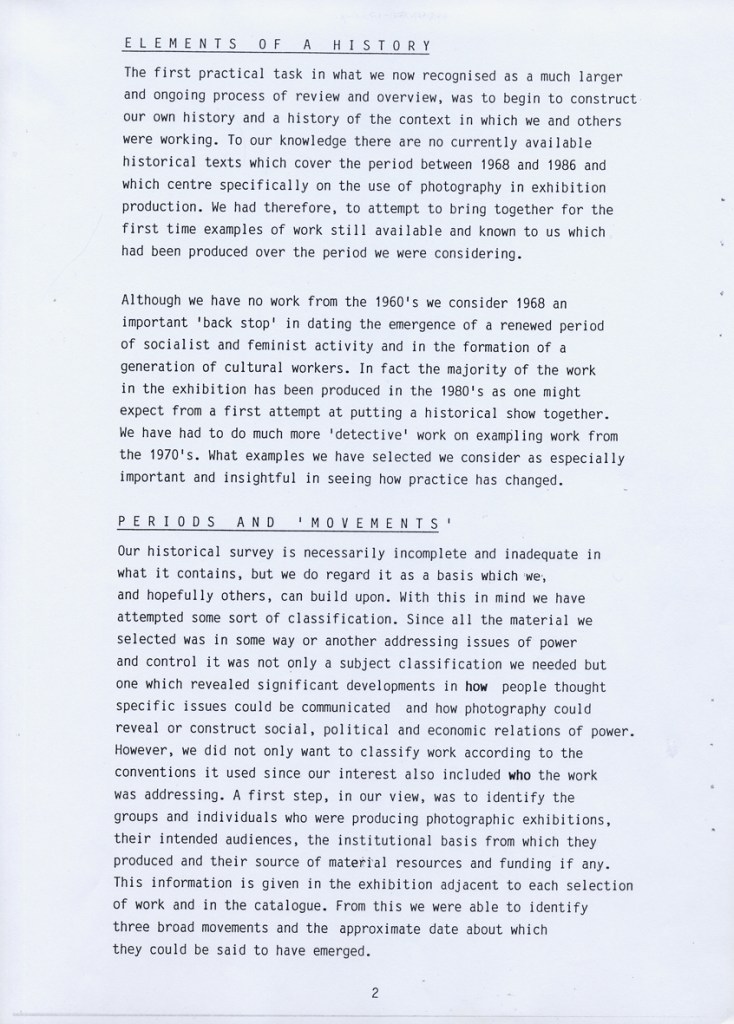
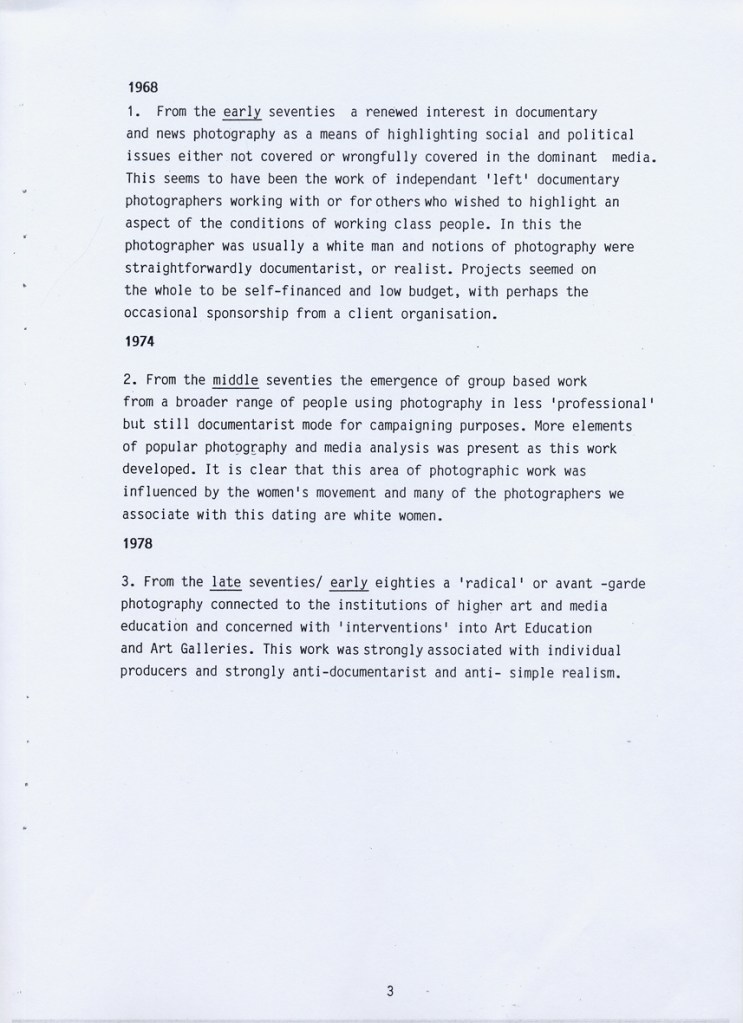
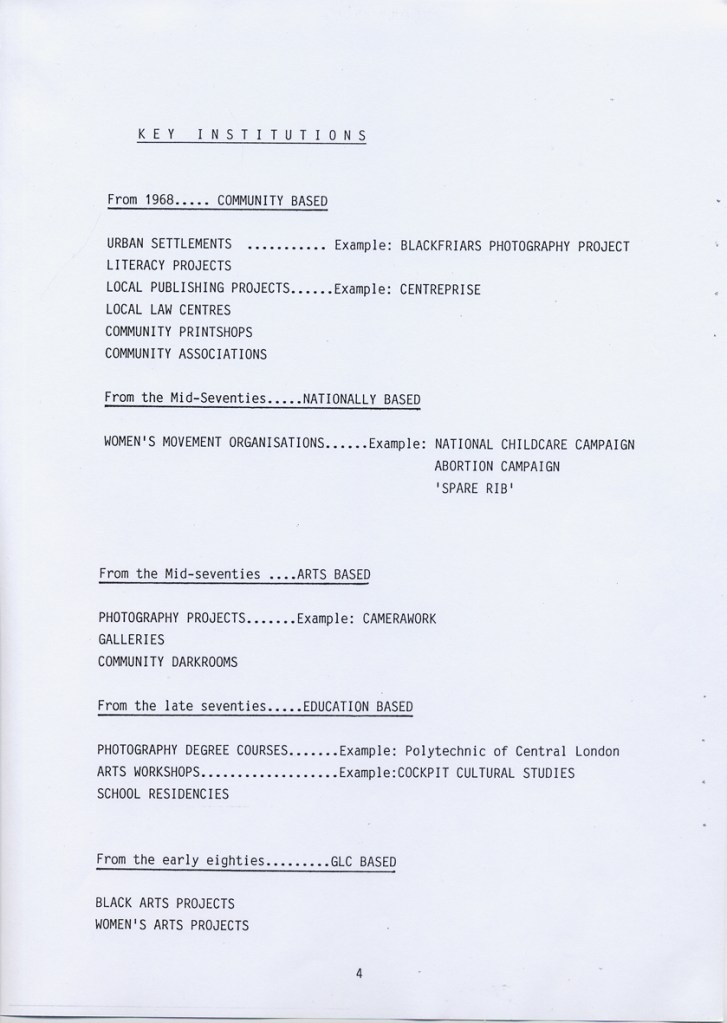
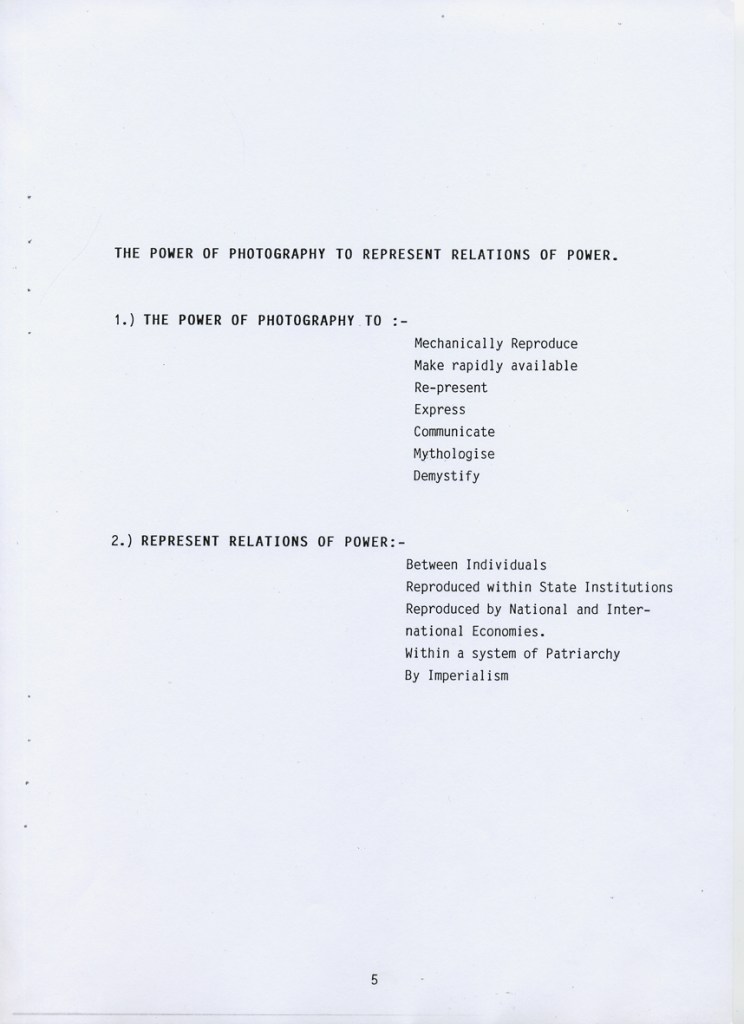
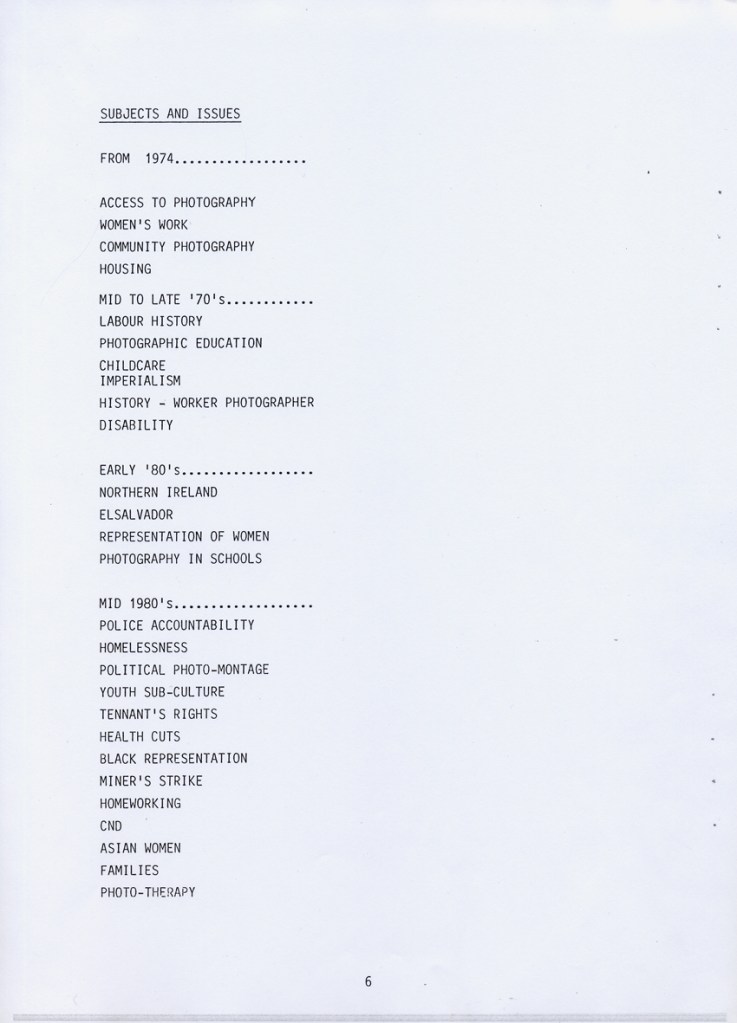
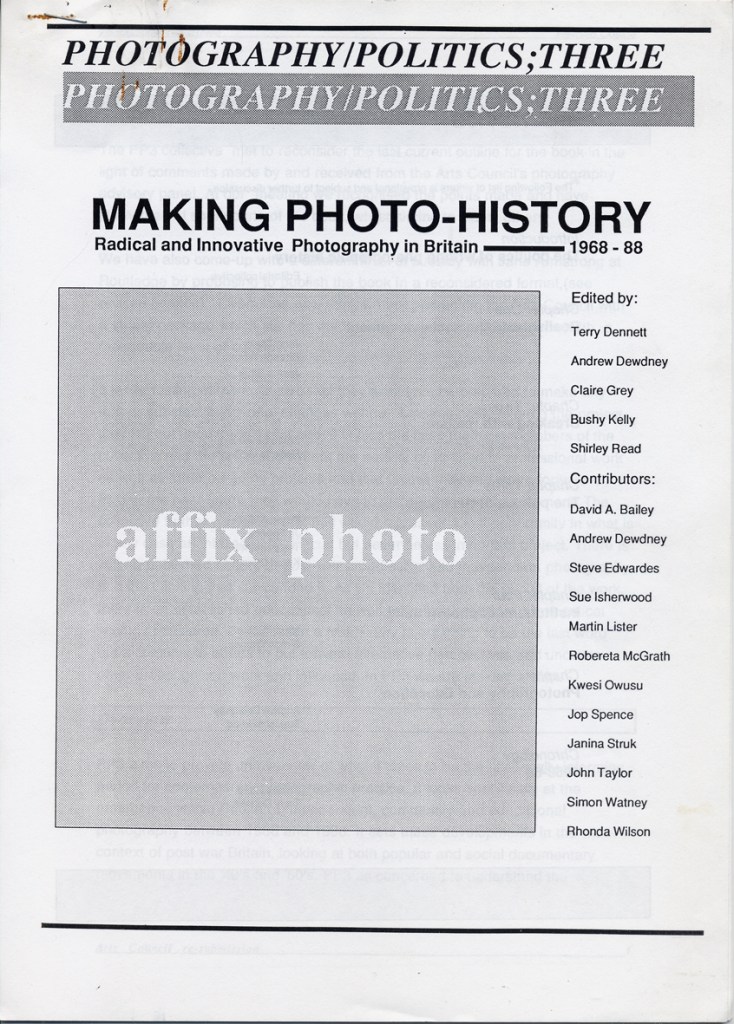
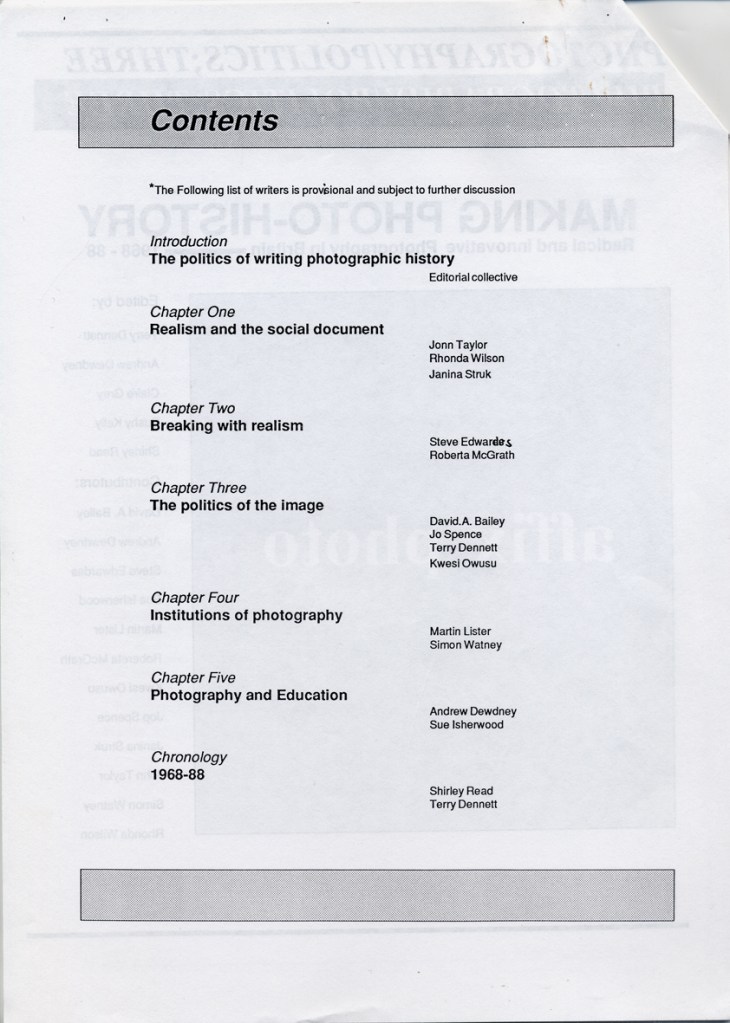
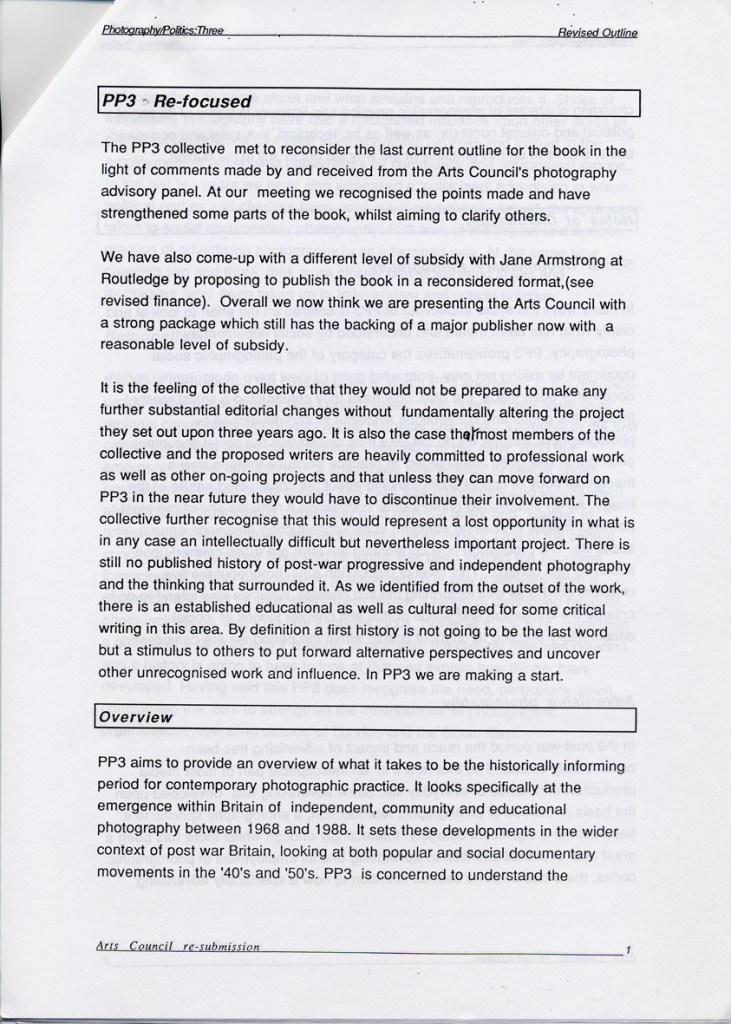
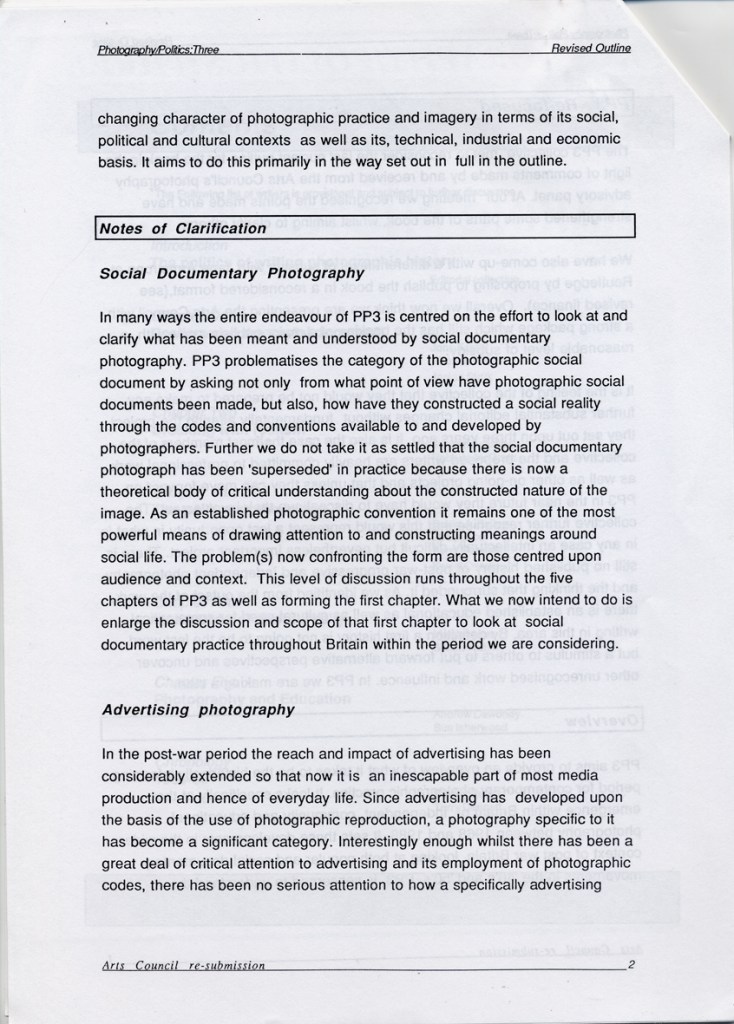
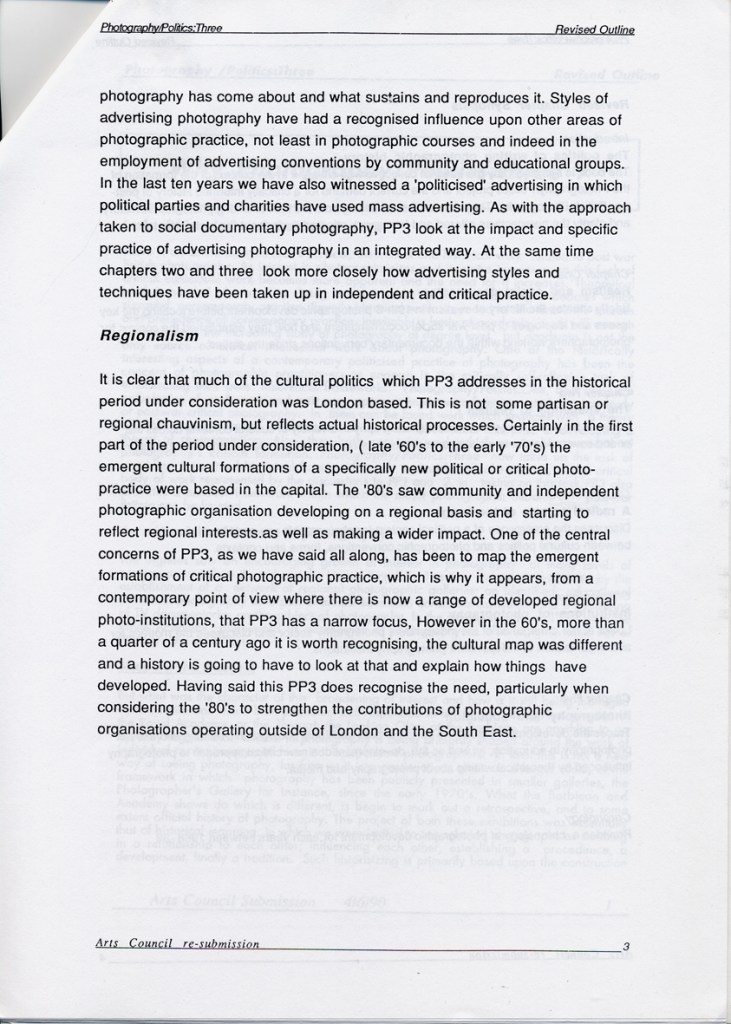
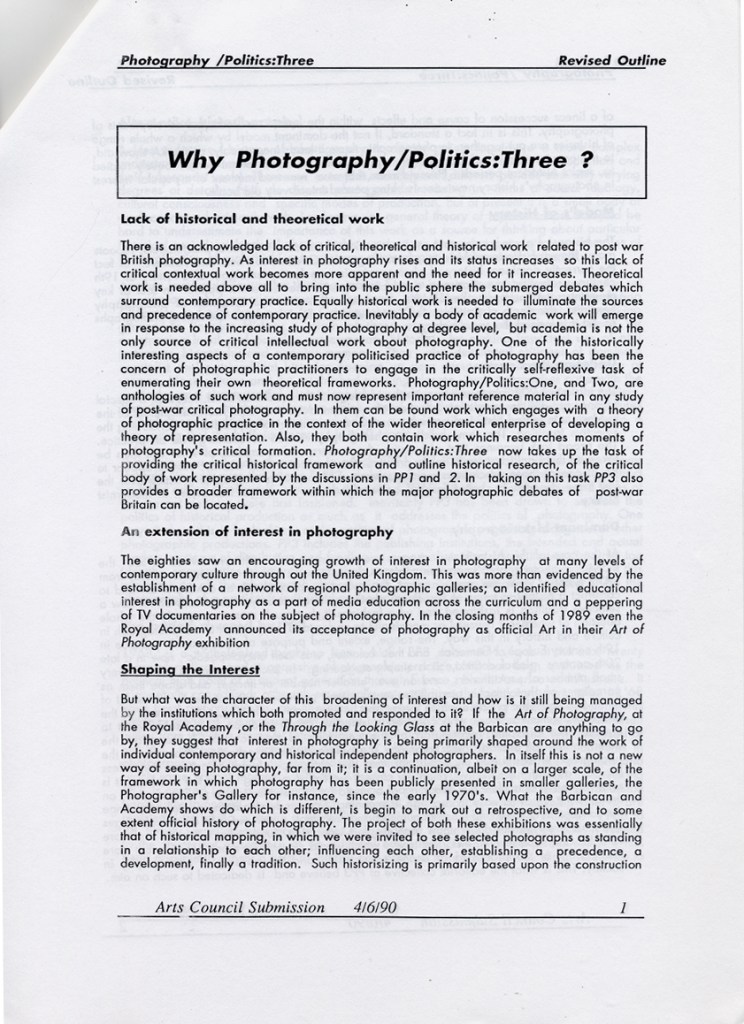
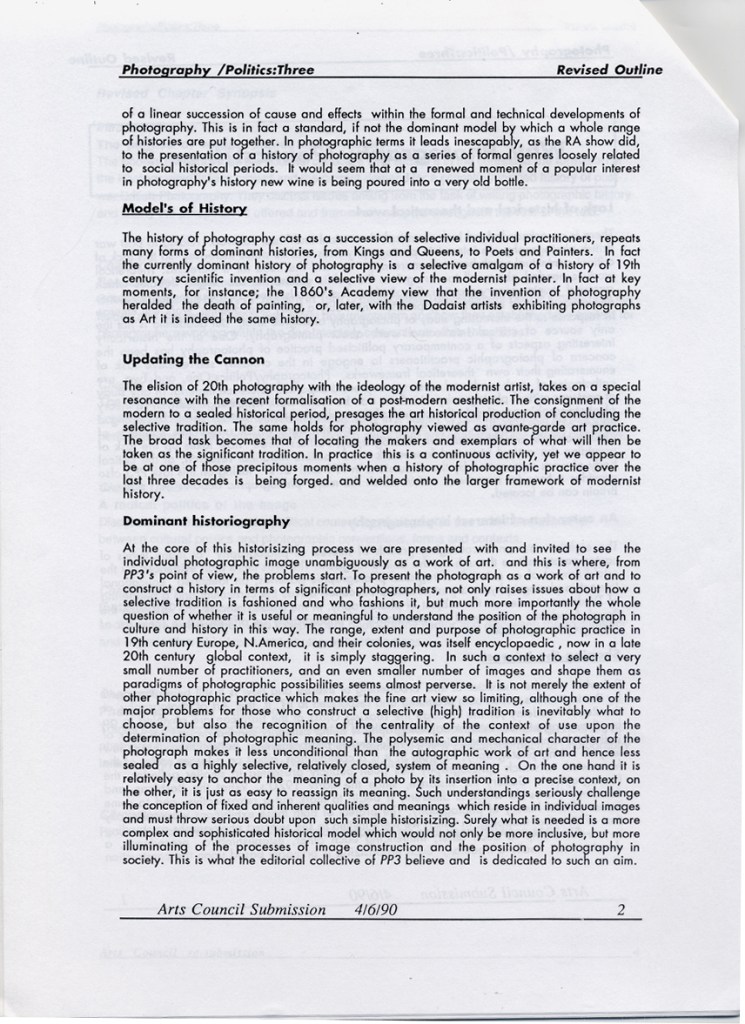
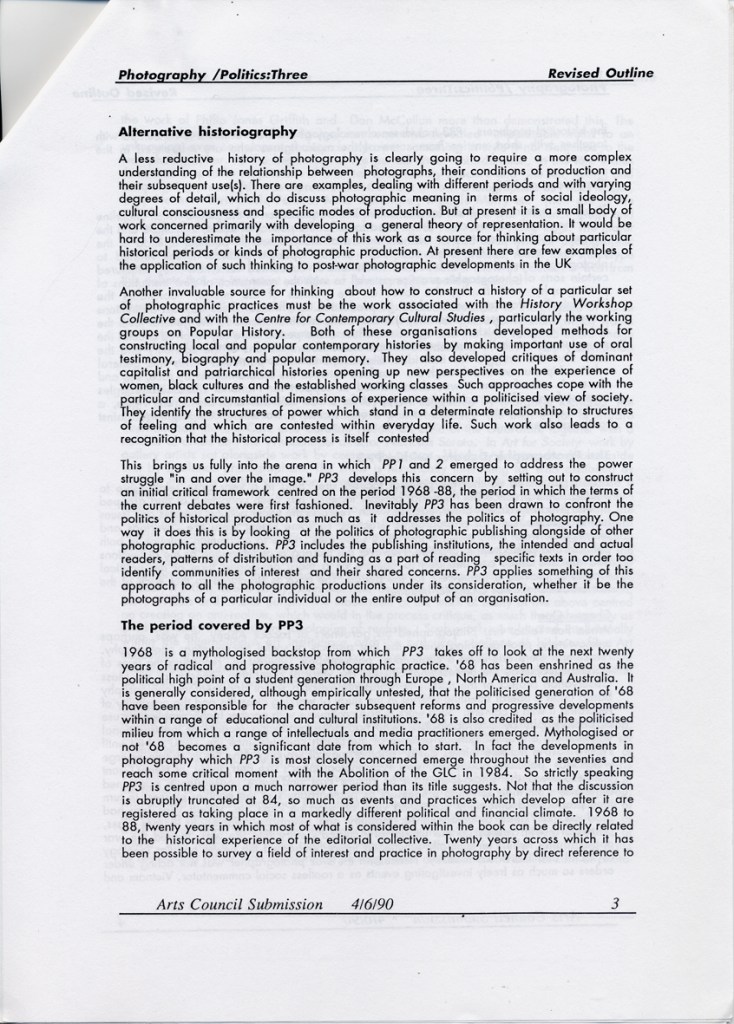
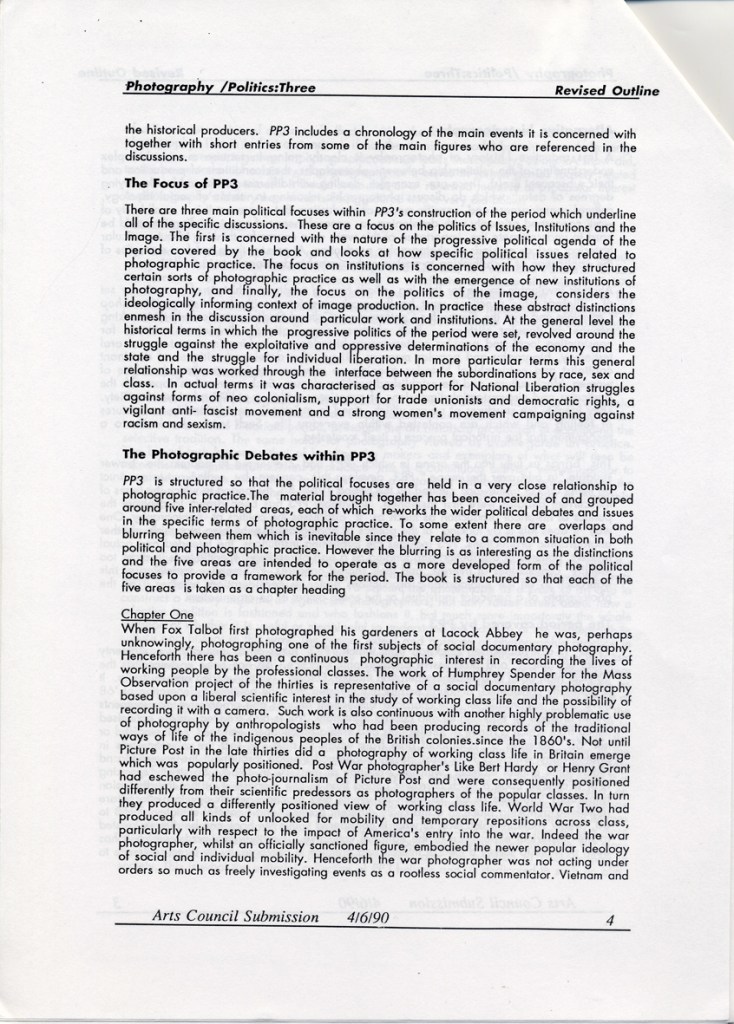
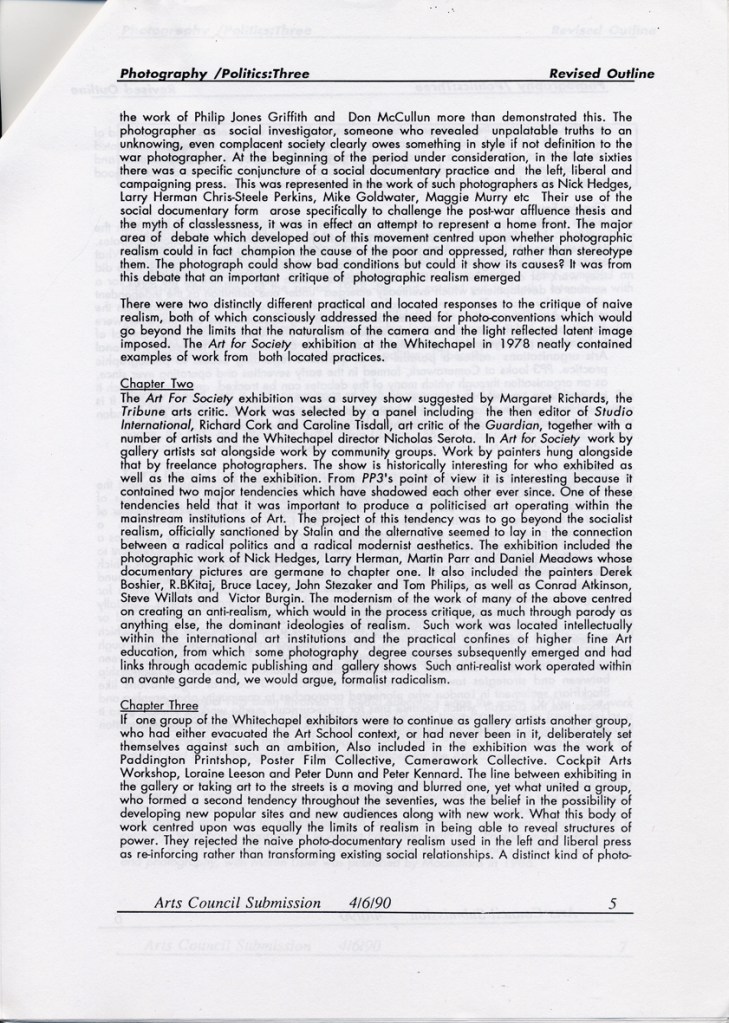
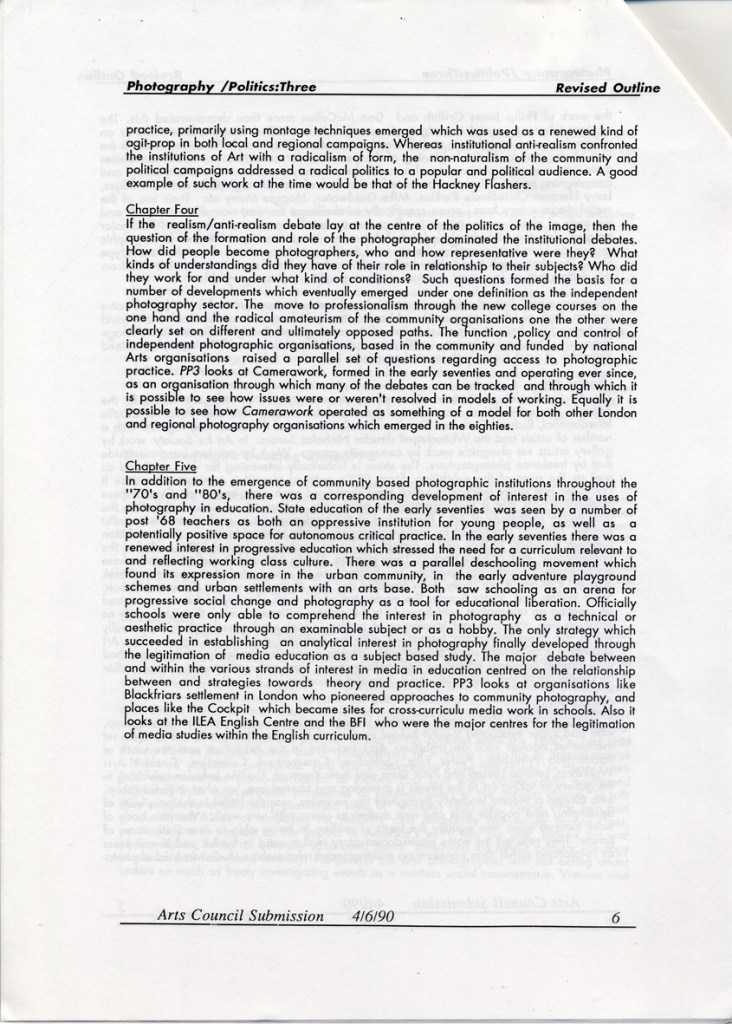
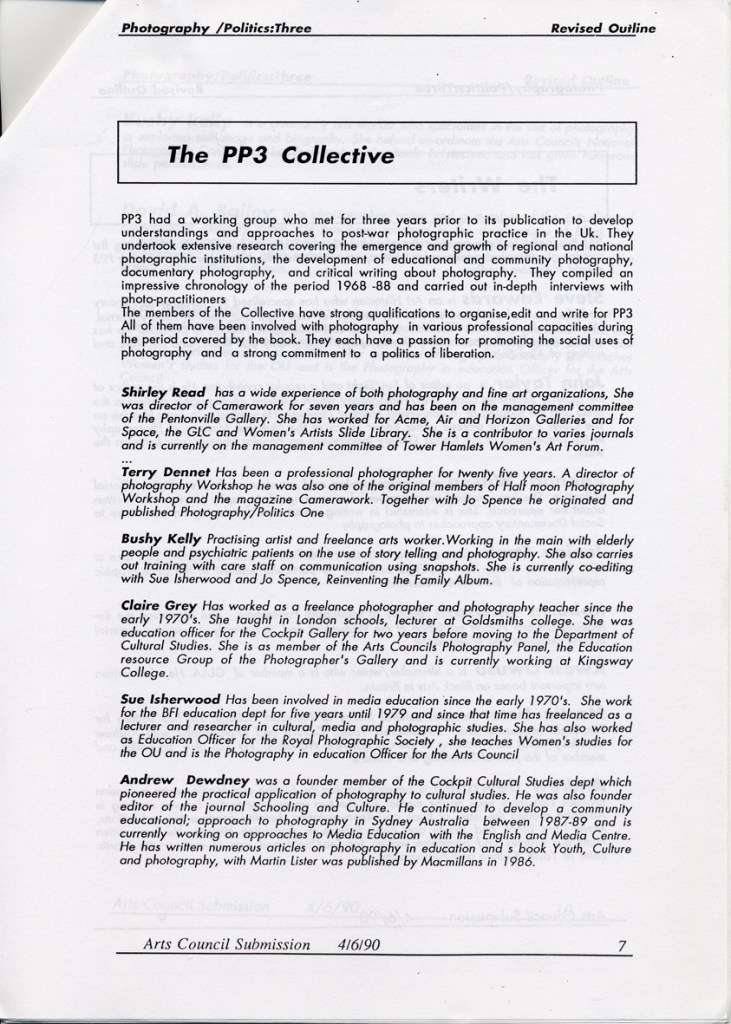
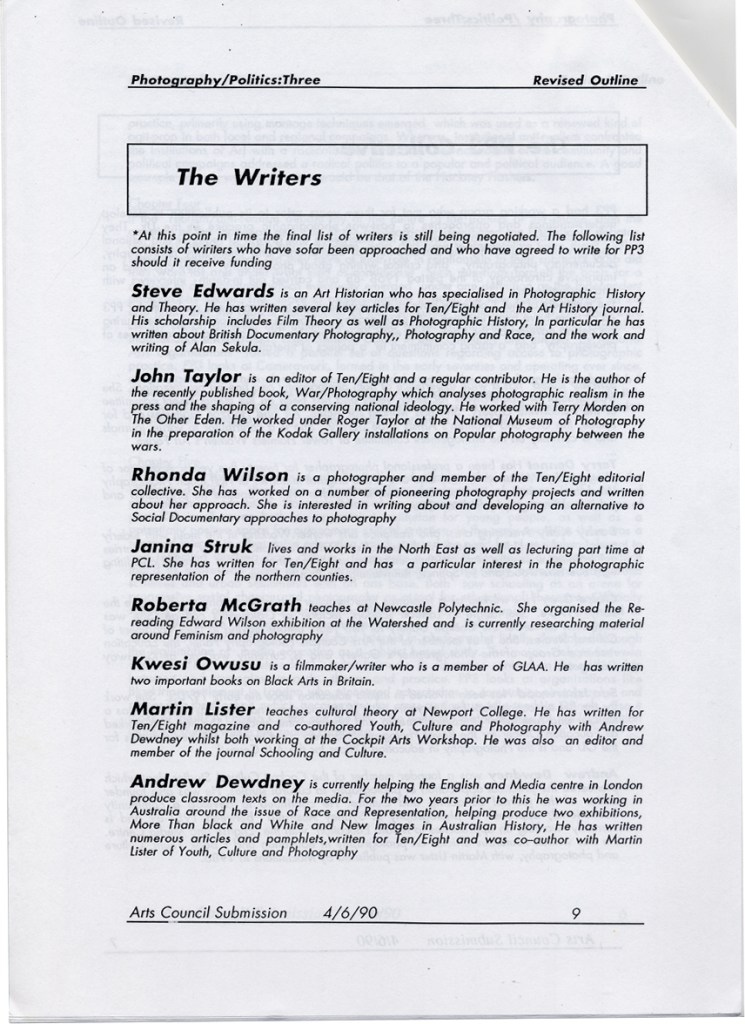
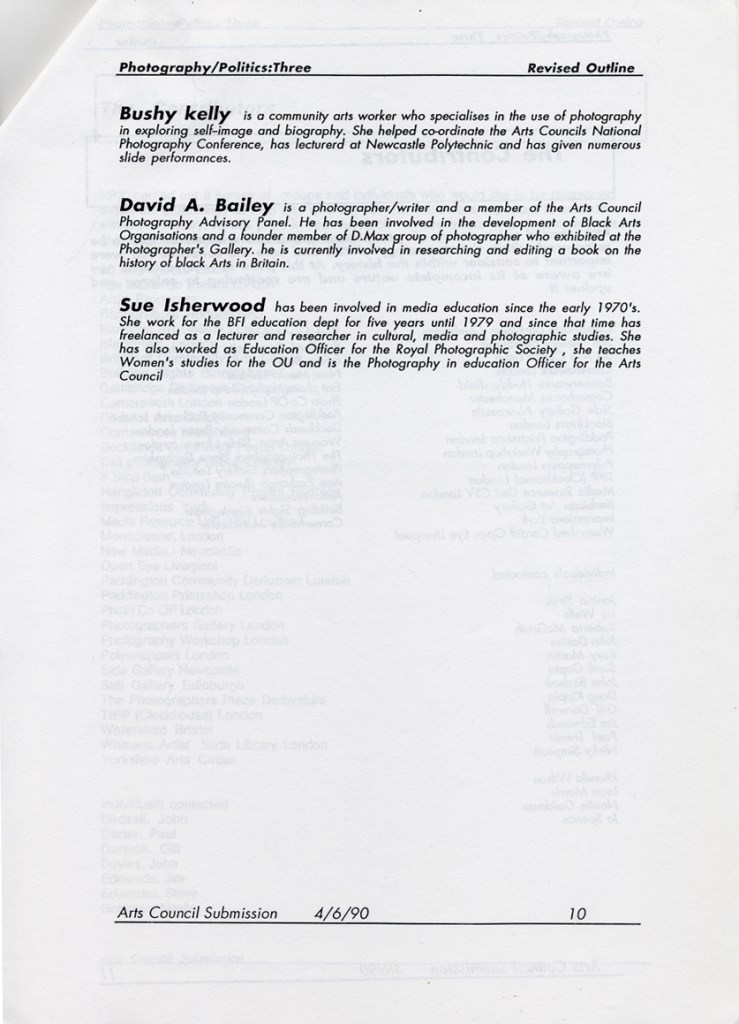
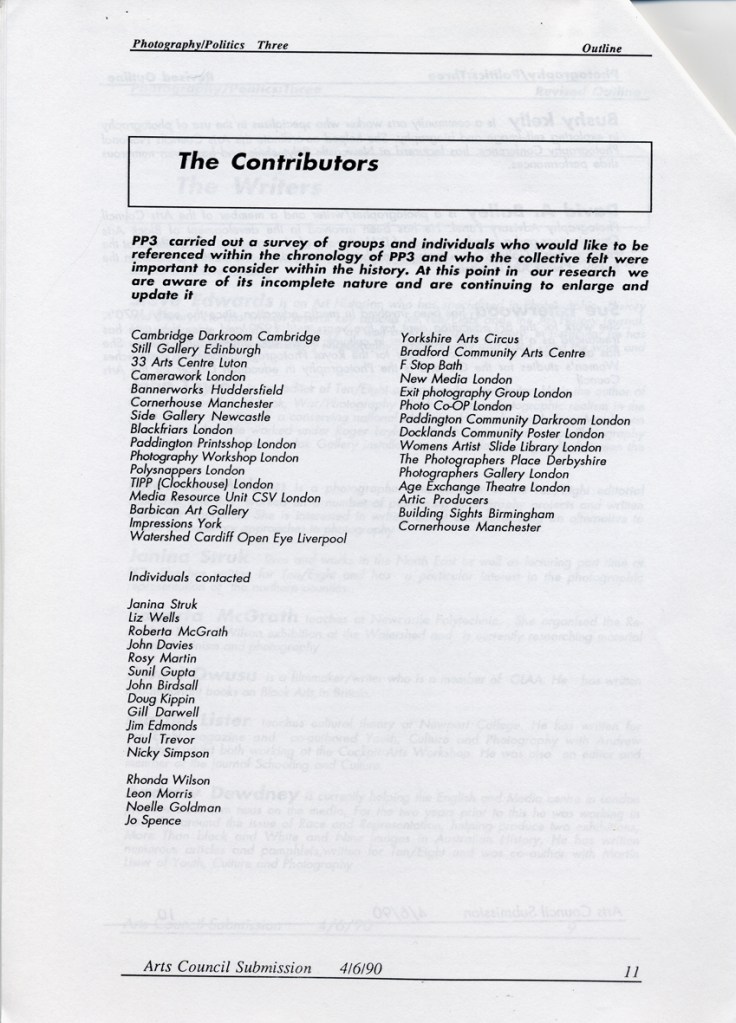
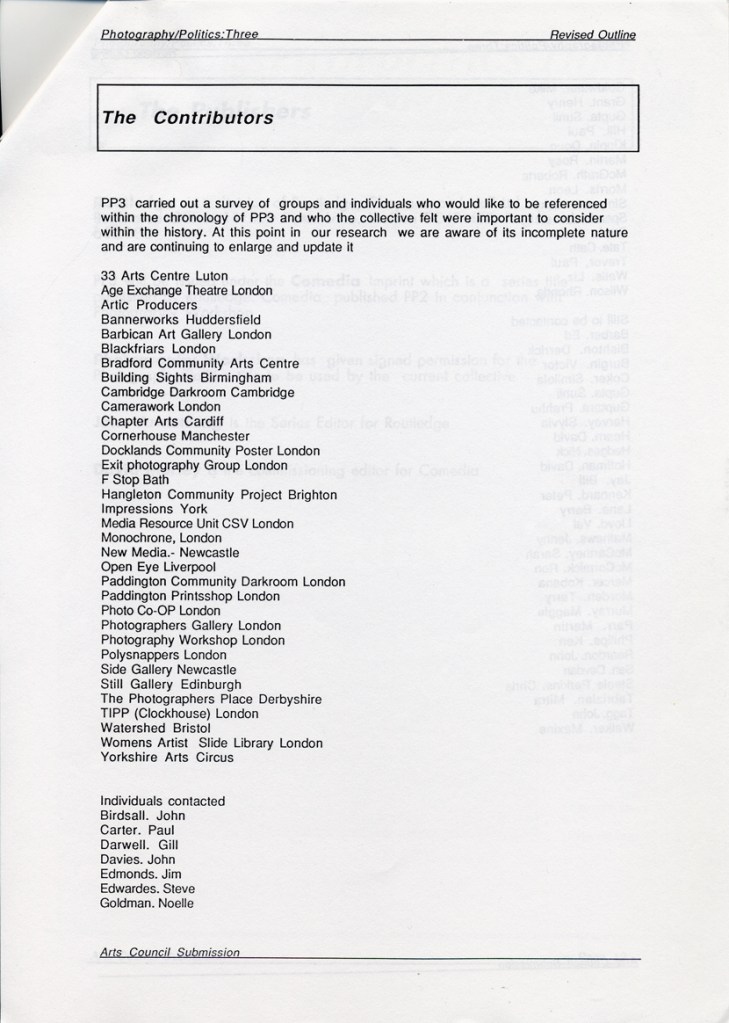
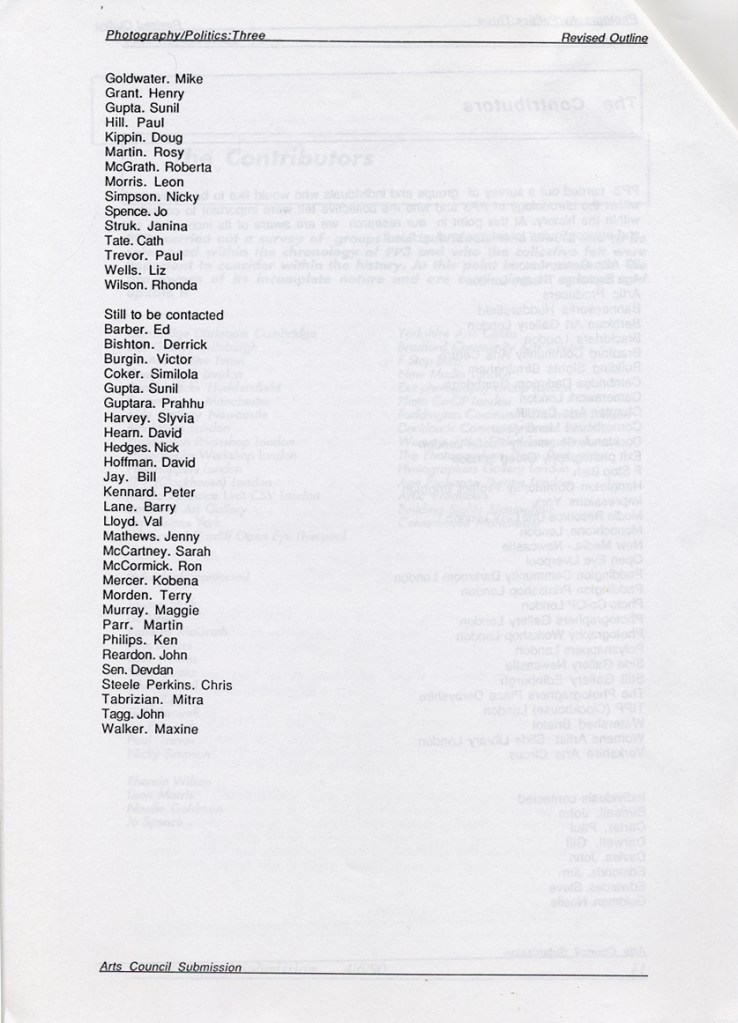
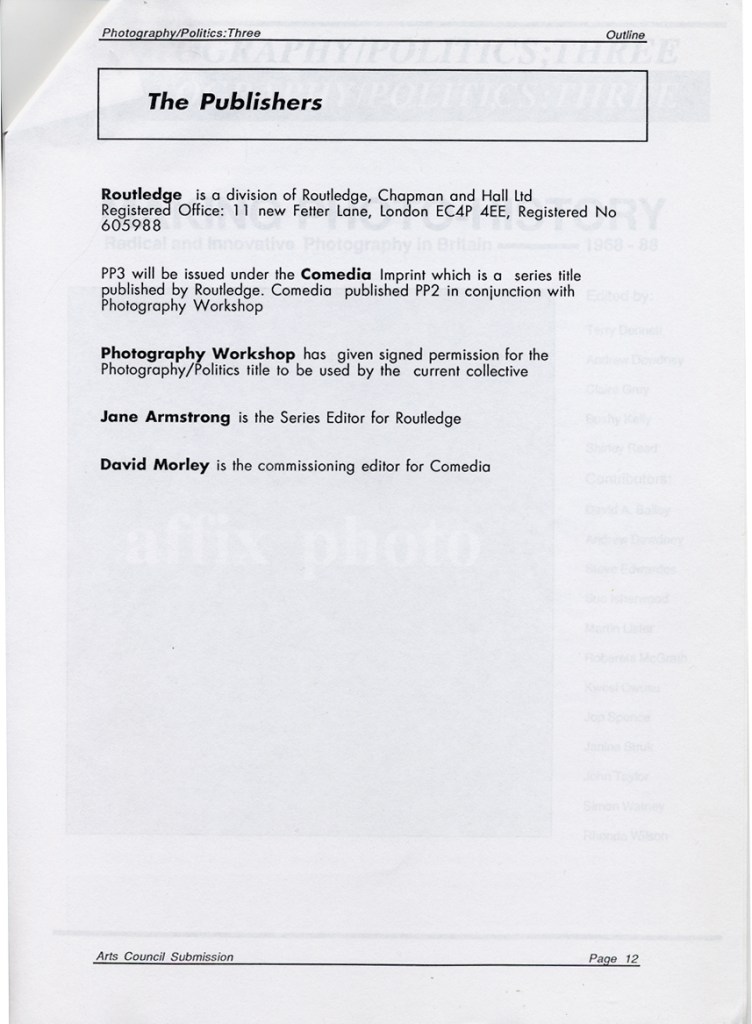
After the Hang Ups exhibition it was decided to expand on the history and make it into a book. An editorial group was formed which included Terry Dennett. Photography Workshop agreed that Hang Ups could become the next issue of Photography Politics. Photography Politics One had been published by Jo Spence and Terry in September 1979. Photography Politics Two edited by Patricia Holland, Jo Spence and Simon Watney was published in 1986. It included an article by Andrew Dewdney and Martin Lister describing the Cockpit’s Schools Photography Project. The Cockpit employed Shirley Read to research an extensive chronology of political and photographic events covering three decades which would form a key part of the book. Terry produced the illustrations based in part on the Hang Ups exhibition. Despite having the backing of Routledge the proposal failed to receive funding from the Arts Council twice. The second submission gives an idea of the concept which had to be abandoned when the Cockpit closed in 1990.

 Cockpit Gallery Exhibitions & Cultural Studies projects 1973-89